Ɛhia
1
Ɛhia
2
HS-SEP-6.b
Ɛhia
1
Ɛhia
3
HS-SEP-6.b
Ɛhia
1
Place the skater on the ramp at a height of 4 meters. Let it go. What new type of energy does the skater get in this simulation?
What force caused an increase in this new type of energy?
Don't write a sentence. Just write one word. Spell it right!
As the skater goes back and forth, what happens to the height of the skater as time goes on?
Even though the type of energy changes, the total mechanical energy of the system ____.
When friction is present, the skater is not able to go as high as the height it starts from. Based on what you read above, why not?
Use "thermal energy," "gravitational potential energy," and "kinetic energy" in your answer.
Use complete sentences with your best punctuation, spelling, and grammar.
Check out this advertisement from Honda! It's a giant Rube Goldberg machine. It is real - not CGI - although it's so seamless, it looks fake.
There is one part in the video, however, that looks like it defies the laws of the universe.
Which part looks like it shouldn't work? What is it about it that doesn't seem right?
Use complete sentences with your best punctuation, spelling, and grammar.
Try to propose a way the filmmakers made that part work.
Your idea will not lose points if it is not what they actually did. You're being evaluated on your ability to problem solve and consider ideas. Just give it a try. Hint: They did not edit the video. They used physics and problem solving.
After you come up with an idea, go ahead and look at the hints. BUT ONLY AFTER YOU THOUGHT OF SOMETHING YOURSELF! And then don't go changing your original answer! Just add another answer if you want to change your mind! I want to know what you come up with!!!!!!!
Use complete sentences with your best punctuation, spelling, and grammar.
One observation that appears everywhere in the universe is that energy cannot be created or destroyed. This is called the “Law of Conservation of Energy.” Energy cannot be created or destroyed; it can only change forms. It is also called "The First Law of Thermodynamics."
If energy isn’t created or destroyed, that means all of the energy the skater gained from its height should be transferred to its speed at the bottom, and all of its speed at the bottom should be transferred to its height on the other side.
But when friction is present, some kinetic energy is turned into thermal energy (heat) instead, and now there is less usable energy available to turn into height on the other side.
However, the energy doesn't disappear when it is "lost." The wheels, rail, and surrounding air all heat up slightly. You can feel the same thing right now: rub your hands together quickly. You can feel the thermal energy that is given off as a result of friction.
Unfortunately, even though the thermal energy was not "lost," it isn't useful anymore. You burned calories to rub your hands together, but the heat from your hands is now in the environment. You can't "gather it up" and use it again to power your body. You'll have to eat instead, and that food energy has to come from another source, too.
This is referred to as The Second Law of Thermodynamics: All energy is eventually dissipated (spread out) as unusable heat. This disordered, unusable energy is referred to entropy, and as the 2nd law describes, entropy
is always increasing in the universe.
This is why the skateboarder couldn't go as high as time went by; instead of all of the kinetic energy becoming height (gravitational potential energy), some of it was turned into thermal energy (heat) instead.
To sum all of this up, another way to think about the Law of Conservation of Energy is that you can't get out what you don't put in.
But a word to the wise: As the 2nd Law of Thermodynamics states, all energy eventually becomes dissipated over time. Therefore, you actually have to put more work in than you hope to get out. Essentially, you must shoot for the stars if you want to reach the moon.
Sounds like there's a life lesson in there somewhere...
What is the The First Law of Thermodynamics? (Also referred to to as the Law of Conservation of Energy)?
Does energy disappear when it is "lost?" Explain: What happens to it? Be specific about the type of energy.
What did you feel when you rubbed your hands together? Be specific about the type of energy.
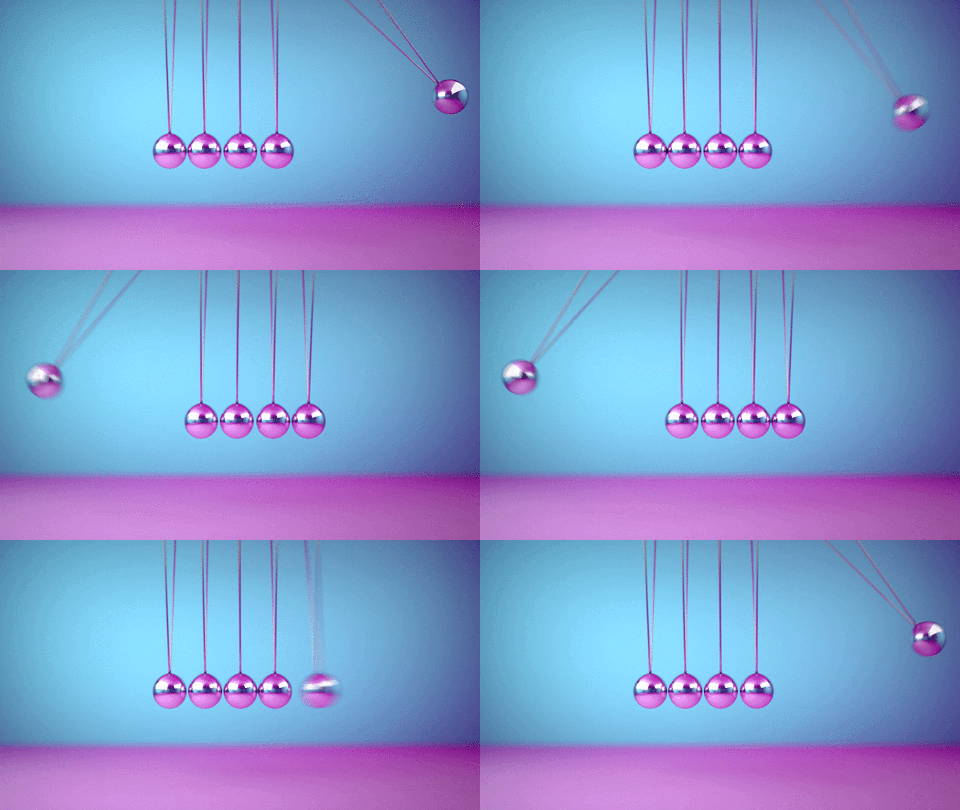
Look at the gif above.
Could it actually go on forever in the real world where friction is present? Why or why not?
Include specific energy type(s) in your answer. Talk about what types of energy the spheres start out with and what the energy becomes at the end. Is that energy useful?
Copy the bolded part from the passage to the left because not only is it a law of the universe, it's also a life lesson. Two for one; what a deal.