Chromosome Abnormalities
star
star
star
star
star
Last updated 7 months ago
4 questions
Karyotypes
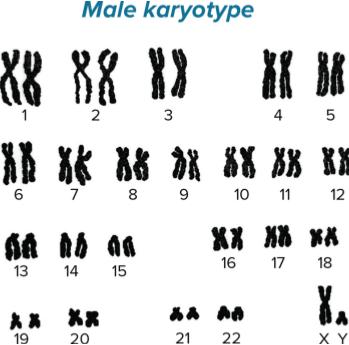
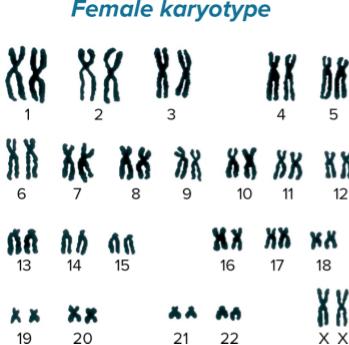
Have you ever wondered what your genetic material looks like? Scientists have been able to stain & take chromosomes from cells undergoing mitosis (usually during metaphase). They then are able to match up the chromosome pairs and view them under a light microscope. The staining marks different bands on the chromosomes allowing them to be matched up with their homologous pair. The homologous pairs are then arranged in size order from largest to smallest for pairs 1-22 (your autosomes). The 23rd pair is made up of an individual's sex chromosomes (XX for female, XY for male).
Nondisjunction
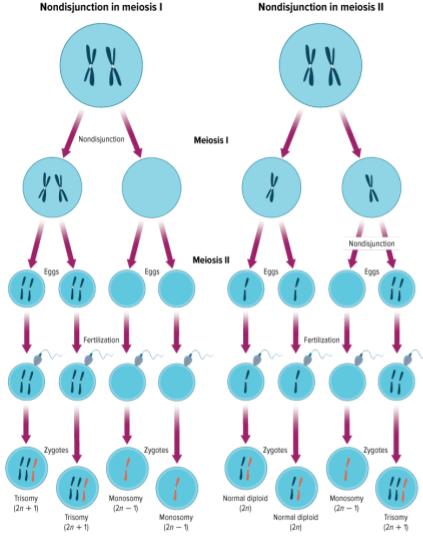
During cell divisions, the chromosomes separate, with one of each of the sister chromatids going to opposite poles of the cell. Therefore, each new cell has the correct number of chromosomes. Cell division in which sister chromatids fail to separate properly, which does happen occasionally, is called nondisjunction.
If nondisjunction occurs during meiosis I or meiosis II, the resulting gametes will not have the correct number of chromosomes. When one of these gametes fertilizes another gamete, the resulting offspring will not have the correct number of chromosomes.
Nondisjunction can result in extra copies of a certain chromosome or only one copy of a particular chromosome in the offspring. Having a set of three chromosomes of one kind is called trisomy. Having only one of a particular type of chromosome is called monosomy.
Nondisjunction can occur in any organism in which gametes are produces through meiosis. In humans, alterations of chromosome numbers are associated with serious human disorders, which are often fatal.
1
Down syndrome is caused when there's an extra chromosome at the 21st pair, which is called a __________.
1
Why does nondisjunction occur?
1
Having only one of a particular chromosome is called a monosomy.
1
What could explain a HUMAN karyotype showing 47 chromosomes?