Log in
Sign up for FREE
arrow_back
Library

STAAR Grade 7 RLA

star
star
star
star
star
Last updated about 1 month ago
45 questions
1
7.2.B
1
b.8.E.ii
2
1
b.8.E.iii
1
7.5.F
1
7.6.D
1
7.9.G
1
b.8.E.i
1
b.8.D.iii
1
7.5.H
1
7.9.C
1
7.7
1
7.7.B
1
7.7.D
1
7.5.E
1
7.5.E
1
7.5.E
1
7.5.E
1
b.8.D.i
1
7.6.D
1
7.2.A
1
7.6.C
1
7.9.F
1
7.5.G
1
7.9.G
1
7.9.B
5
7.11.C
1
b.10.B.i
1
7.10.C
1
7.10.C
1
7.10.C
1
b.10.B.i
1
7.10.C
1
b.10.B.i
1
b.10.B.ii
1
b.10.B.ii
1
b.10.B.i
1
7.10.D.i
1
7.10.D.i
1
7.10.D.i
1
7.10.D.ix
1
7.10.D.viii
1
7.10.D.ii
1
7.10.D.ix
1
7.10.D.vii
Read the selection and choose the best answer to each question.

Why We Need Solo Sports

(1) Cornelius "Cork" Kelly has lived a long, full life—enviably so. His teaching career spanned 20 years. He writes and publishes poetry and has competed in the state and national Senior Games as a swimmer. Kelly, now in his 80s, is healthy, happy, and still active.

(2) What is the secret to such a long, healthy life? Part of the answer may lie in one detail above: swimming. Fitness is a great predictor of longevity, and now research is showing that individual sports such as swimming and running are some of the best ways to stay fit and live long. People interested in a long life would be smart to follow Kelly's example and pick up a solo sport or two to see them through a lifetime of fitness.

(3) The benefits of team sports have long been touted. Sports such as soccer, field hockey, and basketball can teach kids how to work with others. They can help kids develop good sports conduct. But it is often difficult to continue playing on a team once a person graduates from high school or college. Most kids drop out of organized sports even sooner than that. The National Alliance for Youth Sports did a poll in 2016 and found that 70 percent of kids in the United States dropped out of organized sports by the age of 13. In 2019, Utah State University did a similar poll, which found that the average child quit by age 11.

(4) Clearly, team sports won't deliver a lifetime of health for most people.

(5) But picking up an individual sport and pursuing it for life is an option for just about everyone. Running, for example, requires very little equipment and can easily fit into someone's busy schedule with little modification—yet the payoff is huge. Researchers have found that runners live about three years longer than non-runners. And people didn't have to run marathons or change their lives to enjoy this benefit. It was observed even in runners who ran just five to ten minutes a day.

(6) An even greater benefit has been observed in swimming. In Denmark, the Copenhagen City Heart Study followed 8,577 participants for up to 25 years. The researchers found that swimmers lived nearly four years longer than people who were inactive. Swimmers were also more likely to meet general physical activity guidelines and could participate in their sport longer since it is low impact. When a sport is low impact, it does not strain the body as much as other exercises such as running and walking.

(7) Cycling, hiking, and skateboarding are other individual sports that are great for staying active. But the benefits of individual sports go beyond physical fitness. Exercise from solo sports boosts feel-good brain chemicals, known as endorphins, that regulate mood. There is a social element to solo sports as well. Chatting in the swim lanes at the public pool or meeting up with friends at the skate park creates opportunities for social interaction. Scientists are studying the effect social contact has on a variety of cognitive and mood problems. And any solo sport can offer these benefits. According to the American Heart Association, being more active in general helps a person sleep better, think better, and feel a greater sense of well-being.

(8) And when it comes to certain aspects of mental development, individual sports can't be beat. People pursuing solo sports can't rely on teammates; they must learn to solve problems independently. They must also learn how to set goals for themselves. Individual sports are a great path for any child or adult hoping to learn more self-reliance.

(9) A lot of schools that traditionally focused on team sports are recognizing the value of getting kids excited about individual sports. Some schools are even offering classes in hip-hop dance, kickboxing, and even Dance Dance Revolution—maybe the world's healthiest video game. The hope is that students will find activities they love enough to pursue for life.

(10) There is a wide enough array of individual sports for just about everyone to find fun ways to stay active. And maybe fun is the biggest key. The kids dropping out of organized sports are doing so in large part because it isn't fun for them anymore. But Kelly loves swimming enough that he is still doing it today. He clearly picked a sport that serves him well.

Third party trademark Dance Dance Revolution® was used in these testing materials.
Question 1
1.

Question 2
2.

Question 3
3.

Read the question carefully. Then enter your answer in the box provided.

Read the question carefully. Then enter your answer in the box provided.

Question 4
4.

Question 5
5.

Question 6
6.

Question 7
7.

Question 8
8.

Read the next two selections. Then choose the best answer to each question.

Passage 1:
Art for the People, Art by the People

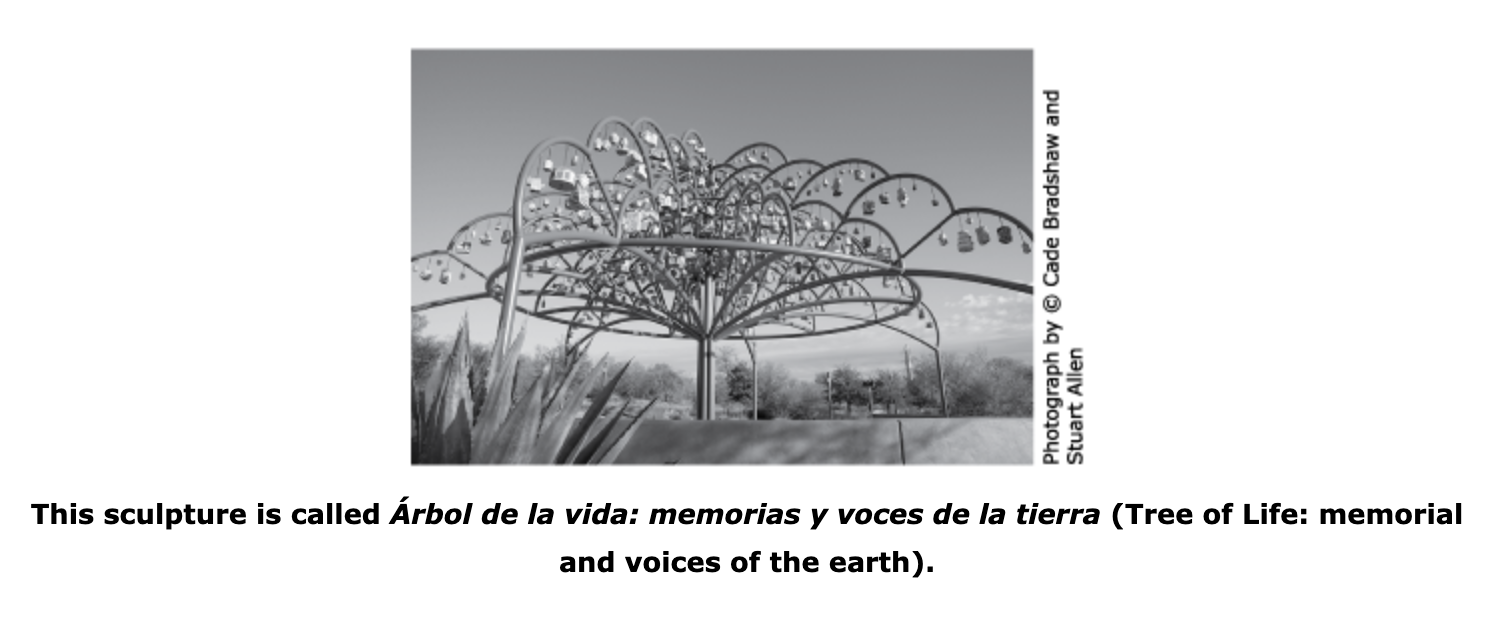
(1) Along the path to Mission Espada, a San Antonio mission nestled near the river, stands a magnificent tree unlike any other. This is not a tree made of wood and leaf. It's a tree created with steel and clay. The enormous man-made tree stands 40 feet tall and 80 feet wide. Its branches are curved poles that wind and connect to form a supporting structure for the true focal point. Hundreds of heavy clay sculptures dangle like ornaments from these branches. The stunning monument arouses the curiosity of its many visitors. What is this tree and where did it come from? It is an árbol de la vida—a tree of life.


(2) This work of art was the brainstorm of artist Margarita Cabrera. Cabrera, who was born in Monterrey, Mexico, had seen firsthand the difficult conditions faced by some people in Mexico. She wanted to create art that reflected the love and respect Texas has for its Hispanic communities. Cabrera wanted to celebrate San Antonio's history from the point of view of the people who lived there.

(3) In 2017, Cabrera led a series of public chats. At these events, people were invited to tell stories about their families. These were ordinary people—shopworkers, schoolteachers, farmers, and more—sharing their family histories and cultures with others. Then Cabrera taught the participants how to create clay sculptures representing these histories and stories. The completed sculptures represent many cultures, religions, and lifestyles. One sculpture of a television set celebrates an early Spanish-language TV station. Many of the pieces show corn and other local crops. Still others show family keepsakes. Cabrera installed the finished sculptures in a gigantic steel tree, which became Árbol de la vida.

(4) The artwork was a huge success. The head of the San Antonio River Foundation called it "an amazing love letter" to the city. In creating Árbol de la vida, Cabrera encouraged many voices to sing together, showing that despite their differences, all people have value and can coexist in harmony.
Question 9
9.

Question 10
10.

Question 11
11.

Question 12
12.

Question 13
13.

Question 14
14.

Question 15
15.

Question 16
16.

Question 17
17.

Question 18
18.

Read the selection and choose the best answer to each question.

A Different Approach to Budgeting

(1) If you had to choose just one, would you vote to fund new air conditioners in the cafeteria or a school carnival? Money matters, and budgeting helps us pay for what we need. Who decides how the money to pay for school is spent? It's an important question. According to the Center for Public Justice, 50 million students attend U.S. public schools. Most communities have a school board of elected officials who make budget decisions that affect every student. But a different system is growing in popularity: participatory budgeting, often shortened to PB.

(2) With PB, more people get a say in how money is budgeted. When PB is used by school districts, this includes students! Some people are pleased to have students involved in the school budgeting process. Others are concerned that the idea is unrealistic. If students determine spending decisions, will they choose to fund what's best for schools?

(3) To understand participatory budgeting, it is helpful to first look at its history and how it works. PB began in the 1980s and is now used in over 3,000 cities worldwide. Community members help plan city budgets to fund everything from city roads to public swimming pools. PB is also used today by some school districts. This different approach to budgeting requires planning for it to work. It has five stages: designing the budgeting process, brainstorming project ideas, creating project proposals, selecting the projects to be funded, and implementing the winning ideas.

(4) Participatory budgeting can benefit students in several ways. Debating ideas and voting on them offer civic learning opportunities and the chance to work together to address shared problems. The Community Development Project researched some of the effects of PB and found that "participants actively engaged in discussions and decision-making and worked collaboratively. with other community members." PB participants feel an increased sense of social responsibility and learn that their decisions have the power to affect their lives and those of future generations. Community discussions build self-confidence because they empower people to share their experiences and concerns.

(5) Students learn about democracy by experiencing it. The National Civic League, founded in 1894 by such leaders as Teddy Roosevelt, encourages civic participation. The group reported on a PB project in Arizona where schools used an online platform to collect ideas. The experience "mirrored [the] real-life voting process to prepare students for active civic life in adulthood." Dr. Carolina Johnson, an independent researcher, conducted a study for the Participatory Budgeting Project. She found that people who participate in PB are 7 percent more likely to vote in future elections.

(6) Learning about financial concepts such as creating a budget and managing money prepares students for adulthood. The Hechinger Report, a nonprofit independent news organization, describes the results of one project in New York. Students were given $2,000 to spend. Three projects were pitched by teams of students. One idea was to build a greenhouse garden that could provide fresh food. The second was to create a dance and music studio. The third was to install filters in all the water fountains. A large majority voted for the choice that also benefited the community as a whole: the greenhouse garden. One participating student said the process made her feel that her "voice actually does count."

(7) The PB process does not always include everyone, though. The system used by most schools involves first setting up a committee of students who are recommended by their teachers and elected by their peers. These students gain most of the benefits. They plan project options, research costs, and decide which ideas to offer as choices. But most students have only one part in that whole process: the final vote.

(8) There are other challenges too. Some people say the amount given for student projects isn't enough to make a difference. One student participating in the New York project found that $2,000 "seems like a lot" but didn't go very far. Students were considering building improvements "until they realized their money wouldn't stretch," says Bobby Thomatos, a government teacher leading the project.

(9) Participatory budgeting is also time-consuming. The planning process alone takes a full year, and some situations cause additional difficulties. If the vote results in a tie, one student asks, "Do we revote? Do we fund both projects? Should we do a runoff of the top two?" Students who are already busy may not have time for the responsibility PB requires. Additionally, some people say that giving everyone from students to administrators an equal vote devalues the education and experience of the adults traditionally responsible for creating school budgets.

(10) Time magazine reported in 2015 that students in Arizona presented PB projects ranging "from $157 for volleyball equipment to $1,000 to fund a music club, and from $217 for a school garden to $740 for shade umbrellas in the school courtyard." Ultimately, in three years 30,000 students voted on how $250,000 should be spent. They funded the winning projects above, building improvements, refillable water stations, and more. Did they spend the money wisely? One parent involved in a PB process at Walker Elementary in Virginia says, "We don't know what the students will come up with. It's a point of tension, but that's part of the process."

(11) Students should have a voice in their schools. They should be included as valued members of our society. Should they participate in planning how school money is spent? That is for each school to decide.
Question 19
19.

Question 20
20.

Question 21
21.

Question 22
22.

Question 23
23.

Question 24
24.

Question 25
25.

Question 26
26.

Question 27
27.

ESSAY: Write your essay in the empty box below.

Read the selection "A Different Approach to Budgeting." Based on the information in the selection, write a response to the following:

Should students be involved in deciding how money is spent in their schools or communities through participatory budgeting? Why or why not?

Write a well-organized argumentative essay that uses specific evidence from the selection to support your answer.

Remember to—
  • clearly state your claim
  • organize your writing
  • develop your ideas in detail
  • use evidence from the selection in your response
  • use correct spelling, capitalization, punctuation, and grammar
Manage your time carefully so that you can—
  • review the selection
  • plan your response
  • write your response
  • revise and edit your response
Write your response in the box provided.

Read the selection and choose the best answer to each question.

Milagros wrote this paper about a famous Texan. Read Milagros's paper and look for revisions she needs to make. Then answer the questions that follow.

Author J. Frank Dobie: Preserving the Lore of Texas

(1) Some American authors have used their writings to bring places they are closely associated with to life. (2) Mark Twain, however, immortalized his hometown of Hannibal, Missouri, in The Adventures of Tom Sawyer. (3) Jack London set many of his stories in the Pacific Northwest, where he lived for most of his life. (4) J. Frank Dobie, a well-known author who wrote dozens of books, is another good example. (5) In his works he aimed to capture the colorful heritage and folklore of his home state of Texas.

(6) Dobie was born on a Texas cattle ranch in 1888. (7) At the age of 16, he moved to Alice to live with his grandparents. (8) While his upbringing gave him a strong appreciation for country life, he also learned to enjoy literature. (9) He graduated from college in 1910 and began teaching high school. (10) In 1913, Dobie earned a master's degree from Columbia University.

(11) Soon after receiving his graduate degree, Dobie began teaching at the University of Texas at Austin. (12) He took after a few years a break to work as the foreman on his uncle's ranch. (13) He spent time with the vaqueros, or cowboys, who told him all sorts of stories. (14) During this period he earned a passion for the culture of his home state.

(15) After a year, Dobie returned to teaching with an increased interest in preserving the unique culture of Texas. (16) He was already a member of the Texas Folklore Society, a group that seeks to collect and share all kinds of state folklore, from oral history to cowboy ballads. (17) But Dobie had never been very active in the organization. (18) His newfound passion brought fresh energy to the group. (19) In 1921 he became its secretary, a post he would hold for 21 years. (20) He wrote many articles about life in Texas and encouraged other members to do so as well.

(21) Dobie's first book was published in 1929. (22) The Vaquero of the Brush
Country described the experiences of a real vaquero. (23) His second book shared the tales of those who had sought gold and other fabulous treasures, Coronado's Children. (24) Many books followed, and Dobie became a famous figure. (25) People started to think of him as a spokesperson for Texas.

(26) There are other details to share about this famous author. (27) Titles such as The Voice of the Coyote, The Mustangs, and I'll Tell You a Tale showed his devotion to his favorite subiect, rural Texas. (28) President Lyndon Johnson, a fellow Texan, noticed Dobie's achievements. (29) In 1964, Johnson awarded him America's highest civilian honor, the Medal of Freedom.

(30) J. Frank Dobie died just a few days after receiving the prestigious honor, but he has not been forgotten. (31) The ranch house where he produced much of his work is now part of a program designed to help Texas writers. (32) This program highlights some of the things Dobie loved most: links between past and present, good writing, and of course, Texas.
Question 28
28.

Question 29
29.

Question 30
30.

Question 31
31.

Sentence 23 needs to be revised. In the space provided, rewrite sentence 23 in a clear and effective way.

Question 32
32.

Read the selection and choose the best answer to each question.

Onir wrote this paper to tell about a time he made an unlikely new friend. Read Onir's paper and look for revisions he needs to make. Then answer the questions that follow.

An Unexpected Friend

(1) The stormy August weather outside matched my mood. (2) It all felt ugly to me—color of the carpet, the clouds rolled, and especially this new place where I had never wanted to live.

(3) I had been perfectly happy in our previous home. (4) I'd had a great group of friends that I'd known since kindergarten. (5) Crowds of unfamiliar faces rushed by without even noticing me. (6) I didn't like the rootless feeling of being transplanted.

(7) I slouched in the chair and stared out the window, feeling sorry for myself. (8) That's when I noticed Carl walking past my house. (9) He was strolling right in front of my house. (10) Carl was an older man who lived a few houses away. (11) I had absolutely no interest in him or his dog. (12) But day after day, I saw him walking his labradoodle. (13) And every time he passed our window, he burst into a smile and waved enthusiastically at me. (14) I typically responded with a half-smile of dismissal, but on this day I decided to wave back. (15) What could it hurt?

(16) The next morning, I was getting the mail when Carl and Rufus passed by again. (17) Carl smiled, and instead of mumbling a response, I returned the smile. (18) It felt strange at first, almost as if my face had been cemented into a frown for weeks. (19) But we exchanged some pleasant conversation about the weather, and I felt something inside me begin to thaw just a bit.

(20) Weeks passed, and I realized that Carl and Rufus never missed a walk; I found myself starting to look for them. (21) Their daily friendliness soon became the highlight of my mornings. (22) By October my family had met some of the neighbors, who told us a little more about Carl. (23) A kind and friendly man, he was always willing to help new families when they moved in.

(24) At the fall block party a few weeks later, my dad and I spent most of the day talking to Carl. (25) We realized he had a unique ability to connect with people. (26) He asked questions and seemed to really care about the ups and downs of everyone's life. (27) It didn't take long for me to realize that what had started with a simple smile and a hello was going to turn into a true friendship.

(28) Eighty-year-old Carl might be the last person you would expect to change a grumpy teenager's attitude. (29) If he'd never looked past the scowl on my face, I would probably still be grumbling and griping in my living room. (30) If I'd only seen someone who was decades older than me, I would have missed meeting one of the kindest friends I've ever known. (31) I'm so glad I met Carl last year in my neighborhood.
Question 33
33.

Question 34
34.

Question 35
35.

Question 36
36.

Question 37
37.

Read the selection and choose the best answer to each question.

Juan Carlos is writing a paper about a NASA study. Read these paragraphs from the body of Juan Carlos's paper and look for corrections he needs to make. Then answer the questions that follow.

Twin Space Study

(1) While in space, astronauts may appear to be healthy and alert, but this isn't always the case. (2) The space environment can be unfriendliest to the human body. (3) Astronaut Scott Kelly wanting to help scientists learn more about this.

(4) Kelly had enjoyed a long career at NASA and had piloted the space shuttle several times. (5) In 2015 he was preparing to spend almost a year in space. (6) Scientists planned to study the affects space had on his body during this trip. (7) Kelly suggested that scientists also study his twin brother, who had almost the exact same genes and would be on Earth at the time. (8) Kelly thought the comparison might help researchers understand even more about the impact space can have on an astronaut's health.
Question 38
38.

Question 39
39.

Question 40
40.

Question 41
41.

Read the selection and choose the best answer to each question.

Lorelei is writing a paper about the discovery of some famous caverns in Texas. Read this paragraph from the body of Lorelei's paper and think about the corrections she needs to make. Then answer the questions that follow.


A Grand Discovery

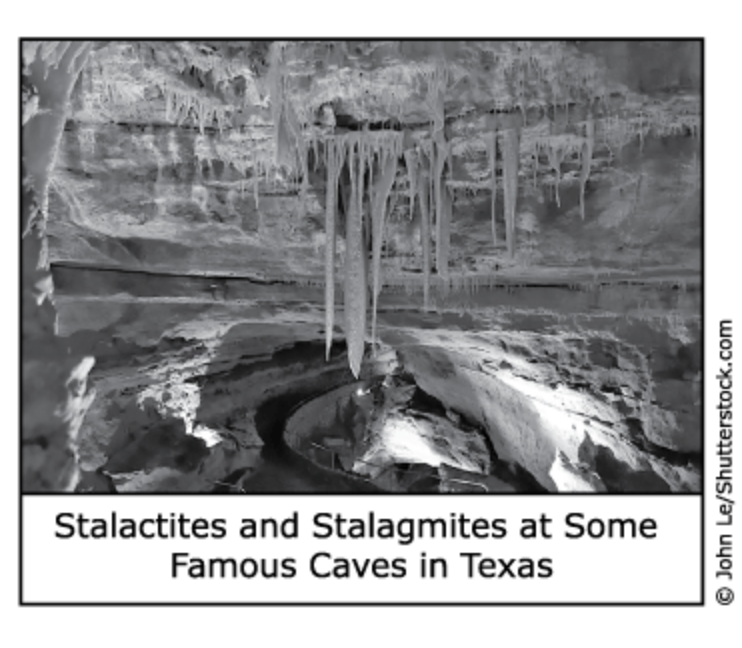
(1) Fascinated by caves, the four college students asked the ranch owner for permission to explore further. (2) With hammers in hand, the young men wedged themselves through an 11-inch space they continued down a narrow passageway. (3) They crawled on their hands and knees, knocking rubble out of their way. (4) Suddenly one of the men feels a cool draft. (5) Reconizing that this was an indication of more rooms or passages, he encouraged the group to keep going. (6) The tight passageways eventually opened into a huge room that was filled with stalactites and stalagmites. (7) The men looked around and realized there were no footprints in sight. (8) This meant that they were in a previously undiscovered cave, part of what would soon become known as the Natural Bridge caverns.
Question 42
42.

Question 43
43.

Question 44
44.

Question 45
45.
Select the response that corrects the error in sentence 8.

This meant that they were in a previously undiscovered cave, part of what would soon become known as the __________.
Which word from paragraph 5 best helps the reader understand the meaning of modification?
A. example
B. equipment
C. payoff
D. change
How does the author support the argument made in the selection?
A. By highlighting the proven benefits of various individual sports
B. By explaining the widespread popularity of certain individual sports
C. By revealing how schools have transformed individual sports
D. By reflecting on how individual sports have been viewed in the past
The author wrote this selection most likely to appeal to—
A. doctors who would like to advise their patients well
B. teachers of physical education classes in schools
C. people who would like to live a long and healthy life
D. researchers in the field of physical and mental health
What is the most likely reason schools are offering individual sports such as hip-hop dance, kickboxing, and Dance Dance Revolution?
A. They provide more benefits than traditional forms of exercise.
B. They appeal more to young people looking for fun activities.
C. They are more widely available with school settings.
D. They require less training and thus are easier to perform.
Read these sentences from paragraph 7.

There is a social element to solo sports as well. Chatting in the swim lanes at the public pool or meeting up with friends at the skate park creates opportunities for social interaction.

What is the best paraphrase of these sentences?
A. Swimming and skateboarding are both individual sports that offer the opportunity for social interaction, such as chatting with friends.
B. Individual sports provide opportunities to socialize, such as chatting in pool swim lanes and meeting friends at the skate park.
C. Social interactions that can occur during individual sports include meeting friends at the public pool or the skate park.
D. People can have social interactions while engaged in individual sports, whether they are swimming or skating.
What is the most likely reason the author begins paragraph 2 with a rhetorical question?
A. To suggest that the conclusions drawn are somewhat uncertain
B. To increase curiosity about the information that follows
C. To suggest doubt that there could actually be an answer
D. To introduce a touch of humor into an otherwise serious subject
What is the main claim the author makes in the selection?
A. Solo sports should take the place of team sports in childhood education.
B. Solo sports make it possible for more people to stay fit throughout their lifetime.
C. Solo sports teach people to make their own goals rather than depending on a team.
D. Solo sports are the most enjoyable form of physical activity for most people.
How does the use of a cause-and-effect structure in paragraphs 2 and 3 of "Art for the People, Art by the People" help support the topic of the article?
A. It shows that the people of the city have a deep appreciation for their culture and history.
B. It demonstrates why people from the community were willing to share their stories.
C. It emphasizes the importance of the materials used by the artist to build the sculpture.
D. It explains why the artist was inspired to create the sculpture in the way that she did.
Based on the ideas presented throughout the article "Art for the People, Art by the People," what can the reader conclude about the city of San Antonio?
A. It is more appreciative of art than other cities.
B. It is the permanent home of the artist Cabrera.
C. It is a very popular place for tourists to visit.
D. It is a city with a Hispanic history.
What is the most likely reason the author includes the photograph in the article "Art for the People, Art by the People"?
A. To show how the sculpture reflects local history and art
B. To demonstrate how the sculpture was built by the artist
C. To illustrate the size and appearance of the sculpture
D. To suggest the best way for visitors to view the sculpture
Which of the following is an important theme in the story "Grandfather's Legacy"?
A. By paying careful attention to details, one can easily master any challenge.
B. When people honor animals, they also honor themselves and their culture.
C. By sharing artistic skill and knowledge, people connect across generations.
D. Everyone has a special talent, but it sometimes takes a long time to find it.
How does a personality trait of Manuel's affect the plot of the story "Grandfather's Legacy"?
A. His curiosity leads him to ask his grandfather about the carving.
B. His creativity causes him to seek out his grandfather in the garage.
C. His boredom leads him to help his grandfather paint the carvings.
D. His dedication causes him to go with his grandfather to the market.
How does the setting of the story "Grandfather's Legacy" affect Manuel?
A. The setting of Oaxaca gives him an opportunity to learn something new about his family.
B. The setting of Oaxaca causes him to feel alone and completely out of place.
C. The setting of Grandfather's garage allows him to feel a new sense of purpose in his life.
D. The setting of Grandfather's garage provides him with materials to improve his creativity.
In paragraph 1 of the article "Art for the People, Art by the People" and in paragraph 6 of the story "Grandfather's Legacy," BOTH authors' use of questions contributes to the tone by—
A. suggesting a lack of understanding to be remedied
B. revealing concern with something mysterious
C. emphasizing a feeling of wonder about an object
D. conveying playful familiarity with the subject
Which sentence best expresses a DIFFERENCE in the authors' reasons for including information about the materials the artists use in their work in the article "Art for the People, Art by the People" and the story "Grandfather's Legacy"?
A. The author of "Art for the People, Art by the People" shows the difficulty of working with manufactured materials, while the author of "Grandfather's Legacy" emphasizes the simplicity of natural materials.
B. The author of "Art for the People, Art by the People" shows how modern materials can express a heritage, while the author of "Grandfather's Legacy" highlights the beauty of using traditional materials.
C. The author of "Art for the People, Art by the People" shows the ease with which anyone can use certain materials, while the author of "Grandfather's Legacy" stresses the importance of skill in handling materials.
D. The author of "Art for the People, Art by the People" shows how a variety of materials are used in a single work, while the author of "Grandfather's Legacy" reveals how a single material is used in many art pieces.
What is most likely a DIFFERENCE in the authors' reasons for writing the article "Art for the People, Art by the People" and the story "Grandfather's Legacy"?
A. The author of "Art for the People, Art by the People" wants to draw attention to a real piece of art created by a community, while the author of "Grandfather's Legacy" wants to honor the idea of art made by individuals within a family.
B. The author of "Art for the People, Art by the People" hopes to persuade people to view a particular work of art, while the author of "Grandfather's Legacy hopes to inspire people to make works of art for themselves.
C. The author of "Art for the People, Art by the People" hopes to reveal the amount of planning that goes into creating art, while the author of "Grandfather's Legacy" hopes to show that art can be made anytime and anywhere.
D. The author of "Art for the People, Art by the People" wants to promote individuality through art, while the author of "Grandfather's Legacy" wants to emphasize that all art should be entirely unique to the artist's culture.
The authors of the article "Art for the People, Art by the People" and the story "Grandfather's Legacy" BOTH use a sequential organizational structure most likely in order to—
A. explain the process by which a work of art is made
B. show how the skills of an artist improve with practice
C. emphasize the amount of time it takes to create art
D. describe the relationships that make artists successful
What is the controlling idea of the selection?
A. Many people believe that student projects such as community gardens are more successful when participatory budgeting is
used.
B. Participatory budgeting has a long history involving many people across the world in city and school budget planning.
C. Many people believe that participatory budgeting is the best way to plan school budgets, because it involves students.
D. Participatory budgeting is a way for students to be involved in planning school budgets, but not everyone agrees that the process works.
Which of these is the best summary of paragraphs 10 and 11?
A. A 2015 Time magazine article reported that 30,000 students in Arizona voted on more than six projects for their schools. The projects included refillable water stations and a school garden. One parent involved in a participatory budgeting decision-making program in Virginia noted the project ideas are not all agreed on and questioned whether students should participate in deciding how school money is spent.
B. A 2015 Time magazine article reported that one participatory budgeting program in Arizona funded several smaller projects before successfully growing to include 30,000 students. Over three years, these students voted on how to spend $250,000 in their schools. The participatory budgeting process can be a source of both reward and tension, so each school must carefully decide for itself if the process has value for the students and the community.
C. A 2015 Time magazine article reported that smaller participatory budgeting projects in Arizona, such as funding volleyball equipment, were successful. Tensions rose after students voted to spend $250,000 on other projects. Some parents questioned the value of the participatory budgeting process and whether students should be involved in making budgeting decisions.
D. A 2015 Time magazine article reported that students involved in participatory budgeting presented projects for their schools ranging from low to high cost. Within three years, 30,000 students involved in the participatory budgeting process voted on how $250,000 should be spent in their schools. Students should share their ideas and concerns with the community.
Read the dictionary entry.

pitch /'pich/ v

1. to throw with careful aim
2. to fall heavily forward
3. to make a proposal for something
4. to give one's share of the work

Which definition best matches the meaning of pitched in paragraph 6?
A. Definition 1
B. Definition 2
C. Definition 3
D. Definition 4
Which text evidence from the selection best supports that people should be open-minded about the results if they decide to start a participatory budgeting program?
A. One participating student said the process made her feel that her "voice actually does count." (paragraph 6)
B. The system used by most schools involves first setting up a committee of students who are recommended by their teachers and elected by their peers. (paragraph 7)
C. Additionally, some people say that giving everyone from students to administrators an equal vote devalues the education and experience of the adults traditionally responsible for creating school budgets. (paragraph 9)
D. "We don't know what the students will come up with. It's a point of tension, but that's part of the process." (paragraph 10)
Read this sentence from paragraph 3.

PB began in the 1980s and is now used in over 3,000 cities worldwide.

How does the author's use of language in this sentence contribute to the tone of the selection?
A. By providing a fact and a statistic, it creates an informative tone.
B. By sharing a detailed description, it creates a convincing tone.
C. By highlighting the history of the topic, it creates a serious tone.
D. By including a number and a date, it creates a positive tone.
Which details from paragraphs 5 through 7 best support the key idea that the benefits of participatory budgeting are long-lasting?

Select TWO correct answers.
A. Those taking part in a participatory budgeting program in Arizona used the internet to gather possible project ideas.
B. Students who are involved in participatory budgeting programs learn money-management and budgeting skills.
C. Engaging in participatory budgeting programs increases the chances that a person will vote in elections.
D. Most of the students in one New York participatory budgeting program voted to fund a greenhouse garden.
E. One student in a participatory budgeting program said that the process made her feel as though her voice had been heard.
Read this sentence from paragraph 1.

If you had to choose just one, would you vote to fund new air conditioners in the cafeteria or a school carnival?

What is the most likely reason that the author uses direct address at the beginning of paragraph 1?
A. To help the reader relate to the decision-making process that budgeting requires
B. To encourage the reader to research facts about how money is budgeted for schools
C. To suggest to the reader that budgets take time and cooperation to successfully create
D. To emphasize to the reader that voting on how to spend school budget money works
The author uses a categorical organizational structure in the selection most likely to—
A. demonstrate different ways that students can get involved in participatory budgeting at school
B. show effects on students who are involved in community projects and on students who are not
C. group together issues and evidence related to participatory budgeting
D. illustrate the process needed to set up a student action program at school
Milagros has not used the most effective transition in sentence 2. Which phrase should replace however in this sentence?
A. in the meantime
B. as a result
C. for instance
D. above all
What is the MOST effective way to revise sentence 12?
A. After a few years, he took a break to work as the foreman on his uncle's ranch.
B. He took a break to work as the foreman after a few years on his uncle's ranch.
C. After a few years to work as the foreman on his uncle's ranch, he took a break.
D. He took a break after a few years, and he also worked on his uncle's ranch as the foreman.
The word earned is not the most appropriate word to use in sentence 14. Which word should replace earned in this sentence?
A. originated
B. enlarged
C. developed
D. produced
Which sentence should replace sentence 26 to provide a more effective topic sentence for the sixth paragraph (sentences 26-29)?
A. Dobie was well educated and enjoyed studying and learning.
B. Dobie was a fascinating author from Texas who eventually became famous across the nation.
C. Throughout his life, Dobie continued to be recognized for writing books that many people enjoyed.
D. The efforts of this prominent Texan have changed the world.
What revision, if any, should be made in sentence 2?
A. It all felt ugly to me—the carpet color but rolling clouds in a new place where I had never wanted to live especially.
B. It all felt ugly to me—the color of the carpet especially and the clouds that rolled in this place that was new where I had
never wanted to live.
C. It all felt ugly to me—the color of the carpet, the rolling clouds, and especially this new place where I had never wanted to
live.
D. No change is needed.
Onir wants to add this sentence to the second paragraph (sentences 3-6).

Now I was starting a new school year as a stranger, in a school building that felt like a maze.

Where should Onir add this sentence?
A. After sentence 3
B. After sentence 4
C. After sentence 5
D. After sentence 6
Onir has included a sentence in the third paragraph (sentences 7-15) that repeats information. Which sentence should be removed from this paragraph?
A. Sentence 9
B. Sentence 10
C. Sentence 11
D. Sentence 12
Which sentence can BEST follow and support sentence 22?
A. He had lived in the neighborhood for 40 years and was liked and respected by everyone.
B. The neighbors across the street had moved in just a few months before we did.
C. I was excited to learn that everyone planned to help decorate the neighborhood for the holidays.
D. There were three kids on my street who were also in the seventh grade.
Which sentence should replace sentence 31 to emphasize the main point of this story and bring it to a more effective close?
A. Since that day I've obviously made some other friends, but Carl is still a great neighbor to us.
B. It's absolutely true that Carl is one of the greatest people who has ever lived in this neighborhood.
C. I'll always be grateful to Carl, not only for the friendship but for the lessons he has taught me.
D. I've lived here for more than a year now, and I've watched Carl make even more friends.
What change needs to be made in sentence 2?
A. Change environment to enviroment
B. Change unfriendliest to unfriendly
C. Change human to Human
D. Change body to bodies
What is the correct way to write sentence 3?
A. Astronaut Scott Kelly wanted to help scientists. Learn more about this.
B. Astronaut Scott Kelly wanted to help scientists. Who wanted to learn more about this.
C. Astronaut Scott Kelly wanted to help scientists learn more about this.
D. Astronaut Scott Kelly, who wanted to help scientists learn more about this.
What change, if any, needs to be made in sentence 5?
A. Change In 2015 to From 2015
B. Change preparing to preparring
C. Insert a comma after spend
D. No change is needed.
What change is needed in sentence 6?
A. Change affects to effects
B. Change had to has
C. Insert a comma after body
D. Change during to durring
What change needs to be made in sentence 2?
A. Change wedged to wedging
B. Change themselves to themselfs
C. Change through to threw
D. Insert a semicolon after space
What change, if any, needs to be made in sentence 4?
A. Change Suddenly to Suddenley
B. Change feels to felt
C. Change cool to cooler
D. No change is needed.
What change needs to be made in sentence 5?
A. Change Reconizing to Recognizing
B. Change was to were
C. Insert a comma after indication
D. Change he to it