Log in
Sign up for FREE
arrow_back
Library

Unit 1 Cells On Level Exam

star
star
star
star
star
Last updated 25 days ago
28 questions
Required
1
Required
1
Required
1
Required
1
Required
1
Required
1
Required
1
Required
1
Required
1
Required
1
Required
1
Required
1
Required
1
Required
1
Required
1
Required
1
Required
1
Required
1
Required
1
Required
1
Required
1
Required
1
Required
1
Required
1
Question 1
1.

Cell theory was first proposed in 1838. Evidence obtained through additional scientific investigations resulted in the current cell theory. Which statement describes a component of the original cell theory that was removed because of new scientific knowledge?

Question 2
2.

Which of the following is found in plant cells but NOT in animal cells?

Question 3
3.

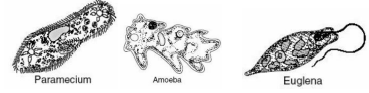
The single-celled, eukaryotic organisms above are all found in freshwater ponds. What is one characteristic they all have in common?

Question 4
4.

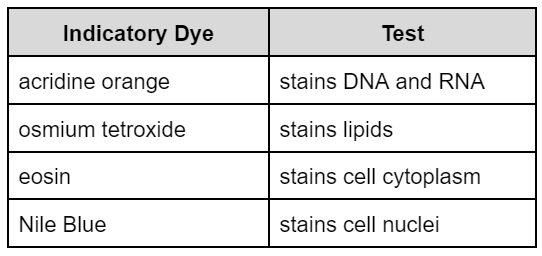
A lab technician needs to determine whether cells in a test tube are prokaryotic or eukaryotic. The technician has several dyes she could use to stain the cells. Four of the dyes are described in the table below.

Which dye could the technician use to determine whether the cells are prokaryotic or eukaryotic?

Question 5
5.

Sort the characteristics of eukaryotic and prokaryotic cells below?

  • DNA
  • nucleus
  • cell membrane
  • no nucleus
  • no membrane-bound organelles
  • ribosome
  • cytoplasm
  • membrane-bound organelles
  • Prokaryotic (2 items)
  • Eukaryotic (2 items)
  • All Cells (4 items)
Question 6
6.

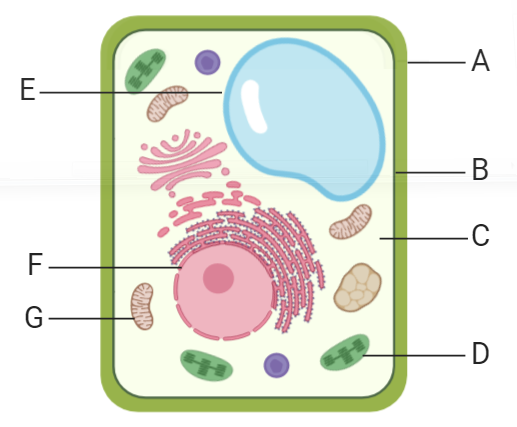
The diagram below represents a cell of a green plant.

Solar energy is used to produce energy-rich compounds in which structure?

Question 7
7.
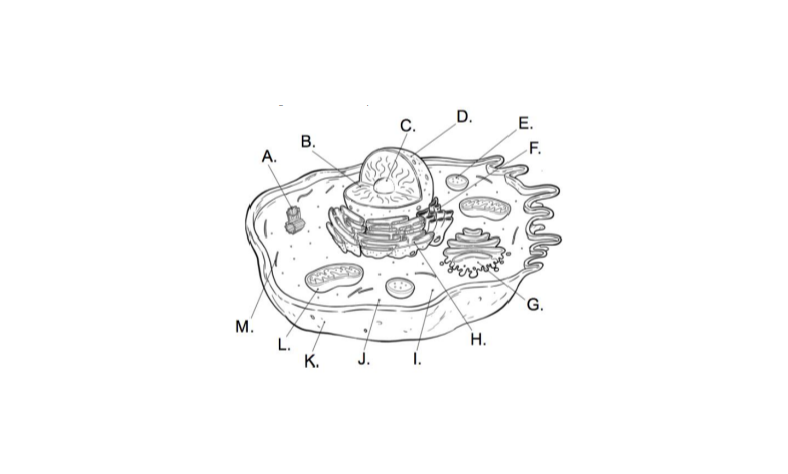
Drag and drop to correctly match the organelles using the following information below as a hint.
1. Structure G packages and modifies proteins.
2. Structure B contains genetic material.
3. Structure L converts glucose into ATP.
Other Answer Choices:
Golgi apparatus
Mitochondrion
Nucleus
Chloroplast
Lysosome
Endoplasmic reticulum
Question 8
8.

Generally speaking, how do the vacuoles of plant cells differ from those of animal cells?

Question 9
9.

Muscle cells are responsible for obtaining energy so the body can perform voluntary and involuntary movements. Using your knowledge about organelles and muscles, how would a muscle cell be different from other types of animal cells?

Question 10
10.

Tay-Sachs is a disease that occurs when lipids accumulate in cells. The lipid accumulation occurs because of the inability of the cell to break down lipids due to the lack of function of the organelle responsible for intracellular digestion. Which organelle is defective in Tay-Sachs disease?

Question 11
11.

Correctly match the organelle with its function.

Draggable itemarrow_right_altCorresponding Item
nucleus
arrow_right_alt
protein synthesis
ribosome
arrow_right_alt
genetic information (DNA) storage
chloroplast
arrow_right_alt
stores food, water and waste in the cell
vacuole
arrow_right_alt
solar energy conversion
Question 12
12.

Which of the following is a fluid or gel-like substance that surrounds the organelles?

Question 13
13.

The nucleus, ribosomes, endoplasmic reticulum, Golgi bodies (apparatus), and vesicles are all involved in what process?

Question 14
14.

Which macromolecule is the main component of cell membranes?

Question 15
15.


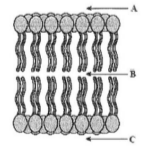
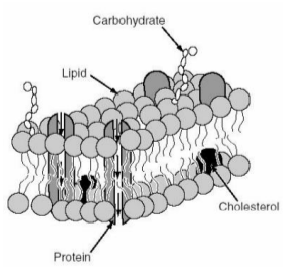
In the illustration, where would you most likely find water molecules?

Question 16
16.
The process by which water passes into or out of a cell is called __________.
Question 17
17.

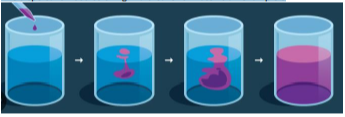
The dispersal of food coloring in a breaker of water is an example of

Question 18
18.

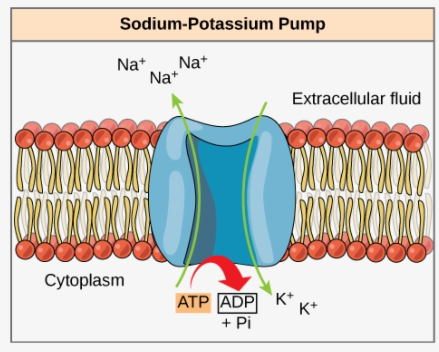
Molecules and ions are constantly being moved across cell membranes. A student was asked to determine if an illustration shows active or passive transport of potassium (K+) and sodium (Na+).

Which statement is the best description of the transport occurring in the illustration?

Question 19
19.

In the cell membrane model shown above, __________ move large molecules into and out of the cell.
Question 20
20.


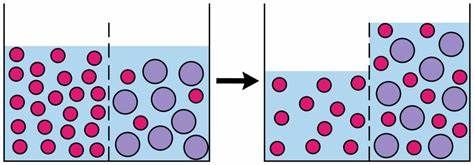
The above diagram shows the process of osmosis. Only the water molecules could pass the membrane in the center of the beaker because water molecules _________________________.

Question 21
21.

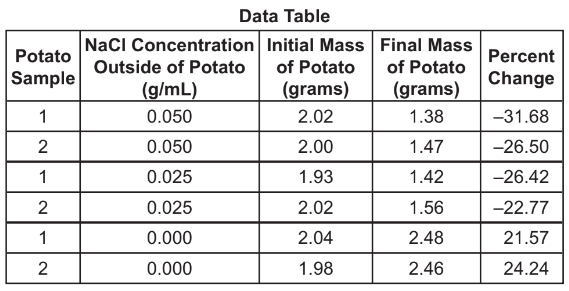
Examine the data table.
Select two statements that support the data and explain the movement of molecules across the cell membranes.

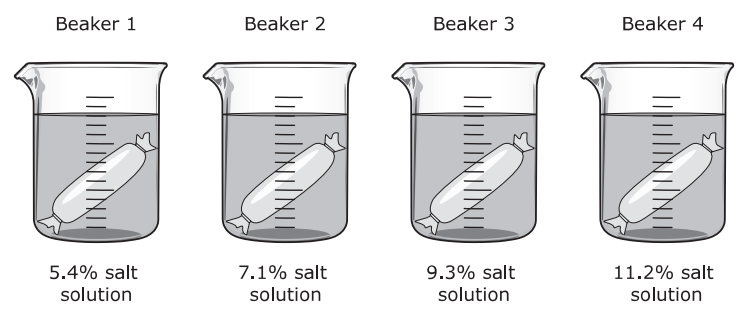
Students investigate osmosis using dialysis tubing. Dialysis tubing is a semipermeable membrane that allows water molecules to pass through while preventing salt ions from passing through. The students follow this procedure:
  1. Mix salt into water to make a 7.1% salt solution.
  2. Add equal amounts of this saltwater solution to four small bags made of dialysis tubing.
  3. Fill four beakers with different salt solutions, as shown in the image.
  4. Place each small bag into one of the four beakers.
  5. Observe changes in the size of the bags.
The setup for the investigation is shown.
(click the image to enlarge)
Required
1
A cell membrane is composed of a double layer of lipids in which many kinds of proteins are embedded. Many of these proteins act like gates, allowing only certain particles to enter or leave the cell.
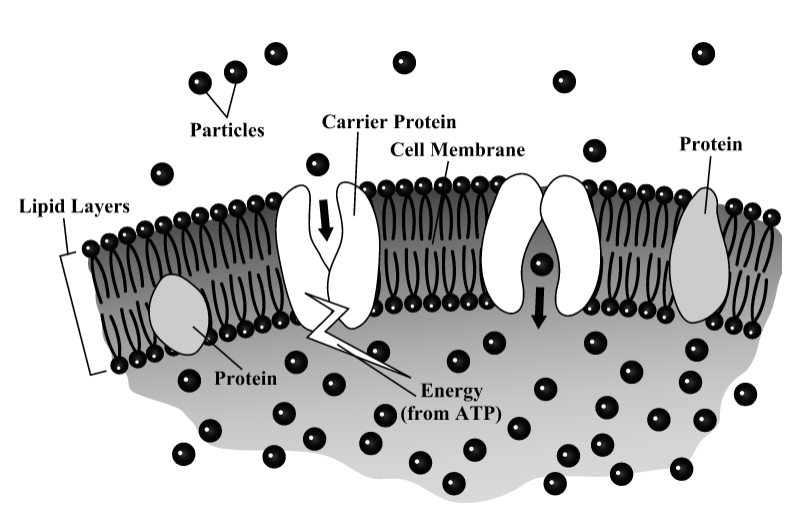
(click the image to enlarge)

When a particle has to go against its concentration gradient through one of these gates, energy is supplied by the cell to the correct protein to move the particle through the membrane. A sodium-potassium ion pump is an example of a type of carrier protein that uses a large portion of the cell’s energy to move sodium ions through the cell membrane.
Required
0
Required
1
Required
1
Question 26
26.
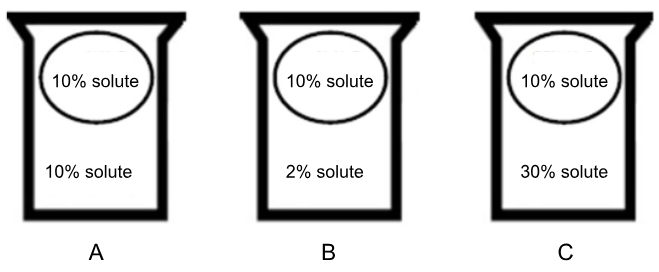
According to the image above, Beaker A is __________ and Beaker C is __________.
Question 27
27.
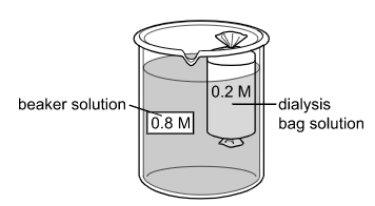
A student is performing an investigation using two solutions. The solution in the dialysis bag has a lower solute concentration in moles per liter (M) than the solution in the beaker.

The dialysis bag is a __________ solution and the beaker solution is a __________ solution. Therefore, the water is moving __________ the dialysis bag.
Question 28
28.

The strongest evidence that supports the endosymbiotic origin of eukaryotic organelles is the homology (similarities) between currently living prokaryotes and the energy carrying organelles which are the

Question 22
22.

In which beaker will osmosis cause expansion of the dialysis tubing bag?

Question 23
23.

The sodium potassium ion pump found in cell membranes is made of which of the following basic structural components?

Question 24
24.

What is a primary function of the cell membrane?

Question 25
25.

Why does the study of cell membranes lead to a better understanding of cell function?