Log in
Sign up for FREE
arrow_back
Library

Quiz: DNA Structure

star
star
star
star
star
Last updated 4 months ago
10 questions
Required
1
Required
1
Required
1
Required
1
Required
1
Required
1
Required
1
Required
1
Required
1
Required
1
Question 1
1.

Draggable itemarrow_right_altCorresponding Item
arrow_right_alt
arrow_right_alt
arrow_right_alt
Question 2
2.

Draggable itemarrow_right_altCorresponding Item
arrow_right_alt
arrow_right_alt
arrow_right_alt
Question 3
3.

Question 4
4.

Question 5
5.

Question 6
6.

Question 7
7.

Question 8
8.

Question 9
9.

Question 10
10.

Match the DNA base with its complementary partner in the DNA strand.
Guanine (G)
Thymine (T)
Cytosine (C)
Cytosine (C)
Adenine (A)
Guanine (G)
Associate the following genetic components with their respective intricate descriptions.
Nucleotide
Five-carbon sugar in DNA
Deoxyribose
Structure of DNA resembling a twisted ladder
Double Helix
Consists of sugar, phosphate, and a nitrogen base
What is the primary building block of a DNA molecule?
Phosphate
Nucleotide
Amino acid
Sugar
Which of the following nitrogenous bases is NOT found in DNA?
Adenine
Thymine
cytosine
Uracil
What is the long name for DNA?
denatured ribonucleic acid
deoxoribonuclear acid
deoxynucleic acid
deoxyribonucleic acid
The "rungs" of the DNA ladder are made of:
glucose and sugars
base pairs and hydrogen bonds
phosphates and hydrogen bonds
sugars and phosphates
DNA molecules differ from RNA molecules in which of the following ways?
I. DNA molecules contain a different type of pentose sugar than do RNA molecules.
II. DNA molecules contain the nitrogenous base cytosine while RNA molecules do not.
III. RNA molecules contain the nitrogenous base uracil while DNA molecules do not.
I and III only
I, II, and III
II and III only
I and II only
What type of bond holds the complementary base pairs together in a DNA molecule?
Ionic bond
covalent bond
Peptide bond
Hydrogen bond
RNA differs from DNA in that:
it is single stranded
it has uracil
all of these
it has a different kind of sugar
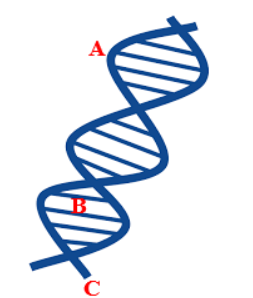
The above diagram illustrates what DNA looks like when it is twisted into the double helix. Three parts of the molecule are labeled: The backbone/sides (A), the "rungs" (B) and the end (C). Predict which part of the molecule you will find phosphorous.
C
A
A and B
B