CAASPP Grade 3 Math - Performance Task
star
star
star
star
star
Last updated 10 days ago
10 Nsɛmmisa
The “Go Green” company held a week-long recycling contest at your school. The grade that collects the most bottles and cans wins the contest.
Your task is to determine which grade won the “Go Green” contest.
The items that can be recycled are shown.
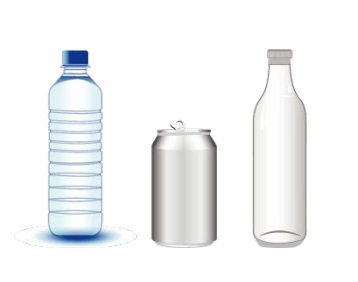
Plastic bottles
Aluminum cans
Glass bottles
Students from the 3rd grade, 4th grade, and 5th grade classes collected bottles and cans and brought them to school.
Table 1 shows how many bottles and cans each grade collected on each day of the week.
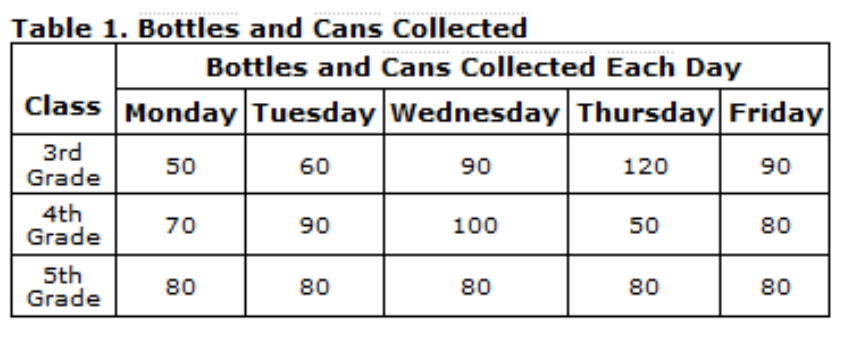
Use Table 1 to help you answer this question.
On which days did the 3rd grade class collect more cans and bottles than the other two grades? Select all that apply.
Use Table 1 to help you answer this question.
On Tuesday, how many more bottles and cans did the 4th grade class collect than the 3rd grade class?
English glossary :
collect: get
You are the contest judge. You need to figure out who won the contest. Did 3rd grade, 4th grade, or 5th grade win the “Go Green” contest?
Use words and numbers to clearly explain:
which grade won the contest, and
how you know they collected the most cans and bottles.
English glossary :
collect: get
The 2nd grade class got excited about the "Go Green" contest and wanted to join in. They started collecting bottles and cans on Wednesday, even though they missed the first two days.
Complete the table to show a way for the 2nd grade class to still win the contest.
Use your answers from questions 3 and 4 to explain how the 2nd grade class could have won the “Go Green” contest.
Your class is getting ready to conduct science experiments. To prepare, several science kits must be put together.
The table shows the science supplies your teacher has in the classroom.
Table 1. Classroom Supplies
Science Tool | Number of Each Tool in the Classroom |
|---|---|
Thermometer | 10 |
Ruler | 30 |
Beaker | 27 |
Safety Goggles | 25 |
Scale | 6 |
Students will work in groups to conduct science experiments. Each group will need one science kit.
The table shows the number of each science tool needed for one kit.
Table 2. Science Kits
Science Tool | Number Needed for One Kit |
|---|---|
Thermometer | 2 |
Ruler | 3 |
Beaker | 5 |
Safety Goggles | 4 |
Scale | 1 |
You will work with two classmates, Jake and Kate.
Your task is to determine how many science kits can be made using only the supplies in the classroom.
Use the information in Table 1 Classroom Supplies to help you answer this question.
You need 18 rulers to conduct an experiment.
How many more rulers do you have in the classroom than you need?
English glossary:
Supplies: tools
conduct: do
experiment: science procedure or test
Students are heating some water. The thermometer now reads 57 degrees. The water is done heating when the thermometer reads 72 degrees.
What is the difference, in degrees, of these temperatures?
English glossary :
thermometer :
tool to measure how hot an object is
Use the information in Table 2 Science Kits to help you complete the chart.
Enter the numbers of each science tool needed to make 6 science kits.
Thermometer:
Ruler:
Beaker:
Safety Goggles:
Scale:
English glossary:
Enter: Click, type
Use the information in Table 1 Classroom Supplies to help you answer this question.
In Question 4, you determined the number of each science tool needed to make 6 science kits.
Kate says that you do not have enough supplies to make 6 science kits.
Explain why Kate is correct. Use words and numbers to support your answer.
English glossary:
support: Give details for
supplies: tools
kits: box of tools
You do not have enough science tools to make 6 complete kits.
You can only use the number of science tools listed in Table 1 Classroom Supplies.
There are 30 students in the class.
Answer the following questions in the response box.
How many complete science kits can you make?
How many students will share each complete science kit?
Use words and numbers to explain your answers.
English glossary:
response box: answer box
kit: Box of tools
Supplies: tools