Twa kɔ nsɛm atitiriw so
Log in
Sign up for FREE
arrow_back
Laabri

CAASPP Grade 4 ELA

star
star
star
star
star
Last updated 13 days ago
69 Nsɛmmisa
CCR.R.1
CCR.R.2
+8
CCR.R.1
CCR.R.3
+8
RI.3.1
RI.3.3
+8
RI.3.1
RI.3.3
+7
RI.3.1
RI.3.7
+8
RI.3.1
RI.3.2
+8
1
W.4.3.b
1
W.4.2.b
1
W.4.2.b
1
W.4.2.c
1
W.4.2.c
1
W.4.1.b
1
W.4.3.d
1
W.4.3.d
1
L.4.6
1
W.4.3.d
CCR.R.1
CCR.R.3
+8
RL.5.1
RL.5.3
+5
CCR.W.3
L.6.6
+5
1
W.4.2d
1
L.4.3a
1
W.4.2d
1
L.4.1b
1
L.4.2c
1
L.4.2a
1
L.4.2b
1
L.4.2a
1
L.4.2a
1
L.4.2a
1
L.4.2.c
RI.4.1
RI.4.2
+6
RI.5.1
RI.5.4
+6
1
W.4.8
1
W.4.8
1
W.4.9.a
1
W.4.9.a
1
W.4.9.a
1
W.4.9.a
1
W.4.9.b
1
W.4.9.a
1
RI.4.4
1
RI.4.1
1
RI.4.2
1
RI.4.5
1
RI.4.1
1
RI.4.2
1
RL.4.2
1
RL.4.4
1
RL.4.3
1
RL.4.5
1
RL.4.1
1
RL.4.5
1
L.3.5b
1
RL.4.3
1
RL.4.3
1
RL.4.4
1
RI.4.1
1
RI.4.4
1
RI.4.2
1
RI.4.2
1
RI.4.1
1
RI.4.1
1
RI.4.2
1
RI.4.3
1
RI.4.3

The Telephone Is Born

Listen to the presentation. Then answer the questions.

Listening passage (audio transcript, read aloud to students):

In the following presentation you will hear a speaker discuss the birth of the telephone. On March 10, 1876, Alexander Graham Bell toiled in his lab in Boston, Massachusetts. The lab was actually a few small bedrooms in a boardinghouse. Hanging on one of the walls was a portrait of an owl. It was given to the inventor as a joke because he often worked late into the night. A pale, tall man with sideburns and a bushy mustache, Bell stared at his unusual contraption. He had been working on it for several years. Along the way, his invention had become an instrument of metal, rods, and wires. Bell had experimented with many other machines, but those trials had ended in failure. Sometimes he got discouraged, but he never gave up. Now history was about to be made. To see if the device would work, Bell called into the mouthpiece: “Mr. Watson—Come here— I want to see you.” Seconds later, his assistant burst through the door. He had heard Bell's voice, even though he was in another room with a hallway in between. The two men switched places. Thomas Watson read from a book. A few of his words came through clearly. Then he said: “Mr. Bell, do you understand what I say?” Alexander Graham Bell heard every word. After years of research, the telephone was finally born.

1
SL.4.3
1
SL.4.3
1
SL.4.3
1
SL.4.3

Balloon Wranglers

Listen to the presentation. Then answer the questions.

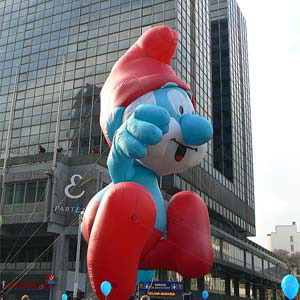
A giant balloon of a cartoon character in a parade

Listening passage (audio transcript, read aloud to students):

In the following presentation, you will hear about balloon wranglers. Listen to the presentation and then answer the questions that follow. Every Thanksgiving, a giant parade winds through the streets of New York City. The parade has singers, dancers, and bands. It has funny clowns and colorful floats. Most people, however, want to see the balloons. The balloons in this parade are huge! Many look like famous cartoon characters. Most are as tall as five- or six-story buildings and are just as long. Because the balloons are so large, many people must help guide them. These people are called balloon wranglers. Each balloon needs between fifty and seventy wranglers. The wranglers hold ropes, called “bones.” The bones attach to different parts of the balloon. Sometimes wranglers use the bones to make parts of the balloon move. For example, they might make the balloon wave its hand or wag its tail. Balloon wranglers bring the balloon to life for the crowd. Being a balloon wrangler is not easy, though. Balloon wranglers receive special training before the parade. They must walk the whole length of the parade, which is about 2.5 miles. They also must walk in all kinds of weather, including rain, snow, and wind. Even so, many balloon wranglers return year after year because they have so much fun.

1
SL.4.3
1
SL.4.3
1
SL.4.2

The First Bicycles

Listen to the presentation. Then answer the questions.

Listening passage (audio transcript, read aloud to students):


In the following presentation, you will learn about early kinds of bicycles. Listen to the presentation and then answer the questions that follow. Modern bicycles are fun to ride. Soft seats and rubber tires make riding smooth and comfortable. Years ago, riding bicycles was not quite so comfortable. One of the earliest bikes rattled riders so much that people called it a "Boneshaker"! One of the first bicycles was known as the walking machine. It was a simple bike with two wheels and a pair of handles that steered the front wheel. It didn't have pedals. Riders--really walkers--pushed themselves along the ground using their feet. The walking machine was invented in 1817 for getting around a garden on nice, smooth paths. In the 1860s, a bicycle with pedals on the front wheel was invented. It was called a velocipede. The first velocipedes were made of wood and had wooden tires. At the time, roads were made of stones. Riding a bike with wooden tires on bumpy roads was quite rough. People nicknamed these bicycles "Boneshakers" because of how much they shook riders. Early bike riders did all the work with their legs. When the bicycle chain was invented around 1879, bikes became more like the smooth moving machines we use today. Still, it was many years before riding bicycles became comfortable.

1
SL.4.2
1
SL.4.2
1
SL.4.2
Asemmisa {{asɛmmisaAhyɛnsode}}
36.

Parker is writing a story for her class about a dog that helps people who are blind. Parker wants to revise her story to add better detail about the main character. Read the draft paragraphs of her story and complete the task that follows.

About a year ago, a young Black Labrador puppy was adopted by a loving and helpful family. The family named the pup Bailey, and they taught her how to assist people who are blind.

Each day, Bailey learned a new skill for being a good guide dog. She learned how to listen very carefully to commands, and she also learned how to warn people when there was danger. Bailey seemed to beam with pride and happiness every time she was praised for her good work. She knew she was destined for great things in life. Bailey wanted nothing more than to help people. Bailey wagged her tail in delight when she heard, "Good girl! What a helpful dog you are!“

Finally, the day arrived for Bailey to go to her new home. A lovely lady who had lost her eyesight only a month earlier adopted the helpful dog. Bailey quickly became her faithful friend and assistant. Bailey always made sure the woman was safe both at home and in the neighborhood. In return, the woman made sure Bailey felt loved and treasured.

Choose the best sentence to add detail to show or explain who the main character is.

Asemmisa {{asɛmmisaAhyɛnsode}}
37.

A student is writing a report for science class about recycling. The student wants to revise the draft to include more information about recycling paper. Read a portion of the report and complete the task that follows.

Recycling is when waste and other materials are turned into new products. This prevents possibly useful materials from being wasted. It also cuts down on pollution and energy use.

There are a lot of materials that can be recycled, such as plastic, glass, metal, clothing, electronic equipment, and paper. Paper is one of the most common items that people recycle.

Aluminum can be recycled from cars, planes, computers, bicycles, wires, cookware, and cans. When glass is recycled, it is usually separated by color because glass will keep its color after it is recycled.

Although we normally think of recycling as something new, history shows that humans have recycled for thousands of years.

My notes on recycling:

  • people have recycled for thousands of years

  • Reduce, Reuse, Recycle

  • cuts down on pollution

  • cuts down on energy use

  • many materials can be recycled

Choose the sentence that adds information to the idea developed in the second paragraph of the report.

Asemmisa {{asɛmmisaAhyɛnsode}}
38.

A student is writing a report for his teacher about his class's food drive. The student wants to revise the draft to delete details that do not support the main idea. Read this part of the report and complete the task that follows.

We set a goal of collecting one hundred cans of food in four weeks. This number was chosen because we have twenty-five students in the class and hoped that each student could try to collect one can per week. Some students asked their families to donate cans to the effort. Other students put up posters around their churches or neighborhoods to encourage other people to donate food. Two students who play soccer after school asked their teammates to lend a hand. After three weeks, we have already gathered two hundred cans of food.

The next challenge in this project will be to find volunteers to pack up the cans and transport them to the food bank downtown. We plan to ask for parents to assist with this part. Three students are making fliers to send home with everyone in class that will ask for parent drivers. There are only three days left before my family goes on vacation. We hope to deliver the food on Tuesday, October

Choose the sentence that should be deleted because it does not contain details that support the main idea of the report.

Asemmisa {{asɛmmisaAhyɛnsode}}
39.

A student is writing a report for his teacher about raising frogs. Read the draft of the report and complete the task that follows.

When Robert brought the frog eggs to school, they looked like tiny jelly balls. They were attached like a bunch of grapes to a rock under the water of the aquarium tank. For several days, nothing seemed to be happening. We worried that something had gone wrong. Frog eggs will not hatch if the water is not clean enough or if the temperature is too cool. Then, one morning Katie noticed that the eggs had hatched. Tadpoles were swimming around the tank like a swarm of tiny bees. It was disappointing that we were not able to see the hatching itself, raising frogs has been very interesting so far.

Choose the best two phrases to connect “It was disappointing that we were not able to see the hatching itself” and “raising frogs has been very interesting so far.”

Asemmisa {{asɛmmisaAhyɛnsode}}
40.

A student is writing a description for his teacher about a class field trip to the forest. The student wants to revise the description to include better transition words. Read the draft paragraphs from the description and complete the task that follows.

The class poured out of the bus in a stream of loud voices and stamping feet. After the one-hour ride, everyone was excited and wound up. We were glad to be out in fresh air under a sky as blue as the sea. The tour guide made several attempts, and failed, to quiet everyone down as we began our hike.

, we toured the visitors center and saw a film about the many animals that made the forest their home. I was excited to see photographs of hawks and other birds of prey. It is remarkable that these creatures can see squirrels and other small animals from so high in the treetops or sky.

The field trip was inspiring and exciting at the same time. I hope the fourth grade will decide to take this trip next year too.

For each drop-down menu, choose the best word to connect the ideas in the student’s description.

Asemmisa {{asɛmmisaAhyɛnsode}}
41.

A student is writing an opinion article for the teacher about too much homework. The student wants to revise the draft to improve the development of ideas. Read the draft of the article and complete the task that follows.

Students these days have too much homework. At my school, students get more than an hour and a half of homework every night, and that doesn’t include our daily reading.

First of all, our homes should not feel like another form of school. We listen and work all day at school. Home should be for spending time with our families and friends. However, the amount of homework the average fourth-grade student receives is taking away important family time and time to play. Kids also need to get enough sleep to do well in school. Sometimes we have so much homework in so many different subjects that we are up way past our bedtimes trying to get it done.

However, other people believe homework gets students ready for high school and makes them more responsible. They also say homework makes parents get more involved in their child’s learning. I disagree. I believe it’s more important to spend fun times with your family instead of arguing over homework.

After you’ve worked on schoolwork all day long, it’s not fun to go home and do homework. I hope teachers, principals, students, and parents can find an answer and end the problem of too much homework!

Choose the sentence that best supports the underlined reason in the second paragraph.

Asemmisa {{asɛmmisaAhyɛnsode}}
42.

A student is writing a story for her teacher about a bike ride. Read this part of the story and complete the task that follows.

“I’ll race you to the edge of the park!” yelled Quintin as he pedaled fast.

“You must be dreaming!” replied Cassie with a laugh as she soared past.

The bikes were racing side by side like racehorses until the final yards when Quintin pushed his front wheel ahead.

Which of the following descriptive words would best replace the underlined word?

Asemmisa {{asɛmmisaAhyɛnsode}}
43.

A student is writing a story for her teacher about space travel. Read the draft of this part of the story and answer the question that follows.

Disaster loomed in the inky depths toward which the rocket sped. A satellite, like a tiny bug compared to the eagle-like rocket, edged into the rocket's path. Luckily, the two spacecraft did not meet. At the last minute, the rocket got by the silent, blinking satellite.

Which of the following phrases would best replace the underlined detail to make it more descriptive?

Asemmisa {{asɛmmisaAhyɛnsode}}
44.

A student is writing a report on planting bulbs for science class. Read this portion of the report and answer the question that follows.

Fall is the season to plant flower bulbs. My mom has been in her flower garden for days now, planting bulb after bulb. She decides where to plant the bulb, makes a hole, gently inserts the bulb, and then covers it with soil.

Which of the following is a more exact way to say what the writer means in the underlined phrase?

Asemmisa {{asɛmmisaAhyɛnsode}}
45.

A student is writing a story for school about his winter vacation. Read this draft paragraph from his story and the directions that follow.

During my winter vacation I visited my dad, and it was gloomy where he lives! The longer I stayed, the more I became used to the daily blizzards. It was still gloomy, though. Sometimes it would stop snowing, but then icy rain would fall. That made it seem gloomy all the time. Even though I had fun with my dad, I was glad to get back home to the beach!

Select the best two words to replace the underlined words in the paragraph.

Susie is writing a story for language arts about the time she was unprepared for a spelling test. Read this part of the story and complete the task that follows.

A few months ago, I had a huge spelling test coming up on a Monday morning. Normally, I would have studied hard all weekend to do great on the test. However, I woke up Saturday feeling sick to my stomach and very tired, like I could stay in bed all day.

“What am I supposed to do?” I asked my mom. “I feel so bad.”

“Well, Susie, get some rest and study when you can,” she replied.

“Will you help me study?” I asked.

“Of course I will!” Mom said. “Now get in bed and we'll study when you feel better. I promise.”

I had a warm breakfast and went back to sleep for a few hours. I really did stay in bed most of the day. I woke up feeling better on Sunday, and my mom decided I was well enough to study. As she promised, my mom studied with me. By Monday, I was well enough for school. Maybe I wasn't ready to run around during recess, but I was ready for the spelling test—I spelled every word correctly!

1
Asemmisa {{asɛmmisaAhyɛnsode}}
46.

Choose the two word pairs that best replace the underlined words with more exact language.

W.4.3.d

A student is writing a story for language arts about her clubhouse. Read this part of the story and answer the question that follows.

Last summer, my friend Carla and I decided to build our own clubhouse. We wanted someplace quiet to hang out, where we wouldn't be disturbed by our siblings. Our parents helped us build the clubhouse, and then Carla and I decorated. As winter approached, we decided to bring in heavy blankets and pillows to keep warm. Now, in December, we take our books and hot cocoa out there. We spend many winter afternoons in our clubhouse, comfortable and happy.

1
Asemmisa {{asɛmmisaAhyɛnsode}}
47.

Choose two more exact words that the student could use in the place of the underlined word.

W.4.2.d

A student is writing a story for language arts class about the day she got her first pair of contact lenses. The student wants to revise the draft to include phrases that are more descriptive. Read two paragraphs from a draft of the story and complete the task that follows.

When I was two years old, I got my first pair of glasses. I did not realize I could not see well because I was really young, but my parents noticed that I was unable to see certain things. They took me to the eye doctor. According to my parents, the doctor declared, “I've been doing this for many years, and your daughter is by far my youngest patient.” I have gone through many pairs of glasses since that day.

By the time I reached the age of ten, I had my mind firmly set on getting contact lenses. After asking my parents over and over, I finally got them to agree. The day of my eye appointment finally arrived. The school day couldn't go by fast enough.

1
Asemmisa {{asɛmmisaAhyɛnsode}}
48.

Choose the two sets of descriptive phrases that best replace certain things and asking my parents over and over.

W.4.3d
Asemmisa {{asɛmmisaAhyɛnsode}}
49.

A student is writing a story for language arts about her pet turtle. Read a paragraph of the story and complete the task that follows.

Anna loved her turtle. She spent hours watching the turtle as it swam in the pond she had made for him. The turtle [lived / was] in an aquarium. There were rocks and plants in the aquarium, which the turtle [walked / crawled] over. Anna fed her turtle every day. Her turtle liked to eat. Anna and her turtle were happy.

The student needs to add more exact description to her story. Click on two words that are too general and should be replaced.

Asemmisa {{asɛmmisaAhyɛnsode}}
50.

A student is writing a story for her class about Elliot’s first day of school. Read the draft sentences of the story and complete the task that follows. Elliot felt so words. “Good morning, Elliot,” she began. “I know that you are going to do an outstanding job here at Walker Elementary.” For each underlined pair of words, click on the word that is the most exact.

Asemmisa {{asɛmmisaAhyɛnsode}}
51.

A student is writing a story for language arts about learning to ski. Read the draft of the story and complete the task that follows.

This weekend, I went skiing with my friend Jack and his family. I had never been there before, so I was really excited. The mountains looked so beautiful with their peaks covered in snow.

First, Jack’s father gave me a ski lesson and I practiced for a while. Then, we rode to the ski slope on the thing that takes people to the mountain top. It was fun to slide on the skis, but I forgot how to stop and crashed into Jack. We both fell down, but we weren’t hurt. Jack’s dad was laughing. He helped us up and taught me how to stop again.

The student wants to make sure that he has used the right words to make his meaning clear.

Click on two of the underlined words that he should change.

Asemmisa {{asɛmmisaAhyɛnsode}}
52.

Read the sentences below and complete the task that follows.

I have been helping my scout troop collect pet food for the animal shelter in our town. My mom helped me set up plastic tubs around our neighborhood. Each tub has a sign asking for donations. Every Monday, I stop by the tubs to see what is there. By next week, I collected over one hundred cans and bags of food. I cannot wait until we deliver the food to the shelter!

Edit the underlined sentence by selecting the sentence that uses the correct helping verb.

Asemmisa {{asɛmmisaAhyɛnsode}}
53.

Read the following sentences and the question that follows.

The teacher shook her head as she looked at the mess her students had left in the art room. She had asked them to clean up after themselves yet they always rushed off before doing so. She would have to find a solution to this problem.

What is the best way to add the missing punctuation in the underlined sentence?

Asemmisa {{asɛmmisaAhyɛnsode}}
54.

Read the sentences and the question that follows.

Coach Rollins called a team meeting that Saturday afternoon at practice. “I just wanted to tell you how proud I am,” the coach said. “You have been playing so well all Spring. Now we have one final game to end the season. I hope you will all play your best today.”

The whole team cheered loudly, hugged, and ran out onto the field with smiles.

Which word underlined in the paragraph is incorrect?

Asemmisa {{asɛmmisaAhyɛnsode}}
55.

Read the story and the question that follows.

Today, our class went to The Fishery, a local fish store, because we are learning about fish: where they live and how they are different from people. Inside the store was very dark, except for the bright lights on top of each tank.

The girl, working in the store told me that the lights are neon, and they are used to show off the bright, colors of each fish.

The different fish were beautiful under the lights. They were bright blue, purple, yellow, and green.

I wanted to take all of the fish home.

What is the best way to correct the punctuation error in the underlined sentence?

Asemmisa {{asɛmmisaAhyɛnsode}}
56.

Read the paragraph and complete the task that follows.

We went to visit my uncle in Massachusetts. He lives just outside of Boston, so we went sightseeing in the City. We went to see where Paul Revere lived. He was a famous hero in the American Revolution. After that we walked through Boston Commons, a large park. Then we went to a baseball game.

Choose the word that is incorrectly capitalized.

Asemmisa {{asɛmmisaAhyɛnsode}}
57.

Read the paragraph and answer the question that follows.

Over the weekend, my mother and I went to a swim meet because we knew one of the swimmers, Dave, who is my cousin. She said to me We're going to see your cousin swim in a contest. The meet was exciting because all the swimmers were working very hard. Dave was swimming very quickly. He did really well and came in third. He was so excited he let out a cheer when they announced his name. He got an award. We all went out to eat afterward. He was really hungry and had two hamburgers.

What are the two changes in punctuation that will correct the underlined sentence?

Asemmisa {{asɛmmisaAhyɛnsode}}
58.

Asemmisa {{asɛmmisaAhyɛnsode}}
59.

A student wrote a sentence that contains an error in punctuation. Click on the underlined word that should be followed by a comma.

Every morning, my sweet new puppy tries to climb the stairs to get to my bedroom but he never makes it up more than one step.

A student is writing a report about chipmunks. Read the sentences from a source and the directions that follow.

There are 25 kinds of chipmunks, 24 of which live in North America. Chipmunks can also be found in Northern Asia. Female chipmunks have at least one litter per year with four or five babies who stay in the nest for up to six weeks. They look like squirrels, their bushy-tailed cousins, but they are smaller. Chipmunks live in dens with two rooms. One room is a nest lined with leaves, and the second room is where they store their food of nuts, seeds, and grains. Chipmunks hibernate in cold weather, which means they spend most of the winter sleeping in their dens.

1
Asemmisa {{asɛmmisaAhyɛnsode}}
60.

The parts of the student's report are shown below. In which part of the report would the facts from the source best fit?

W.4.8

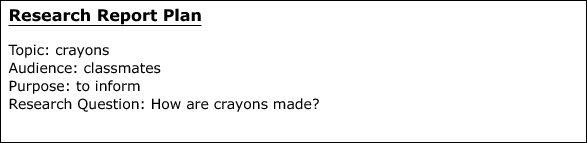
A student has made a plan for research. Read the plan and the directions that follow.

Research Report Plan: Topic: crayons. Audience: classmates. Purpose: to inform. Research Question: How are crayons made?

Research Report Plan

Topic: crayons
Audience: classmates
Purpose: to inform
Research Question: How are crayons made?

1
Asemmisa {{asɛmmisaAhyɛnsode}}
61.

Which of these is the best source for the information needed to answer the research question?

W.4.8
Asemmisa {{asɛmmisaAhyɛnsode}}
62.

A student is writing a report about the landforms of Italy. The student found the following sources. Which source would most likely have information for the report?

Asemmisa {{asɛmmisaAhyɛnsode}}
63.

A student is writing a research report about the sky. Read the sentences from her report and the directions that follow.

It is a clear day in the summer. The sun shines brightly on your face. You lie down on the soft carpet of green grass and look up at the bright blue sky. Suddenly you ask yourself, "If air has no color, then what makes the sky blue?"

Choose two of the sources that would most likely give the student more information about the ideas she has written.

Asemmisa {{asɛmmisaAhyɛnsode}}
64.

A student is writing a research report about sea stars. She wrote an opinion in the report. Read the sentences from the report and the directions that follow.

Amazing Sea Stars

Sea stars are sea animals with hard, spiny skin. They crawl along the ocean floor. Most sea stars have five arms. They also have tube feet on their underside. Sea stars have a surprising ability. It is truly astonishing.

The student took notes about sea stars. Which note supports the student's opinion?

Asemmisa {{asɛmmisaAhyɛnsode}}
65.

A student is writing a research report about writing letters. He wrote an opinion in the report. Read the opinion and the directions that follow.

The Internet has only been around for a short time. Before the Internet, the telephone was a usual way to contact people. And before the telephone, the telegraph was used. But people have written letters for centuries. Some people can express their ideas in a letter better than they can on a computer, and letters can be saved and read many years later. A letter is a special gift that can be enjoyed now and for many years to come.

The student found another source about writing letters.

Which sentence from the source supports the student's opinion?

Asemmisa {{asɛmmisaAhyɛnsode}}
66.

A student is writing a research report about the beginnings of music. He found a source. Read Source 1 and the directions that follow.

Source 1

Music is very important in people's lives. It helps people to come together. It is an important part of many events. How did music begin? It probably started with mothers talking to their babies. They talked to them in a sing-song voice. The babies connected with this musical sound. It pleased and calmed them. Then, music became a way for families or other groups to tell stories. More and more people began connecting through music. After a while, larger groups gathered for the purpose of music. Finally, the concert was born.

The student took notes about the beginnings of music. Choose all of the notes that support the author's opinion in Source 1.

Asemmisa {{asɛmmisaAhyɛnsode}}
67.

A student is writing a research report on how and why cats purr. She found a source. Read Source 1 and the directions that follow.

Source 1

Do cats choose to purr? The answer is yes, they do. Cats actually make the choice to purr the same way humans make the choice to smile or laugh. Purring by a cat shows a friendly mood. They create the purring sound by using a few parts of their bodies. Their voice boxes and other muscles work together to make that low rumbling sound that we come to expect when cats are curled up on our laps. What's very interesting is that a cat's purr has healthy benefits for both cats and humans, including strengthening bones. Feeling weak? Find a cat to hold, and it can make your bones stronger.

The student took notes about how and why cats purr. Choose two notes that support the author's opinion in Source 1.

Asemmisa {{asɛmmisaAhyɛnsode}}
68.

A student is writing a research report about early bicycles. He found a source. Read Source 1 and the directions that follow.

Source 1

Bicycles were invented in the nineteenth century. These early bicycles were a very helpful tool. One of the first bicycles was a "walking machine." It was made by Baron von Drais in 1817. It looked like a bicycle, but a person had to push against the ground with his or her feet to move it.

The student took notes about early bicycles. Choose two notes that support the author's opinion in Source 1.

Asemmisa {{asɛmmisaAhyɛnsode}}
69.

A student is writing a research report about panda bears. He wrote an opinion in the report. Read the sentences from the report and the directions that follow.

A panda bear has black hair around its eyes, ears, nose and all across its tummy. The rest of its fur is white. A panda has a short, stubby tail. It has five claws and an extra finger, kind of like a thumb, that starts at its wrist bone. It uses this extra finger to grip and eat bamboo. Panda bears love to eat lots and lots of bamboo.

The student found another source about pandas. Choose two of the sentences from the source that support the student's opinion.

Read the passage and answer the questions.

Dances with Animals

by Ellen R. Braaf

A honey bee returns to the hive. Sticky pollen clings to her body. Nectar fills her honey sac. She’s found apple blossoms in a distant orchard. How does she tell other worker bees about this new food source? She dances!

Unlike humans, animals don't have words to help them communicate. They can't say “Hey! Look what I found,” or “Keep away! This is my spot,” or “Want to go steady?” Yet, animals communicate all the time. They send out signals—messages others receive and understand using their senses of smell, taste, touch, hearing, and sight.

Animals with good vision “talk” to each other with their bodies. They use patterns of movements to share information, to defend themselves or their territories, and to attract mates. Nature designs their steps, and they dance as if their lives depended on it. Often, they do.

Language of Bees

Most communication takes place among members of the same species. In dark beehives, honeycombed walls become waxy dance floors. Like a rock star swarmed by adoring fans, a bee returning from the apple orchard begins her dance. Other workers follow her as she moves forward in a straight line. She vibrates her wings and wags her body side to side very quickly—13 to 15 times a second. Then she turns to one side, circles back, and begins the waggle run again. When she finishes, she circles around—this time in the opposite direction—and repeats her steps. The dance may go on for hours.

As she traces a figure 8 on the dance floor, the follower bees touch her with their antennae. They sense the odors of apple blossom nectar and pollen clinging to her body. These workers also detect the scent she used to mark the distant flowers. A flight plan is coded in her movements. The length of the waggle run tells workers how far the flowers are from the hive. Its angle tells them how to get there. Because bees steer by the sun, the dancer links her directions to its position in the sky.

However, the position of the sun in the sky keeps changing. If the waggle dance lasts for hours, how do bees leaving the hive long after the dance has begun find their targets? Amazingly, they do. The waggling bee adjusts her dance to account for the sun's movement.

Keep Away!

“This is my spot!” Not all animals cooperate the way honey bees do. Most compete for food, territory, and mates. Fights take time and energy. Rivals risk injury and death, weakening the group as a whole. So some animals dance instead, using movements to make themselves look larger, stronger, and quicker than their competition. “Don’t mess with me,” they say.

Red Fish, Blue Fish

Most fish settle conflicts over territory without fighting. But Siamese fighting fish, also known as bettas, are little fish with a big mean streak. Brightly colored bettas in pet stores have been specially bred for their beautiful veil-like fins. In the wild, they live in rice paddies in Southeast Asia.

If threatened, male Siamese fighting fish switch back and forth between face-to-face and side-to-side positions. Facing each other, they flare out flaps of skin on their necks and extend their fins. This makes them seem twice their size. Side-to-side, they flicker their fins and beat the water with their tails. Tail beating gets faster and faster until one male backs down. The loser lowers his fins and puts his tail down. His bright red, blue, or purple body color fades to a dull hue. Defeated, he swims away.

Whether it is to communicate where to find something or to tell someone to “steer clear,” animal dances can tell us a lot!

“Dances with Animals” by Ellen R. Braaf, from Ask magazine.

Asemmisa {{asɛmmisaAhyɛnsode}}
1.

Read the sentence from the passage.

Because bees steer by the sun, the dancer links her directions to its position in the sky.

Pick the word that best defines position as it is used in the sentence.

Asemmisa {{asɛmmisaAhyɛnsode}}
2.

What does the information in the section “Keep Away!” show about the author’s point of view?

Asemmisa {{asɛmmisaAhyɛnsode}}
3.

Pick the two sentences that should be included in a summary of the passage.

Asemmisa {{asɛmmisaAhyɛnsode}}
4.

What is the most likely reason the author uses dialogue in the passage? Pick three choices.

Asemmisa {{asɛmmisaAhyɛnsode}}
5.

Read the passage excerpt.

Not all animals cooperate the way honey bees do. Most compete for food, territory, and mates. Fights take time and energy. Rivals risk injury and death, weakening the group as a whole. So some animals dance instead, using movements to make themselves look larger, stronger, and quicker than their competition. “Don’t mess with me,” they say.

Click on the two sentences that best support the idea that dancing may be a better way for animals to communicate than fighting.

Asemmisa {{asɛmmisaAhyɛnsode}}
6.

Read the summary of the “Red Fish, Blue Fish” section of the passage.

The male betta fish would rather dance than fight. First, they turn toward each other and stretch out their skin and fins to look bigger. Then, they move side to side and quickly beat the water with their tails until one backs down. The loser lowers his fins and tail and swims away.

An important detail is missing from the summary. Click on the sentence from the passage that includes the missing detail.

Read the passage and answer the questions.

A Rainy Day at the Farmer's Market

I heard the honking of the horn as my dad's truck pulled into the driveway. Immediately, I knew it was time to stop playing catch with my dog. My grandmother called, "Matthew! Your dad is home. Please come help him!"

I was disappointed. It was a cloudy Saturday, and I thought we would be able to skip the Farmer's Market. I had hoped to do what I wanted today, but no such luck.

"Matthew!" Grandmother called again.

"I'll be right there!" I yelled.

"Please get the big umbrellas from the basement," Grandmother said. "It looks like it's going to rain."

I still had to put on some shoes. I decided to wear my cowboy boots, but I couldn't find them. I looked in the front closet, upstairs, and by the back door. I could've worn my sneakers, but I really wanted to wear my boots. I knew that if I didn't hurry, everyone was going to be upset with me. Reluctantly, I put on my sneakers and went outside.

By then there were only a few crates of produce that needed to be loaded onto the truck.

"I could have used your help, son," said Dad. "Kayla helped me load all of this produce into the truck."

I knew he wasn't happy with me, and I felt bad that my sister Kayla had helped instead of me. I started to explain how I wanted to wear my boots, but couldn't find them. Then I realized how selfish I sounded.

Grandmother came outside, and I helped her carry a box of fresh baked goods. Once we were all in the truck, Dad drove toward town. The Farmer's Market was located in a parking lot behind the town square.

Dad stopped the truck at the main entrance to check in. "Good morning, Bill," Dad said to the attendant. "What's the weather prediction?"

"It's not looking good," said Bill. He directed us to where we should park our truck.

Dad drove the truck toward our parking space, and then carefully backed in. We set up our table with fruits and vegetables on one side and baked goods on the other. Grandmother's homemade pies and cookies made my mouth water.

"We'd better put up the umbrellas in case it rains," said Dad.

I gulped. I realized I had forgotten the umbrellas. Dad, Grandma, and Kayla looked at me expectantly.

"I'll be right back!" I yelled, and took off running before anyone had a chance to say anything.

I knew that my friend Jose and his family were supposed to be at the market, so I searched for them, keeping my fingers crossed that it didn't start to rain. I ran past tables of flowers, fruits, vegetables, and even homemade soaps and hand-knitted sweaters, but I could not find Jose.

Exhausted, I continued searching through the rows of tables. I reached the last row with growing concern. If it rained, our truck would get soaked, and so would my family.

Finally I saw Jose. I ran over and almost collapsed.

"Is everything all right, Matthew?" asked Jose's mom.

I gasped for air as I explained how I forgot our umbrellas. I asked if they had any extras we could borrow.

"Of course! Jose, please help Matthew," said Jose's mom.

Then it happened: a drop of rain hit my face!

Jose and I quickly pulled out two large umbrellas from the family's truck. Jose helped me carry the big umbrellas back to our space. We had to go slowly, being careful not to bump into anyone. The market had opened for business, and it was already crowded.

We arrived just in time. As we opened the umbrellas, the few drops of rain began to turn into a steady drizzle. Dad smiled and nodded, seemingly pleased that I had solved the problem on my own. After we set up the umbrellas, Jose hurried back to his family. Luckily the rain didn't stop the crowds. But the rain sure taught me a lesson that day.
Asemmisa {{asɛmmisaAhyɛnsode}}
7.

What happens after Matthew and Jose open the umbrellas?

Asemmisa {{asɛmmisaAhyɛnsode}}
8.

Read the sentences from the passage.

Finally I saw Jose. I ran over and almost collapsed.

What does the use of the word collapsed suggest?

Asemmisa {{asɛmmisaAhyɛnsode}}
9.

How does the author develop the idea that Matthew takes responsibility for his actions?

Asemmisa {{asɛmmisaAhyɛnsode}}
10.

How does the paragraph about Matthew looking for his cowboy boots add to the plot?

Asemmisa {{asɛmmisaAhyɛnsode}}
11.

Matthew and his family go to the farmer's market regularly. Pick the two details from the passage that best support this inference.

Asemmisa {{asɛmmisaAhyɛnsode}}
12.

Read the sentence from the passage.

I ran past tables of flowers, fruits, vegetables, and even homemade soaps and hand-knitted sweaters, but I could not find Jose.

Choose two statements that best explain why the author chose to include this sentence.

Asemmisa {{asɛmmisaAhyɛnsode}}
13.

Read the sentence from the passage.

I knew that my friend Jose and his family were supposed to be at the market, so I searched for them, keeping my fingers crossed that it didn’t start to rain.

Why does the author use the phrase “keeping my fingers crossed”? Pick three choices.

Asemmisa {{asɛmmisaAhyɛnsode}}
14.

The following question has two parts. First, answer part A. Then, answer part B.

Part A: Which of these inferences about Matthew is supported by the passage?

Asemmisa {{asɛmmisaAhyɛnsode}}
15.

Part B: Which sentence from the passage best supports your answer in part A?

Asemmisa {{asɛmmisaAhyɛnsode}}
16.

The author uses the word disappointed in the passage. Click on the group of words in the sentence that best shows that idea.

It was a cloudy Saturday, and I thought we would be able to skip the Farmer’s Market. I had hoped to do what I wanted today, but no such luck.

Read the passage and answer the questions.

Battle in the Sky!

by Lisa Rosinsky

High in the air above the National Mall in Washington, D.C., at the foot of the Washington Monument, five huge, brightly colored kites dip and dive. It’s a cloudy, windy day—perfect weather for kite flying. Suddenly, a red-and-black kite darts straight at an American-flag-patterned kite. Their lines are tangled! Down on the ground, the kite flyers begin to saw their lines back and forth, trying to pull each other’s kites out of the sky. “We have engagement!” shouts the announcer. The audience cheers. The 2012 Blossom Kite Festival Rokkaku Battle has begun!

Rokkaku kites are six-sided “fighter kites” and can be very large. Some are even taller than an adult! Rokkaku battles began in Japan around 1649, and many other cultures in Asia and the Middle East have similar kite-fighting customs. Traditional Japanese Rokkaku kites are painted with images of heroes from folklore or history. Modern kites, however, might be decorated with any design, including animals, insects, flags, or funny faces. Included in the battle today are a rainbow kite and a five-foot-tall kite with a picture of a rock star!

The kite flyers are chasing each other around the field, each trying to wrap his or her kite string, or “line,” around someone else’s. One by one, the kites drop out of the battle, until there are only two kites left in the sky. The red-and-black kite belongs to Andrew Albosta. Andrew’s line is tangled around the other kite’s, and he begins to saw his line back and forth. The other kite wavers, then its line breaks! The kite starts floating away, then falls to the ground. When a kite touches the ground or its line is cut, that kite’s team is out. Andrew is the winner!

But the battle is not over yet. Just like a game of rock-paper-scissors, it’s the best out of three. This competition has three “heats,” or rounds. The same five kites compete in each heat. The last kite remaining in the sky at the end of each heat wins points. After all three heats, the judges add all the points together to determine the final winner.

Rokkaku battles can be fought between individuals or teams. For this battle, each team must have four members: a pilot, a copilot, a launcher, and a scorekeeper. The pilot and copilot work together to fly the kite, and the scorekeeper helps keep track of the points. The person who launches the kite is also in charge of retrieving it when it falls. Andrew is the pilot of his team.

Andrew’s team wins the next heat, too! Now there’s just one more round to go. The announcer gives the “Launch!” signal, and the final round begins! The rock-star kite is back, and so is the American-flag kite. It’s a close contest, but Andrew wins a third and final time, making him the first-place winner of the 2012 Blossom Kite Festival Rokkaku Battle.

Andrew has been flying kites since he was a kid and started entering competitions when he was a teenager. He also enjoys building his own kites.

If you’re interested in flying and building kites, you can ask your parents to help you contact a local kite organization or club. You can also find resources at your local library.

Asemmisa {{asɛmmisaAhyɛnsode}}
17.

Read the sentence and the directions that follow.

Participants in the Rokkaku battle were allowed to repair their kites before they competed in the next round.

Which detail from the passage best supports this conclusion?

Asemmisa {{asɛmmisaAhyɛnsode}}
18.

Read the sentences from the passage.

Down on the ground, the kite flyers begin to saw their lines back and forth, trying to pull each other’s kites out of the sky. “We have engagement!” shouts the announcer. The audience cheers.

The word engagement has multiple meanings. What does the author tell the reader with the use of the word engagement?

Pick two choices.

Asemmisa {{asɛmmisaAhyɛnsode}}
19.

The following question has two parts. First, answer part A. Then, answer part B.

Part A: Which sentence best describes the author’s message?

Asemmisa {{asɛmmisaAhyɛnsode}}
20.

Part B: Which sentence or sentences from the passage best support your answer in part A?

Asemmisa {{asɛmmisaAhyɛnsode}}
21.

Part A: Choose the statement that best describes what the information presented in “Battle in the Sky!” shows about the author’s point of view.

Asemmisa {{asɛmmisaAhyɛnsode}}
22.

Part B: Which sentence from the passage best supports your answer in part A?

Asemmisa {{asɛmmisaAhyɛnsode}}
23.

Click on the sentence that best shows the main idea of the passage.

Rokkaku kites are six-sided “fighter kites” and can be very large. Some are even taller than an adult! Rokkaku battles began in Japan around 1649, and many other cultures in Asia and the Middle East have similar kite-fighting customs. Traditional Japanese Rokkaku kites are painted with images of heroes from folklore or history. Modern kites, however, might be decorated with any design, including animals, insects, flags, or funny faces. Included in the battle today are a rainbow kite and a five-foot-tall kite with a picture of a rock star!

Asemmisa {{asɛmmisaAhyɛnsode}}
24.

This question has two parts. First, answer part A. Then, answer part B.

Part A: Click on the sentence that gives the best conclusion about why it is important to be the last kite in the air.

Asemmisa {{asɛmmisaAhyɛnsode}}
25.

Part B: Click on the sentence from the passage that best supports your answer in part A.

The kite flyers are chasing each other around the field, each trying to wrap his or her kite string, or “line,” around someone else’s. One by one, the kites drop out of the battle, until there are only two kites left in the sky. The red-and-black kite belongs to Andrew Albosta. Andrew’s line is tangled around the other kite’s, and he begins to saw his line back and forth. The other kite wavers, then its line breaks! The kite starts floating away, then falls to the ground. When a kite touches the ground or its line is cut, that kite’s team is out. Andrew is the winner!

But the battle is not over yet. Just like a game of rock-paper-scissors, it’s the best out of three. This competition has three “heats,” or rounds. The same five kites compete in each heat. The last kite remaining in the sky at the end of each heat wins points. After all three heats, the judges add all the points together to determine the final winner.

Asemmisa {{asɛmmisaAhyɛnsode}}
26.

Which detail from the presentation best supports the conclusion that Alexander Graham Bell was a dedicated scientist?

Asemmisa {{asɛmmisaAhyɛnsode}}
27.

Choose two details from the presentation that support the idea that the telephone took a long time to invent.

Asemmisa {{asɛmmisaAhyɛnsode}}
28.

The following question has two parts. First, answer part A. Then, answer part B.

Part A: What is the main idea of the presentation?

Asemmisa {{asɛmmisaAhyɛnsode}}
29.

Part B: Which sentence from the presentation best supports the main idea?

Asemmisa {{asɛmmisaAhyɛnsode}}
30.

The following question has two parts. First, answer part A. Then, answer part B.

Part A: Which conclusion is supported by the presentation?

Asemmisa {{asɛmmisaAhyɛnsode}}
31.

Part B: Which sentence from the presentation best supports your answer in part A?

Asemmisa {{asɛmmisaAhyɛnsode}}
32.

The presentation gives information about the balloons used in the Thanksgiving parade in New York City as well as information about other parts of the parade.

Complete the chart by clicking in the boxes next to the information column that match whether the information describes balloons or other parts of the parade.

Balloons

Parade

Famous Characters

Funny Clowns

Long and Tall

Colorful Floats

Asemmisa {{asɛmmisaAhyɛnsode}}
33.

Based on the presentation, which statement best describes the early bicycles?

Asemmisa {{asɛmmisaAhyɛnsode}}
34.

What are the most likely purposes of the presentation? Pick two choices.

Asemmisa {{asɛmmisaAhyɛnsode}}
35.

Complete the chart to show which statement matches with each type of bicycle. Click in the boxes next to the statements that match the modern bicycle or the first bicycle.

Modern bicycle

First bicycle

It has rubber tires.

It has no pedals.

It is made of wood.

It is comfortable.

It is bumpy.

It has a soft seat.

Read the sentences and complete the task that follows.

One of my best memories was the time I went to the beach with my friend, Marcus. To make the most of our last day there, we decided to stay up all night and watch the sun rise.

“i'm not tired at all. Are you?” I asked Marcus that night.

“Of course not! I think I can stay up all night and the whole next day if I really try,” Marcus replied.

I said, “Me, too. It'll be easy. We need to make a pact, though. If I fall asleep, you have to wake me up. If you fall asleep, I'll wake you up. Okay?”

“That idea sounds good to me. Let's do this!” marcus said excitedly.

Click on two sentences that have mistakes in capitalization.