Source #1
You have found an article that describes how animals survive in different environments, the places where plants and animals live.
It's a Cold (Hot, Dry, Dark) Cruel World!
by Dawn Baertlein
Living creatures survive in all types of environments. Each environment creates different challenges for animals that live there. Some living creatures survive at the bottom of the sea where it is dark as night and very cold. Other plants and animals live in dry, hot environments. People can use tools like flashlights or fans to help them survive. Animals and plants, however, must rely on nature to help them survive.
Near the South Pole, in Antarctica, it is very cold. It is usually about minus 57 degrees Fahrenheit. Water freezes at 32 degrees Fahrenheit, so Antarctica is much colder than ice. Scientists live at the South Pole, but they live in buildings with thick walls and heating. What do animals do?
Some animals have bodies that help them live in the cold. The icefish lives in water so cold that even in summer, chunks of ice continue to float in the water. How do icefish keep from freezing? The only way icefish can survive in this extreme environment is because they have a special substance in their blood that keeps ice crystals from forming inside their bodies.
Penguins have thick layers of fat or blubber to help them stay warm, but sometimes even that is not enough! Often penguins must rely on each other for survival. They cuddle up together as close as they can to share their body heat.
Another area that can be hard to live in is the dry, hot desert. People who live in the desert often wear special clothes to protect them from the heat. When they build homes they have air conditioners to keep them cool and to find water they dig wells that provide water from deep in the ground. How do animals survive in the hot, dry conditions?
Many desert animals come out only at night, when it's cool. Snakes, lizards, mice, and squirrels live in burrows. During the day, they stay under the ground and out of the sun.
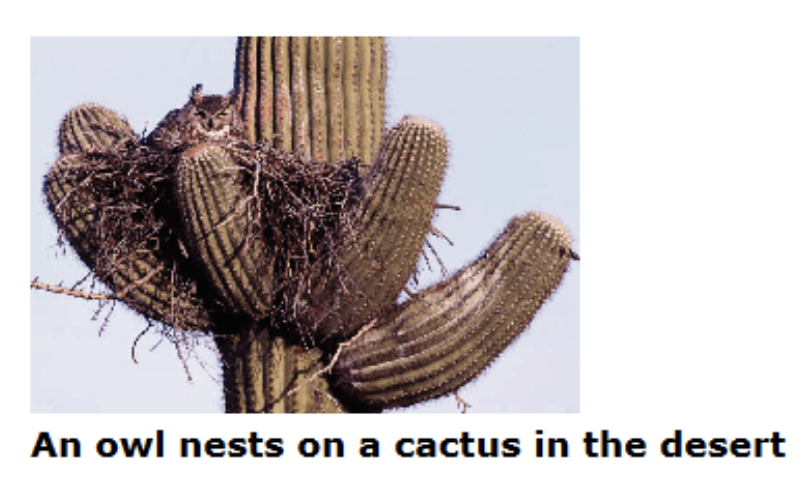
In the hot Sonoran Desert of Arizona, an owl lives in a nest that sits on a tall cactus. The cactus stems store water. Rain doesn't fall often in the Sonoran Desert, but when it does, it falls quickly and heavily. Then the water quickly flows away. The cactus has roots that spread out only inches below the surface of the soil. The roots are like a big sponge, soaking up rainwater fast. Now the cactus can store water for months and the owl has a nice home high up in the cactus.
The ocean has very different challenges from those of the desert. The deepest parts of the ocean are very dark and cold because the sun's rays are unable to shine through all of the layers of water. Some of the very deepest parts of the ocean have thermal vents on the ocean floor that are like little volcanoes under the sea. The water coming out of the vents is very hot. Crabs survive at the bottom of the sea by scurrying around the vents looking for food.
Arctic chill, desert sun, and cold, pitch-dark ocean-these are difficult conditions that would be hard for people to survive. But nature gives plants and animals the ability to live almost anywhere.
Sources Used
Carey, B. (2006, June 19). Fish produces natural antifreeze to stay alive. Retrieved from http://www.nbcnews.com/id/13426864/ns/technology_and_sciencescience/t/fish-produces-natural-antifreeze-stay-alive/
Hill, K. (2007, September 15). What animal never drinks water in its entire life? Retrieved from http://www.bigsiteofamazingfacts.com/what-animal-never-drinks-water-in-its-entire-life
SeaWorld Parks and Entertainment (n.d.). Polar bears: behavior. Retrieved from http: //www.seaworld.org/animal-info/info-books/polar-bear/behavior.htm
The Mariana Trench (n.d.). The mariana trench-biology. Retrieved from
http://www.marianatrench.com/mariana_trench-biology_001.htm
Photo of owl on cactus (Image 1598R-10034017), copyright by SuperStock. Used by permission.