CAASPP Grade 7 ELA - Performance Task

Last updated about 1 month ago
3 questions
Source #1
Here is an article based on scientific research about sleep.

How Much Sleep Is Enough?
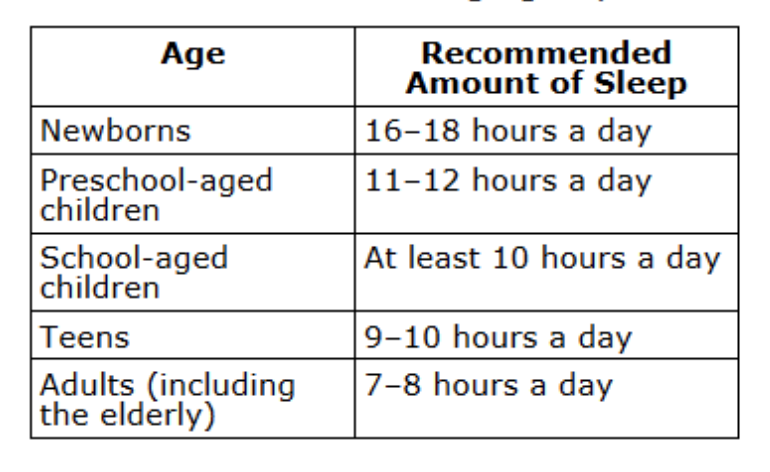
The amount of sleep you need each day will change over the course of your life. Although sleep needs vary from person to person, the chart below shows general recommendations for different age groups.

If you routinely lose sleep or choose to sleep less than needed, the sleep loss adds up. The total sleep lost is called your sleep debt. For example, if you lose 2 hours of sleep each night, you'll have a sleep debt of 14 hours after a week.

Some people nap as a way to deal with sleepiness. Naps may provide a short-term boost in alertness and performance. However, napping doesn't provide all of the other benefits of night-time sleep. Thus, you can't really make up for lost sleep.

Some people sleep more on their days off than on work days. They also may go to bed later and get up later on days off.

Sleeping more on days off might be a sign that you aren't getting enough sleep. Although extra sleep on days off might help you feel better, it can upset your body's sleep-wake rhythm.

Bad sleep habits and long-term sleep loss will affect your health. If you're worried about whether you're getting enough sleep, try using a sleep diary for a couple of weeks.

Write down how much you sleep each night, how alert and rested you feel in the morning, and how sleepy you feel during the day.

Sleeping when your body is ready to sleep is also very important. Sleep deficiency can affect people even when they sleep the total number of hours recommended for their age group.

For example, people whose sleep is out of sync with their body clocks (such as shift workers) or [is] routinely interrupted (such as caregivers or emergency responders) might need to pay special attention to their sleep needs.


"How much sleep is enough?" by The National Heart, Blood, and Lung Institute. In the public domain.
Required
2

Explain how the table in Source #1 supports information provided in the two other sources. Cite evidence and identify the source of each piece of information by title or number.

Required
1

Click on the boxes to show the claim(s) that each source supports. Some sources will have more than one box selected.

Source #1:
How Much
Sleep Is Enough?
Source #2:
The Secret
Truth about
Napping
Source #3:
Ask the
Sleep
Doctor
If you take too long of a nap, you might feel sleepy.
If your sleep patterns interrupt your body's internal clock, you might have trouble getting enough sleep.
A deep sleep helps the brain to operate at a higher level.
Required
10

Part 2
You will now review your notes and sources, and plan, draft, revise, and edit your writing. You may use your notes and refer to the sources. Now read your assignment and the information about how your writing will be scored; then begin your work.

Your Assignment:
Now that you have completed research on the topic of sleep, the journalism club advisor has asked you to write an explanatory article about sleep and naps for the next issue of the school newspaper. The audience for your article will be other students, teachers, and parents.

Using more than one source, develop a thesis/controlling idea to explain about sleep and naps. Once you have a thesis/controlling idea, select the most relevant information from more than one source to support your thesis/controlling idea. Then, write a multi-paragraph
explanatory article explaining your thesis/controlling idea. Clearly organize your article and elaborate your ideas. Unless quoting directly from the sources, use your own words. Be sure to reference the source title or number when quoting or paraphrasing details or facts from the sources.

Explanatory Article Scoring:
Your explanatory article will be scored using the following:
  1. Organization / purpose: How well did you state your thesis/controlling idea, and maintain your thesis/controlling idea with a logical progression of ideas from beginning to end? How well did you narrow your thesis/controlling idea so you can develop and elaborate the conclusion? How well did you consistently use a variety of transitions? How effective was your introduction and your conclusion?
  2. Evidence/elaboration: How well did you integrate relevant and specific information from the sources? How well did you elaborate your ideas? How well did you clearly state ideas using precise language that is appropriate for your audience and purpose?
  3. Conventions: How well did you follow the rules of grammar usage, punctuation, capitalization and spelling?
Now begin work on your explanatory article. Manage your time carefully so that you can:
  • plan your multi-paragraph explanatory article.
  • write your multi-paragraph explanatory article.
  • revise and edit the final draft of your multi-paragraph explanatory article.
Word-processing tools and spell check are available to you.

For Part 2, you are being asked to write a multi-paragraph explanatory article, so please be as thorough as possible. Type your response in the space provided. The box will expand as you type.

Remember to check your notes and your prewriting/planning as you write and then revise and edit your explanatory article.