Match the letter to the fraction

Match the letter to the fraction
Heavy fuel oil | Kerosene | Diesel | |
|---|---|---|---|
X | |||
Y | |||
Z |
Match the letter to the fraction
Heavy fuel oil | Kerosene | Diesel | |
|---|---|---|---|
X | |||
Y | |||
Z |
Fuels

Fuels

Bitumen | Lubricating oils | Kerosene | |
|---|---|---|---|
X | |||
Y | |||
Z |
Fuels

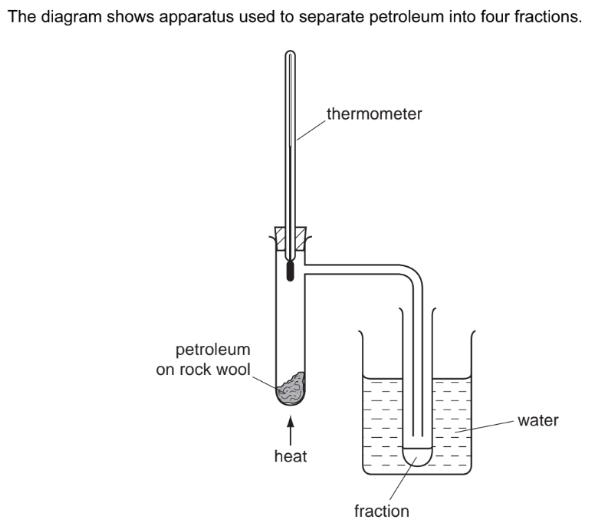
What is this process called?
What is the purpose of the water?
What would be observed (if anything) if the fractions were tested with bromine water?
Fuels

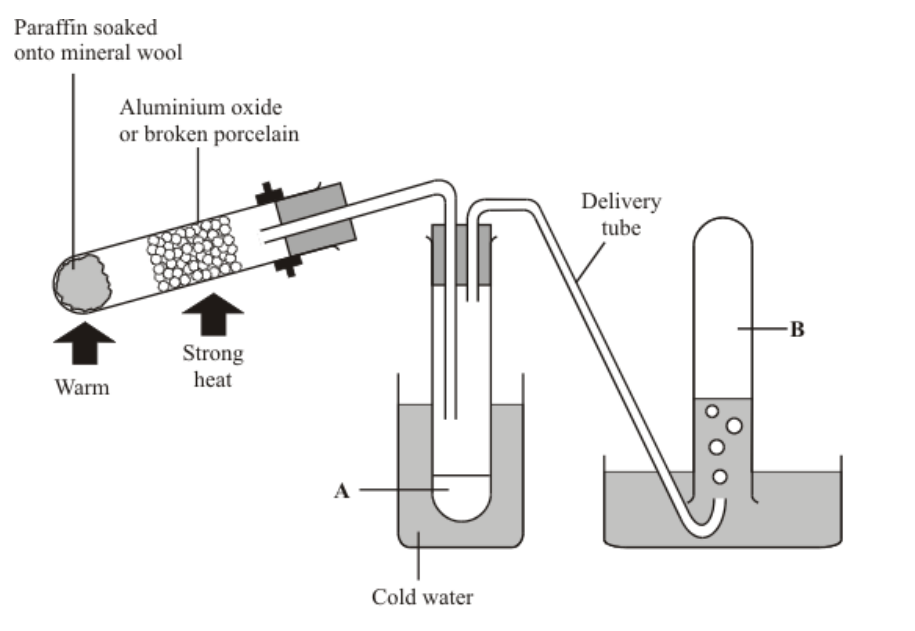
What is the name of this process?
This is known as
What is the purpose of the aluminium oxide?
The aluminium oxide acts as a
The fact that heating has to be continuous for this reaction mean that the reaction is an
If gas B were to to be tested with bromine water the bromine water would decolonise.
This means that B contains an
Hydrocarbon A contains hydrogen and carbon .
Hydrocarbon A has a boiling (condensation) temperature than hydrocarbon B.
Hydrocarbon B contains hydrogen and carbon .
Hydrocarbon B has a boiling (condensation) temperature than hydrocarbon A.
Hydrocarbon has a longer chain length than hydrocarbon
A is a mixture of and alkenes
B is a mixture of alkanes and
The paraffin used at the start decolourise bromine water because paraffin is a(n) hydrocarbon.
The delivery tube should be removed from the water to prevent
Note the path of the gas from the the boiling tube to the inverted boiling tube is continuous!
The purpose of the cold water is to cool the vapours to allow (some of) them to .
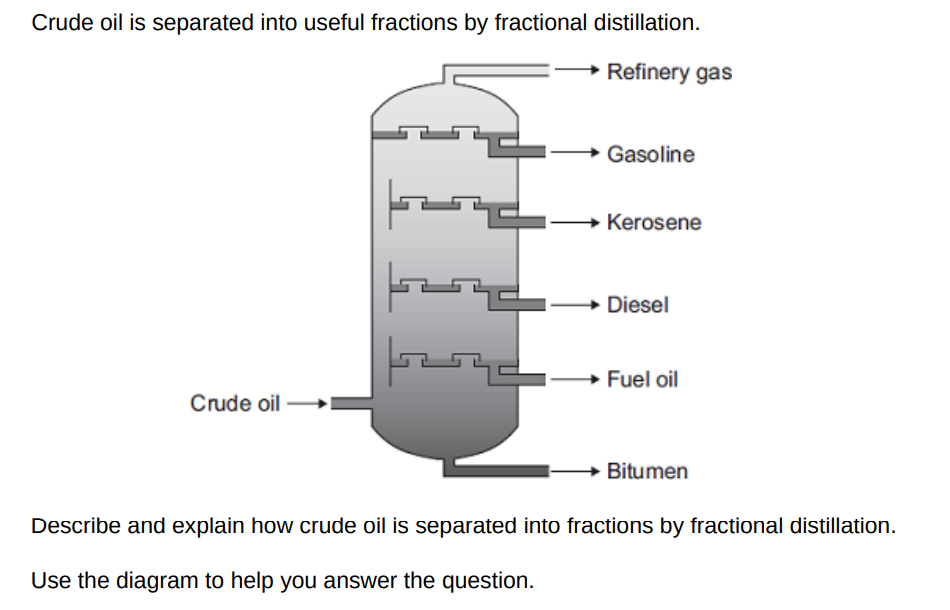
Fractional distillation.
crude oil enters as a
The vapour as it rises up the tower
The fractions have different boiling
As the fraction rises up through the column the fraction will reach a point where the temperature is equal to its boiling point and the fraction will
The liquid is removed and the remaining fractions continue up through the column.
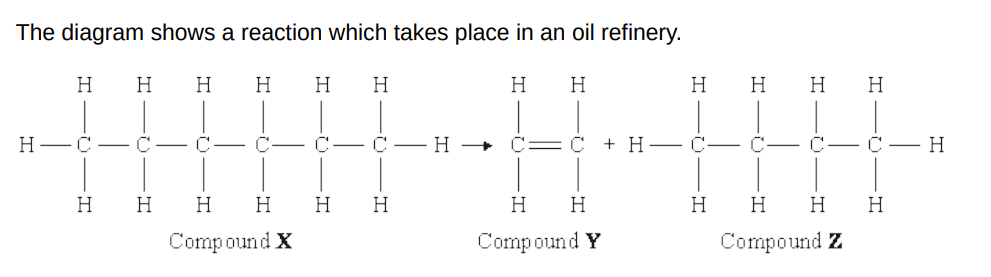
Compound X is a hydrocarbon
Compound Y is an hydrocarbon
Compound Z is a hydrocarbon
Compound X is an
Compound X is an
Compound Z is an
Compound X is
Compound X is
Compound Z is an
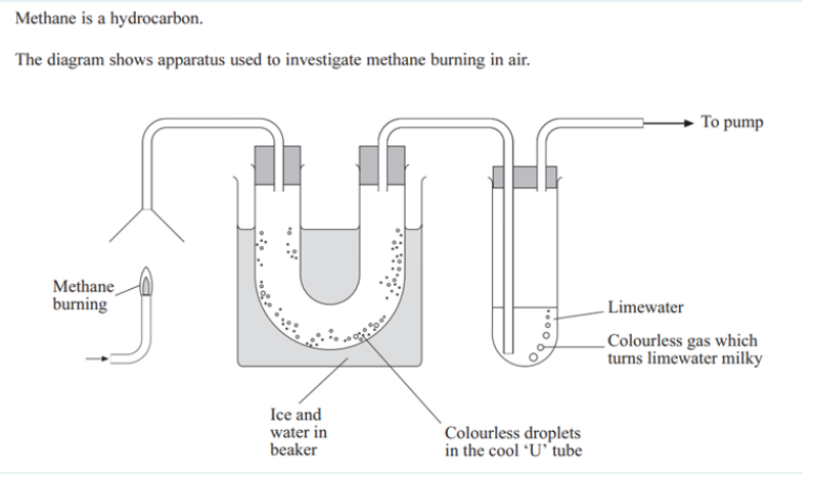
Combustion of methane
combustion will cause soot to form on the inverted funnel.
The ice water in the beaker is to make the condense.
The lime water will turn milky because is a product of complete combustion of a hydrocarbon.
The delivery tube should be removed from the limewater before the heating stops to prevent .
The presence of water could be confirmed using anhydrous copper sulfate that would turn from to
CO2