Log in
Sign up for FREE
arrow_back
Library

Quiz Modules 25-27 & 33

star
star
star
star
star
Last updated 3 months ago
15 questions
Required
2
Required
2
Required
2
Required
2
Required
2
Required
2
Required
2
Required
2
Required
2
Required
2
Required
2
Required
2
Required
2
Required
2
Required
2
Question 1
1.

Question 2
2.

Question 3
3.

Question 4
4.

Question 5
5.

Question 6
6.

Question 7
7.

Question 8
8.

Question 9
9.

Question 10
10.

Question 11
11.

Question 12
12.

Question 13
13.

Question 14
14.

Question 15
15.

The Green Revolution
Discouraged the mechanization of agriculture.
Pertained to leafy green plants only
Decreased the energy subsidy of most food.
Encouraged the use of mono cropping
Plowing and tilling allow nutrients from which horizon to rise to the surface?
C
None of the above
O
B
Which of the following is known as reverse succession?
fertilization
pesticide use
the use of GMOs
slash-and-burn agriculture
Which of the following is an environmental impact caused by synthetic, inorganic nitrogen fertilizer?
Production release on fossil fuel energy.
It reduces global concentrations of carbon dioxide
It contains small concentrations of nutrients
It is difficult for plants to absorb the nutrients contained within
How do some insect pests become resistant to pesticide?
they become resistant through the process of artificial selection
The insects want to become resistant to the pesticide.
exposure to the pesticide makes individual pests resistant to it.
The pesticide being used is not strong enough.
Pest Control is most commonly achieved by the application of pesticides, especially in developed countries. Pesticides reduce pests but have some adverse consequences. Repeated pesticide use over generations of pests can lead to resistance in pests.

Which pest control method is least likely to result in pest resistance?
integrated pest management
persistent pesticide pest management
Fungicide pest management
Rodenticide pest management
Large amounts of water have been withdrawn from the Oglala aquifer in the Great plans. The slow rate of recharge in the aquifer is not keeping pace with the fast rate of water withdrawals from the aquifer.

when deep wells within aquifers like the Oglala are heavily pumped, one result that can occur is that.
The water table rises.
Groundwater recharge increases.
nearby shallow wells go dry.
New springs form
Sustainable farming methods include a variety of farming methods that can be used to improve agricultural yields and retain soil and nutrients.

The sustainable farming practices of intercropping with trees and vegetables to provide windbreaks is called.
no-till agriculture
agroforestry
integrated pest mangement
contour plowing
Avoiding pesticides and synthetic fertilizers allows farmers to have less of an impact on the environment when ______ farming is practiced
monocropping
industrial
no till
organic
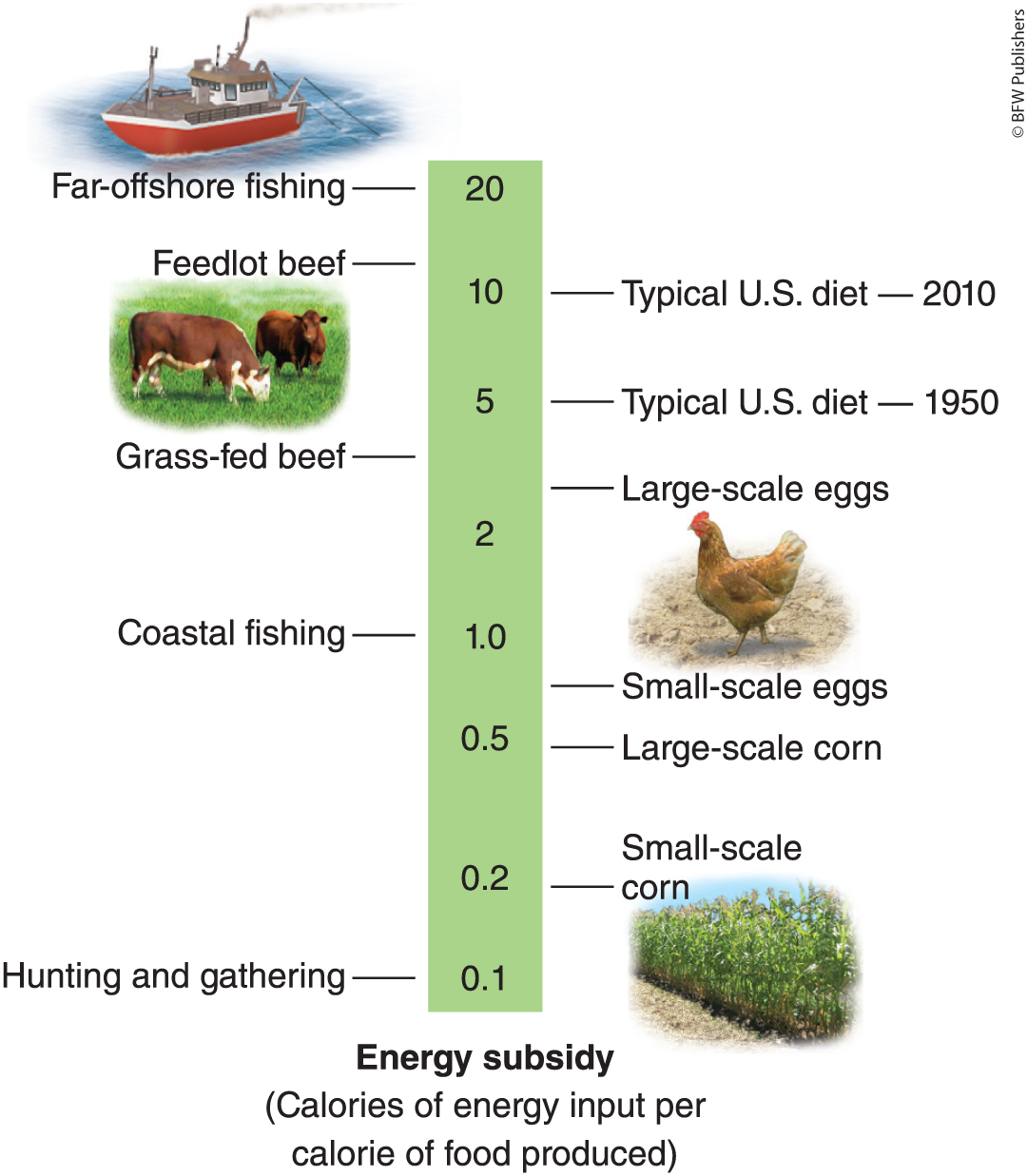
The fossil fuel energy and human energy input per calorie of food produced —beyond that which is provided by the sun—is called an energy subsidy.  For example, if it takes 20 kg (44 pounds) of grain to feed cattle to produce 1 kg (2.2 pounds) of beef, the energy subsidy is 20.
Use the energy subsidies for various methods of food production and diets shown in the figure below to determine how many times greater the energy input to provide food from far-offshore fishing is than providing food from coastal fishing .
The energy subsidy to produce food from far-offshore fishing is ten times the energy subsidy to produce food from coastal fishing.
The energy subsidy to produce food from far-offshore fishing is twenty times the energy subsidy to produce food from coastal fishing.
The energy subsidy to produce food from far-offshore fishing is 1/10th the energy subsidy to produce food from coastal fishing.
The energy subsidy to produce food from far-offshore fishing is 1/20th the energy subsidy to produce food from coastal fishing.
Salinization salts can reach toxic concentrations and impede plant growth.

Salinization occurs
when salts in lake water become highly concentrated on the land surfaces through plant photosynthesis.
when a substance, either natural or synthetic, is applied to soils and kills organisms.
when salts in irrigation water become highly concentrated on the soil surface through evaporation.
when soil remains under water for prolonged periods.
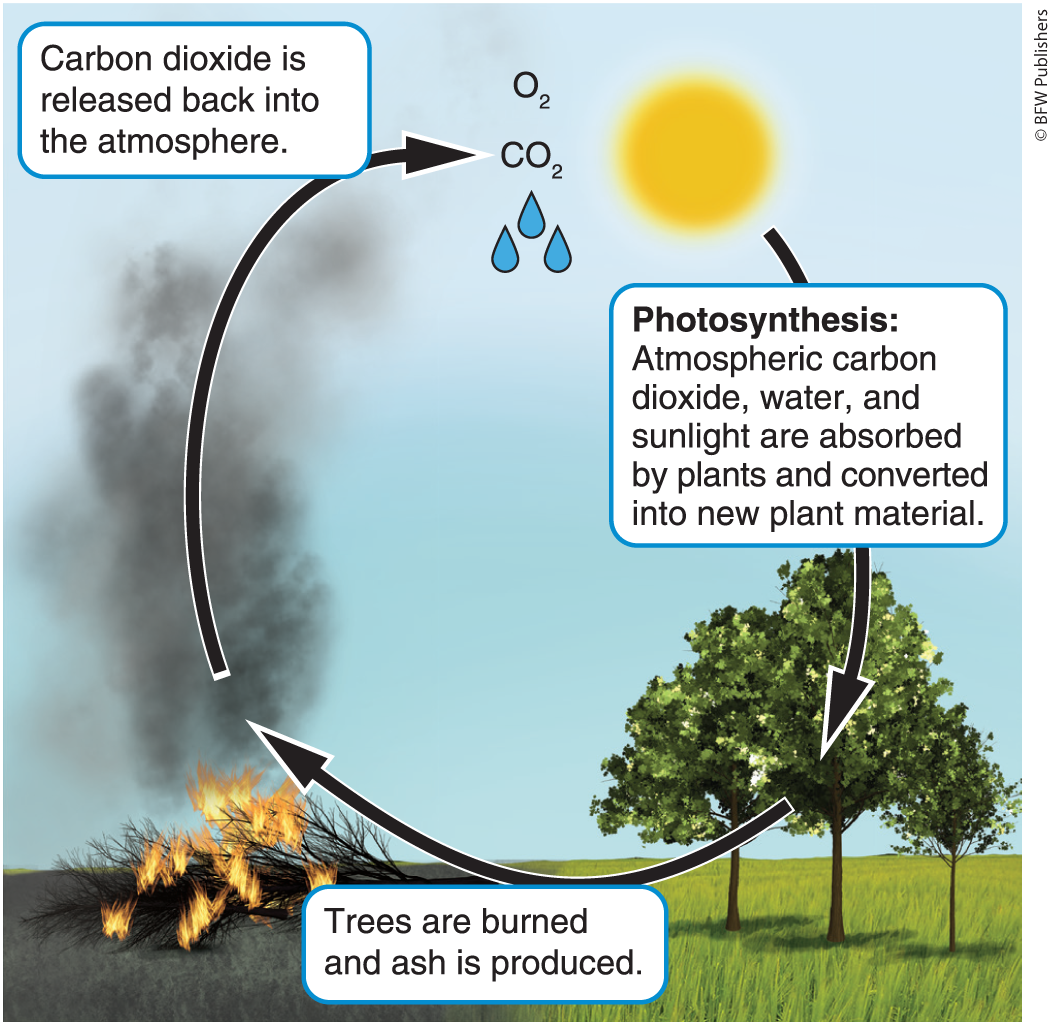
When forests are destroyed by burning, all carbon contained within trees is released to the atmosphere. Subsequently, carbon in the atmosphere is not removed by trees because the trees are no longer there, as shown in the diagram below.

Normally, carbon dioxide taken in from the atmosphere during photosynthesis [shown in the diagram] is released in equal amounts by
land clearing releasing carbon dioxide into the atmosphere.
respiration releasing carbon dioxide into the atmosphere.
photosynthesis releasing carbon dioxide into the atmosphere.
combustion releasing carbon dioxide into the atmosphere.
Ultimately, slash-and-burn agriculture leads to a net loss of nutrients due to
leaching from rainfall in tropical areas.
salinization from fertilizers.
reduction of soil horizons.
drought evaporating essential nutrients.
Which statement best describes the results of repeated pesticide use over generations of pests?
Certain individual in pest populations evolve resistance to pesticides, which become less effective overtime so new pesticide must be developed
Use gray water for watering the landscape
Design a program tourists can take part into patrol the beaches at night to look for nesting turtles, help move the eggs to a protected area, help release hatchlings back into the sea and educate tourists about sea turtles.
Testing of the toxicity of pesticides to humans cannot keep pace with the discovery and production of new pesticides
Which irrigation method is most efficient?
drip irrigation
furrow irrigation
spray irrigation
flood irrigation