Crude oil is the name for the raw, thick, black oil mined directly from the Earth’s surface. Crude oil is refined into gasoline and other useful hydrocarbon compounds, such as jet fuel or propane. This refining is carried out in three main steps, using both the chemical and physical properties of the substances present in the crude oil mixture to separate the mixture’s different parts.
The mixture is initially separated by carefully heating it through a process called distillation, which recaptures vaporized liquids through condensation after they have reached their different boiling points. Since only one liquid component of the mixture boils at a time in each part of the refinery’s distillation tower, the different liquid components of the crude oil can be separated by boiling and condensing without changing their chemical identity.
The leftover chunks of gooey solid at the bottom of the distillation tower that never boil, called bitumen, are periodically filtered out too and used as a major component in producing asphalt for roads. One gaseous byproduct of the refining process is hydrogen sulfide gas. If released directly to the atmosphere, this gas dissolves in water vapor present in the air, producing hydrosulfuric acid, which is one major source of acid rain. To prevent some of this type of pollution, the gas is reacted with oxygen to transform the H2S into H2O and S. This sulfur is then sold to fertilizer producers in the agriculture industry.
Although steps are taken to minimize the pollution produced from the refining of crude oil, no significantly effective treatments have been discovered to prevent the slower, but extremely dangerous effects of releasing more and more carbon into the atmosphere by burning the fuels derived from crude oil and other fossil fuels. The continued use of fossil fuels directly impacts the planet’s global weather patterns and thus represents a serious threat to human and nonhuman ecosystems alike.
Required
1 point
1
Question 1
1.
Which of the following parts of the process that refines crude oil is not a physical change?
Required
1 point
1
Question 2
2.
Which of the substances listed below, and described in the passage are elements?
- crude oil - gasoline
- oxygen - sulfur
- hydrogen sulfide - water
Required
1 point
1
Question 3
3.
The passage describes the bottom chamber of the distillation tower as being full of liquid crude oil mixed with solid chunks of bitumen that have sunk to the bottom. From the choices below, choose the best description for this mixture in the bottom of the chamber with the appropriate explanation for why the description is accurate.
Required
1 point
1
Question 4
4.
Tablets and cell phones emit blue light that disrupts sleep patterns when viewed before going to bed. The longest wavelength that corresponds to blue light is 495 nm. What is the frequency of that radiation?
Required
1 point
1
Question 5
5.
Which statements about emission spectra are true?
I. Two different elements can have the exact same emission spectrum.
II. Light is produced when the nucleus of an atom is energized and then releases neutrons.
III. An emission spectrum is produced when electrons rise in energy levels.
IV. The emission spectrum for an element shows discrete bands of light.
Required
1 point
1
Question 6
6.
Red waves have a higher wavelength than violet waves. Pick the answer that correctly describes the frequency and energy of red waves.
Required
1 point
1
Question 7
7.
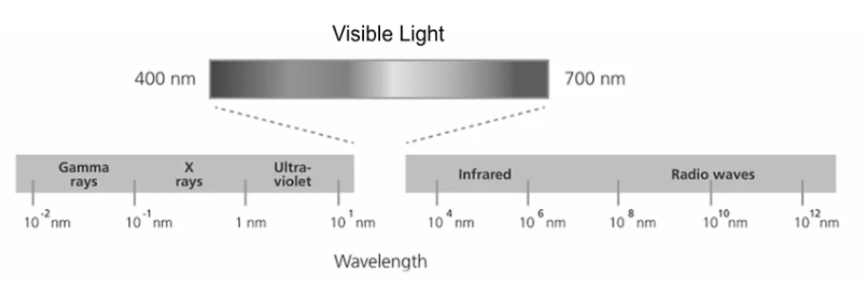
The electromagnetic spectrum includes a variety of types of waves. Two examples are Ultraviolet and X-rays. Which type of wave has the longest wavelength?
Required
1 point
1
Question 8
8.
Most of the light from a sodium vapor lamp has a wavelength of 589 nm. How many meters is that wavelength?
Required
1 point
1
Question 9
9.
At maximum, a p-orbital can hold ___ electrons, d-orbital can hold ___ electrons, and an f-orbital can hold ___ electrons.
Required
1 point
1
Question 10
10.
Which of the following represents the electron configuration for Manganese?
Required
1 point
1
Question 11
11.
Which electron configuration below is incorrect:
Required
1 point
1
Question 12
12.
The magnesium spectrum has a line at 266.8 nm. Which of these statements about this wavelength is/are correct?
i. It has a higher frequency than radiation with wavelength 402 nm
ii. It is visible to the eye
iii. It has a greater speed in a vacuum than does red light of wavelength 652 nm.
iv. Its wavelength is longer than that of x-rays.
Required
1 point
1
Question 13
13.
Using dimensional analysis, how many meters does a car moving at 95.0 km/h travel in 1.0 s?
Required
1 point
1
Question 14
14.
"The Washington Monument in Washington, D.C. contains 36,941 marble blocks and is 169 meters tall. The apex of the monument is made of 2801 grams of aluminum metal and lays on a foundation that is 1400. square meters. If you were to climb to the top, you would have to traverse a total of 893 stairs!" How many significant figures are in the underlined numbered?
Required
1 point
1
Question 15
15.
The largest cut diamond in the world is the Golden Jubilee Diamond with a mass of 1.091x10⁵ mg. How many kilograms is this?
Required
1 point
1
Question 16
16.
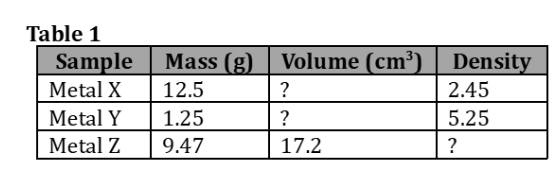
Given the information in the table above, determine the density for Metal Z.
Required
1 point
1
Question 17
17.
Given the information in the table above, determine the volume for Metal Y.
Required
1 point
1
Question 18
18.
Cobalt (III) chloride is a compound used in the making of nanoalloys. What is the formula for this compound?
Required
1 point
1
Question 19
19.
Which theories about the nature of an atom did Rutherford’s gold foil experiment help prove?
I. The nucleus is miniscule in comparison to the rest of the atom.
II. The nucleus is positively charged.
III. Most of the atom is empty space.
IV. The electrons are primarily located in the nucleus.
Required
1 point
1
Question 20
20.
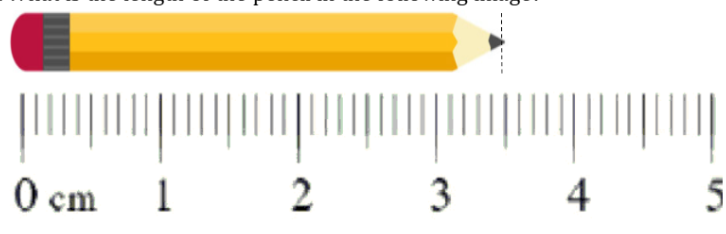
What is the length of the pencil in the following image?
Required
1 point
1
Question 21
21.
The proper name for Ca3N2 is:
Required
1 point
1
Question 22
22.
Which of the following properties is most likely to distinguish ionic compounds from covalent compounds?
Required
1 point
1
Question 23
23.
Silver has two isotopes, silver-107 and silver-109. Silver's atomic number is 47 and its atomic mass is 107.868 amu. What statement about the silver isotopes is true?
Required
1 point
1
Question 24
24.
What is the correct formula for ammonium phosphate?
Required
1 point
1
Question 25
25.
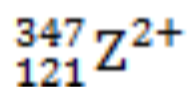
The isotope of element Z was just discovered and was given the following isotopic notation:
How many protons, neutrons, and electrons does this isotope of element Z contain?
Required
1 point
1
Question 26
26.
The element rubidium (85.47 amu) has two naturally occurring isotopes, rubidium-85 and rubidium-87. Determine the percent abundance of the lightest isotope if their relative atomic masses are 84.91 amu and 86.91 amu.
Required
1 point
1
Question 27
27.
It has been determined that the color blue has a higher frequency than the color red, which statement is true comparing the wavelengths and energies?
Required
1 point
1
Question 28
28.
Prolonged exposure to ultraviolet light in tanning booths significantly increases the risk of skin cancer. What is the energy of a photon of UV light with a wavelength of 3.00 x 10⁻⁷ m?
Required
1 point
1
Question 29
29.
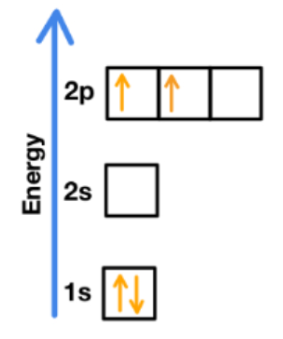
Which of the following most accurately describes the issue with the orbital diagram below:
I. Electrons must have opposite spin to occupy the same suborbital
II. Electrons fill from orbitals of lowest energy first
III. Orbitals need to be filled with one electron first in each suborbital before being paired up
Required
1 point
1
Question 30
30.
What is the name of the following compound: NBr?
Required
1 point
1
Question 31
31.
What is the formula dinitrogen pentoxide?
Required
1 point
1
Question 32
32.
You are given a compound with the formula MCl2, in which M is a metal. You are told that the metal ion has 18 electrons. What is the identity of the metal?
Required
1 point
1
Question 33
33.
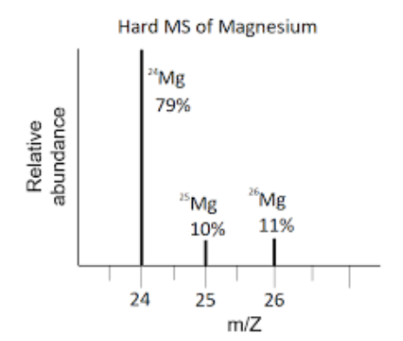
Based on the mass spectrometry data below, what number would you expect Mg to have an average atomic mass closest to?
Required
1 point
1
Question 34
34.
Based on the mass spectrometry data below, calculate the average atomic mass of Mg given the data below.
Required
1 point
1
Question 35
35.
Arrange these elements in order of increasing ionization energy (smallest to greatest).
Cl, As, Rb, Fe
Required
1 point
1
Question 36
36.
Which element has the largest atomic radius?
Required
1 point
1
Question 37
37.
What is the name of the following: PBr5
Required
1 point
1
Question 38
38.
The overall charge of any nucleus should always be ______________.
Required
1 point
1
Question 39
39.
Phosphorus has how many electrons in its outermost energy level (how many valence electrons does it have)?
Required
1 point
1
Question 40
40.
Which of the following is a metalloid with electrons in the 4th energy level and whose electron configuration ends in p2?
Required
1 point
1
Question 41
41.
Which element has the greatest electronegativity?
Required
1 point
1
Question 42
42.
Metals ______________ electrons to form _________ions.
Required
1 point
1
Question 43
43.
What do the elements fluorine, chlorine, and bromine have in common?
Required
1 point
1
Question 44
44.
An atom with the atomic number 56 can form a/an ______________ with a charge of ______________.
Required
1 point
1
Question 45
45.
How many total electrons are in the ion that Aluminum forms?
Required
1 point
1
Question 46
46.
Which of the following is the expected configuration for the ion that Selenium forms, Se2-?
Required
1 point
1
Question 47
47.
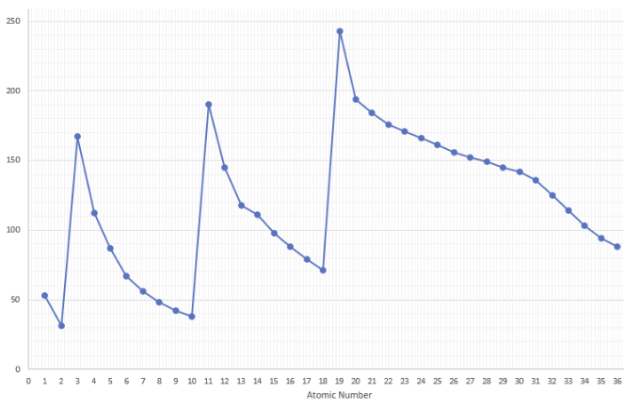
What periodic table trend is demonstrated by the graph above?
Required
1 point
1
Question 48
48.
What can explain the sharp increase in values that are seen on the graph (e.g. atomic #2 → atomic #3, atomic #10 → atomic #11, etc.)?
Required
1 point
1
Question 49
49.
What is the name for Ni3PO4?
Required
1 point
1
Question 50
50.
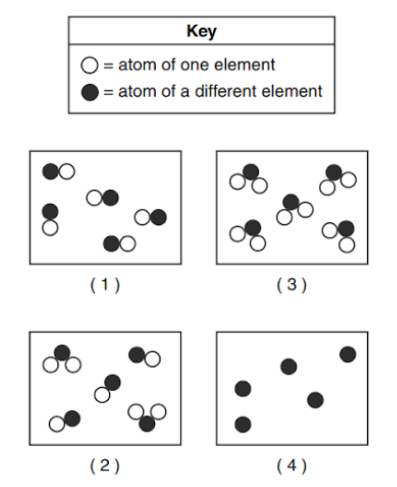
Which particle diagram represents a sample of matter that can not be broken down by chemical means?
Required
1 point
1
Question 51
51.
Consider the orbital diagram for the following elements. Assuming all atoms are in the ground state, which of the following contains exactly two unpaired electrons?
Required
1 point
1
Question 52
52.
The compound CCl4 is nonflammable and was once commonly used in fire extinguishers. On the basis of the periodic properties, which of the following compounds can most likely be used as a fire-resistance chemical?
Required
1 point
1
Question 53
53.
Which of the following correctly identifies which has a higher first- ionization energy, Cl or Ar, and supplies the best justification?
Required
1 point
1
Question 54
54.
Which of the following represents a pair of isotopes?
Required
1 point
1
Question 55
55.
Which of the following ions has the same number of electrons as Br-?