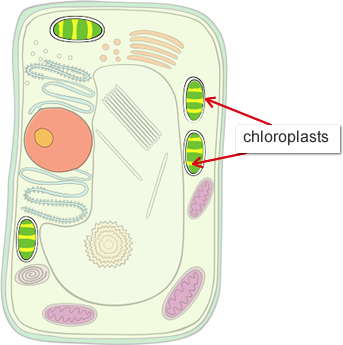
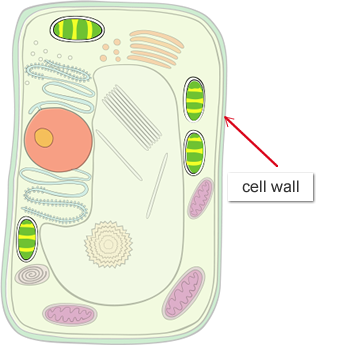
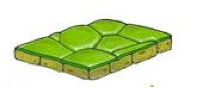
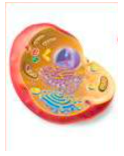
Below, you can see what plant cells look like through a microscope.
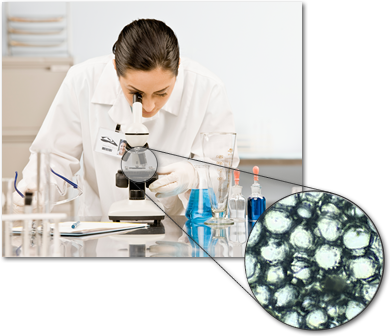
Which answer is not true about what you see?
Below, you can see what plant cells look like through a microscope.
Which answer is not true about what you see?
Below, you can see what plant cells look like through a microscope.
Which answer is not true about what you see?
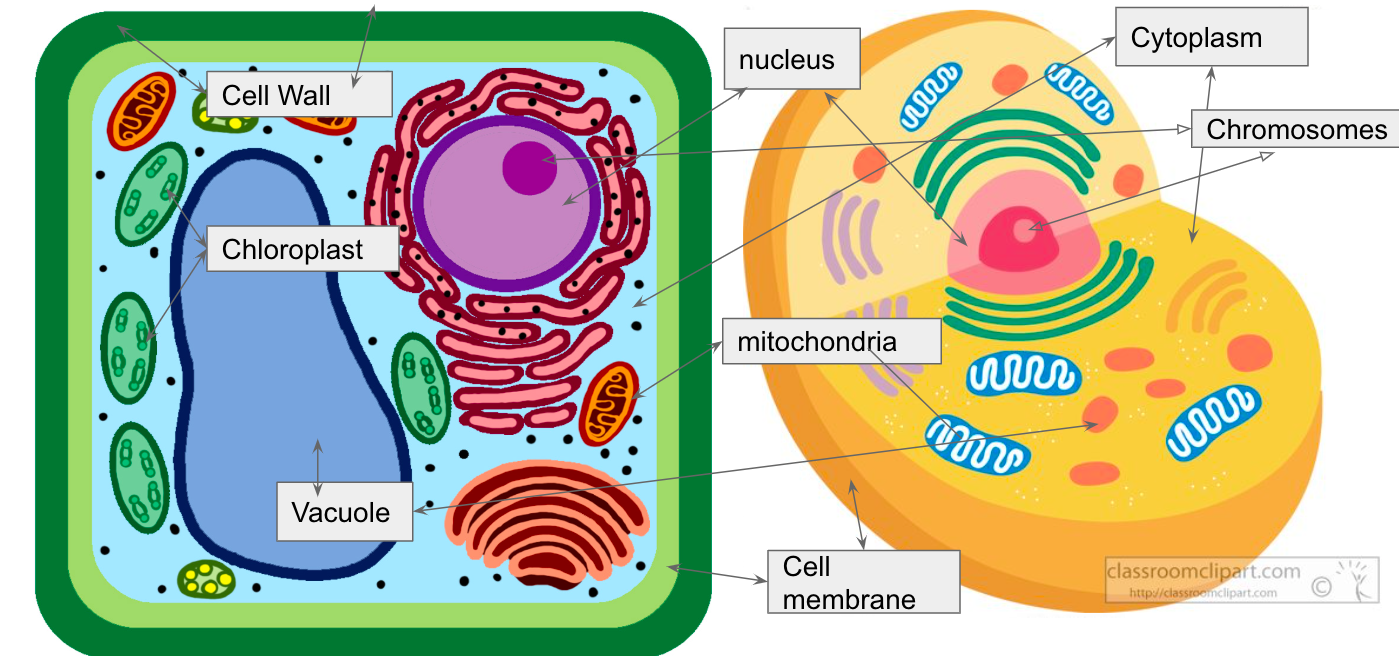
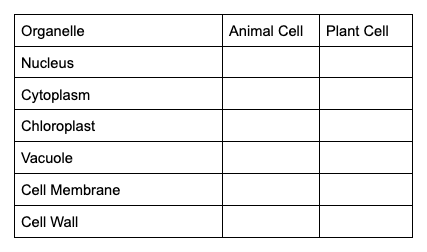
Cells have many organelles that do different jobs. The nucleus is the command center of the cell, telling the other organelles what to do. Chromosomes, which are made of DNA, are inside the nucleus. The cell membrane lets things in and out of the cell. The cytoplasm is a jelly like substance that holds all of the organelles in place. The vacuole is where the cell holds all of its food, water, and waste. It is bigger in a plant cell because the plant cannot move around to get water, so it must store water when it can. The mitochondria is the powerhouse of the cell, turning food into energy.
There are two organelles that we will learn about that are only found in a plant cell. The cell wall gives the plant cell more structure and protect. The chloroplast is a green organelle that makes food for the plant cell using photosynthesis.
Plants can't move on their own. They are stuck. They can't just walk to a stream or pond and get water whenever they want, like an animal can. This helps to explain which of the following phenomena (thing)?
What is true about cells? (Choose 2)
take in nutrients and break them down, This gives the cell .
stores water that the cell needs.
The nucleus .
The mitochondria .
The vacuole .
The cell wall .
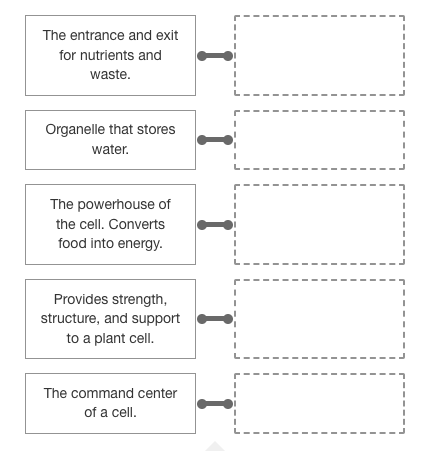
Drag the organelle definition to the correct organelle structure.
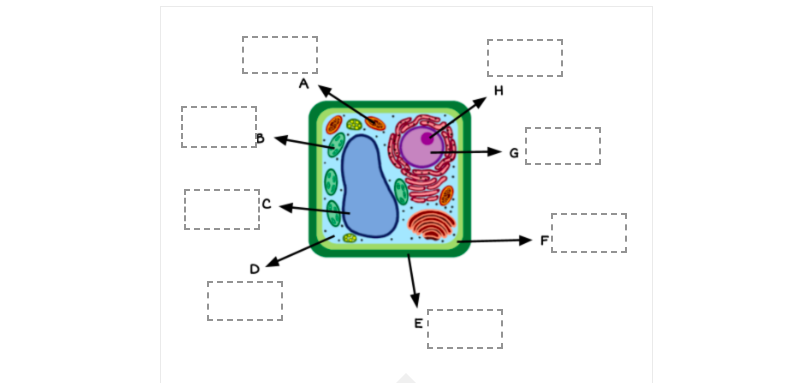
Chloroplasts are a cell part that create food for plants from the sun's energy. Chloroplasts are a cell part found only in plant cells. Just like plants are different from animals, plant cells are different than animal cells.
Each plant cell also has a cell wall, which is a rigid structure that protects a plant cell and gives the cell its shape. Plant cells are more rectangular than animal cells because of their rigid structure. Cell walls give plant cells a strong structure that allows plants to grow.
How are all plants different from animals?
Plants get their energy from the sun. However, animals cannot get their energy from the sun. What does this tell us?
Click on the parts of the plant cell that are not in an animal cell.
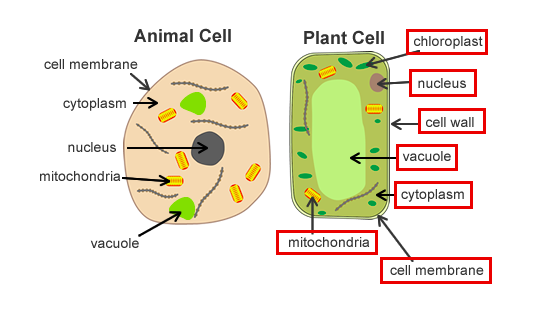
Which of the following are NOT found in animals cells?
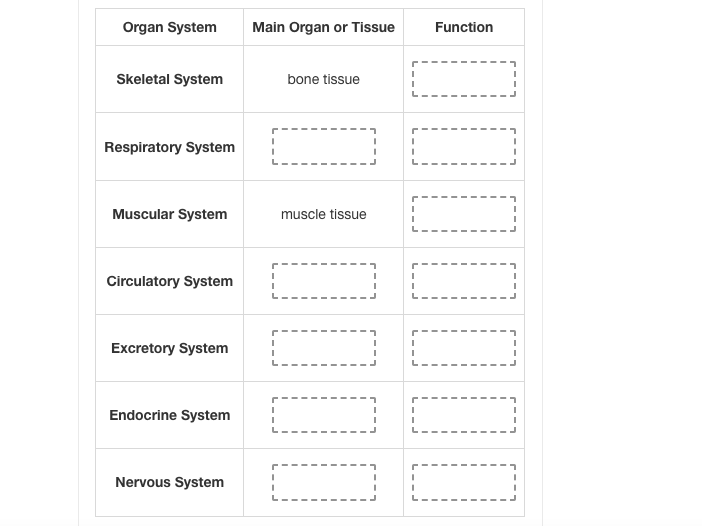
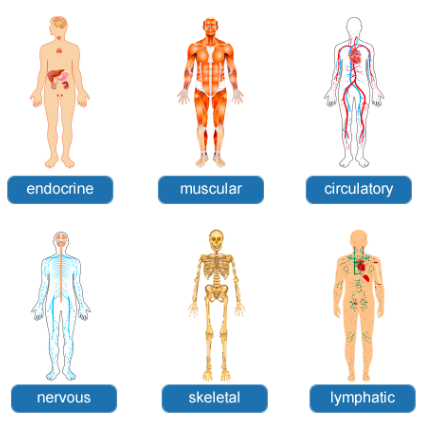
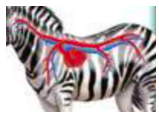
All of the activities of the human body require many organ systems to work together. In order for organ systems to work together, they must be able to communicate with each other. The nervous and endocrine systems work together to control communication in the human body. Both of these systems send signals that allow the organ systems to communicate. The nervous system largely sends electrical messages, while the endocrine system sends chemical messages.
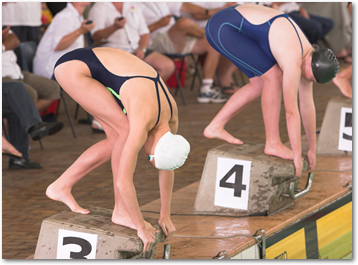
As the body prepares to compete in a swimming race, the endocrine system may release the hormone adrenaline. Adrenaline speeds up the heart rate and the breathing rate. The nervous system sends electrical messages to the muscular system. The muscular and skeletal systems then move the body.
Drag the words to correctly complete the sentences below.
The system sends chemical signals to the excretory system that makes the body sweat.
The system sends electrical messages to direct the muscles to contract and move the fingers to type.
Emily wants to watch a show on television. In order to do so, she must complete the following steps:
1. Find the remote control. 2. Push the buttons to turn the television on. 3. Choose which show she is going to watch.
Which organ system is responsible for sending the signals to the rest of her body in order for these steps to happen?
When someone competes in a swimming race, many organ systems are working together to help the body function.
Theand muscular systems work together to move the body. Thesystem pumps quickly to move blood from the lungs to the body. Thesystem works to take in more oxygen, so it can be moved to cells.
Put the levels of organization in order from most complex on the bottom.



True or False: Most tasks in the human body are completed by only one organ system.
All of the organ systems in the body are constantly working together to help the body function. Different organ systems work together to perform different tasks in the body. Moving the body may seem like a simple task, but it requires many steps in different organ systems:
1. The nervous system must send electrical signals to the muscular system. 2.The muscular system then causes the muscles to contract or relax. 3.The muscles pull on the bones. 4. When the bones in the skeletal system are pulled, they move the body.
Eating and digesting food is another job the body does that involves several different organ systems: 1. The nervous system sends a signal to the other systems.
2. The muscular system moves the food to the mouth. 3. The digestive system breaks down the food into nutrients. 4. The circulatory system moves the nutrients to cells. 5. The digestive and excretory systems remove wastes from the body.
Your body breathes over 20,000 times a day! This requires communication between different organ systems: 1. The nervous system signals the respiratory system. 2. The respiratory system takes in oxygen from the environment using the lungs. 3. The circulatory system moves oxygen into the cells and carbon dioxide out of the cells in the blood. 4. The respiratory system uses the lungs to exhale carbon dioxide from the body.
Which organ systems must communicate in the human body to coordinate eating food and turning food into energy. (choose 2)
How does the body breathe?
Thesystem takes in oxygen through the lungs. 2. Thesystem moves the blood carrying oxygen to the cells. 3. Thesystem moves the blood carrying carbon dioxide out of the cells. 4. Thesystem releases carbon dioxide out of the body through the lungs.
Movement in the human body seems very simple, but actually it uses multiple organ systems. First, thesystem sends electrical signals. Then, thesystem causes the muscles to contract and relax, and the muscles pull on the bones. Lastly, the bones in thesystem move the body.
Which two systems send messages through your body? (one is electrical and one is chemical)
Correct the underlined word in the following statement: Organ systems work together to make the body function.
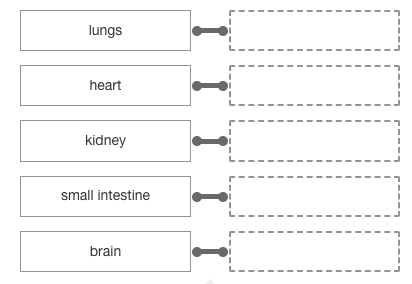
Drag the organ system to each main organ.
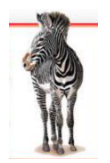
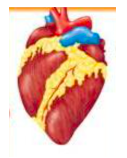
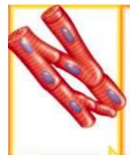
Drag the correct levels of a country to the level of organization is represents.
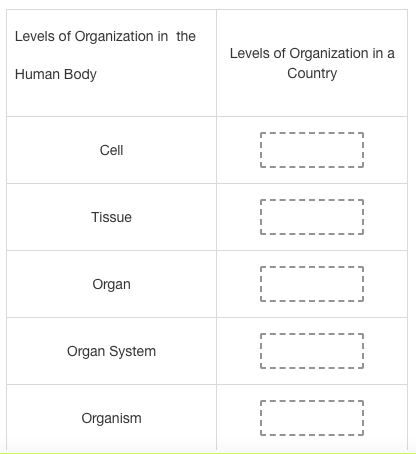
Put the levels of organization in order from most complex on the bottom least complex on the top.
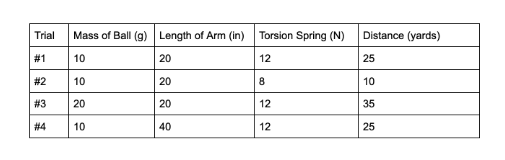
The relationship between the mass of the ball and the distance can be stated as such: As the ball mass the distance .
The relationship between the length of the arm and the distance can be stated as such: As the length of the arm the distance .
The relationship between the torsion spring and the distance can be stated as such: As the torsion spring the distance.
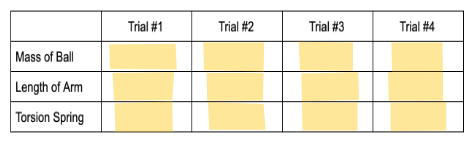
Using the data table from the last question, fill in the chart.
To correctly determine the effect of each independent variable, you have to compare data between 2 trials where ONLY one independent variable changed and the others stayed the same. Choose the two trials that provide evidence of how each independent variable effects the distance. (check 6, 2 from each row)