Advanced Algebra - Unit 1

Last updated 9 months ago
24 questions

Unit 1 - Item 1

Researchers at a local university claimed that “Teenagers who watch at least 10 TikTok prank videos a day are more likely to perform pranks on their friends”. The university randomly selected 1000 teenagers in the United States for a survey.
1

Part A
What would be an unbiased, statistical question that the researchers could ask to answer the claim?

1

Part B
Describe a completely randomized design to represent this scenario.

1

Part C
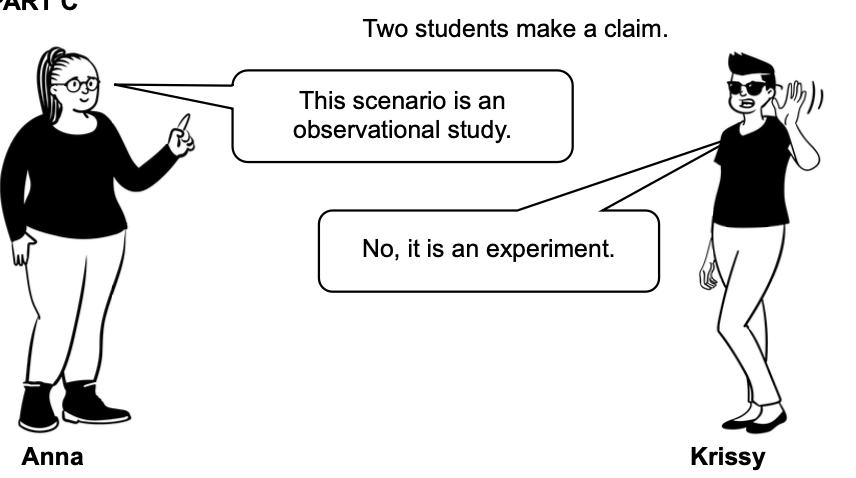
Two students make a claim.


Who is correct and why?

Unit 1 - Item 2

The mayor of Athens, Georgia is interested in finding out the average age of people in the city. Athens is well known for being a college town. He stands in front of one of the local restaurants, located near the campus of the University of Georgia, and asks the age of every person that walks into the restaurant between the hours of 8:00 pm and 11:30 pm. He uses the data from the sample to estimate the average age of all the people in the city.
1

Part A
What is wrong with this survey?

1

Part B
Do you think the mayor will overestimate or underestimate the true mean age of people in Athens? Why?

1

Part C
Determine any confounding variables that would influence the data.

Unit 1 – Item 3

The president of the United States is trying to help the government decide how to distribute funds and assistance to states and localities.
1

PART A
What would you consider to be the best collection method to obtain an accurate public opinion?
Explain why.

1

PART B
Would this scenario be representative of a population distribution or a sample distribution?
Explain why.

Unit 1 – Item 4

Ava and Emma are twin sisters. Ava is planning to take the SAT and Emma is planning to take the ACT. Scores on the SAT are normally distributed with a mean of 1500 and a standard deviation of 300 and scores on the ACT are normally distributed with a mean of 21 and a standard deviation of 5.
1

PART A
If Ava made a 1350 on the SAT, what is her z-score?

If Emma made a 19 on the ACT, what is her z-score?

1

PART B
Who did better, relative to others who took the SAT and ACT?

Unit 1 - Item 5

Suppose the heights of a population are normally distributed with a mean (µ) of 170 cm and a standard deviation (σ) of 10 cm.
1

PART A
Explain how you would use the Empirical Rule to estimate the percentage of data within certain ranges of standard deviations from the mean.

1

PART B
Discuss the role of z-scores in making these estimations.

1

PART C
Describe how technology, such as statistical software or calculators, can be used to facilitate these calculations.

Unit 1 – Item 6

Suppose you are a high school teacher, and you're interested in understanding the distribution of scores on a standardized math test administered to all the students in the school. The scores follow a normal distribution.
1

Part A
You collect the test scores and notice that approximately 68% of the students scored between
70 and 85. Apply the Empirical Rule to estimate the percentage of students who scored:

a) Below 70
b) Above 85

1

Part B
You decide to use z-scores to better understand individual student performance. If a student scored 78 on the math test and the mean score is 75 with a standard deviation of 5, calculate the z-score for this student's score. Use technology, such as a calculator or statistical software, to perform this calculation.

1

Part C
Combining the information from the Empirical Rule and z-scores, estimate the percentage of
students who scored:

a) Below one standard deviation above the mean.

b) Between one and two standard deviations above the mean.

c) Two standard deviations below the mean.

Unit 1 -- Item 7

1

PART A
What is sampling variability in a statistic, and how can we explore it through a simple
simulation?

1

PART B
Choose a statistic (e.g., mean or proportion), create a simulated scenario where you draw
multiple samples from a population, and explain how the values of the statistic vary across these samples.

Unit 1 – Item 8

You are tasked with analyzing the performance of two different models (Model A and Model B) designed to predict student test scores in a high school. To assess the reliability of these models, you decide to construct 95% confidence intervals for the mean predicted test scores.

The mean predicted test score for Model A is 75 with a margin of error of ±3, while the mean predicted test score for Model B is 78 with a margin of error of ±2.
1

PART A
Calculate the confidence intervals for both Model A and Model B.

1

PART B
Compare the widths of the confidence intervals and discuss what this indicates about the
precision of the predictions.

1

PART C
Considering the overlap or lack thereof in the confidence intervals, make conclusions about the reliability of the two models in predicting student test scores.

(Note: Assume a normal distribution of the predicted test scores and explain any assumptions you make in your calculations.)

Unit 1 – Item 9

Researchers in the United States performed an experiment with high school students to examine the effects of multitasking on student learning. The 50 participants in the study were asked to attend a lecture and take notes with their laptops. Half of the participants were randomly assigned to complete other online tasks not related to the lecture during that time.

These tasks were meant to imitate typical student Web browsing during classes. The remaining students simply took notes with their laptops. At the end of the lecture, all participants took a comprehension test to measure how much they learned from it. The results: students who were assigned to multitask did significantly worse (12%) than students who were not assigned to multitask.
1

Part A
Describe how the researchers could have carried out the random assignment.

1

Park B
Why was it important that the researchers randomly assigned treatments to the students?

1

Part C
Identify one variable that the researchers kept the same for all subjects. Provide two reasons
why it was important for the researchers to keep this variable the same.