Twa kɔ nsɛm atitiriw so
Log in
Sign up for FREE
arrow_back
Laabri

Algebra: Unit 6

star
star
star
star
star
Last updated about 1 year ago
16 Nsɛmmisa
1
Asemmisa {{asɛmmisaAhyɛnsode}}
14.

Unit 6 - Item 6

Given the following function of 𝑓(𝑥) = −32 + 𝑘, what will happen to the graph if you substitute

negatives versus positives for “𝑘”? Explain.

A.FGR.9.1
1
Asemmisa {{asɛmmisaAhyɛnsode}}
1.

Unit 6 - Item 1

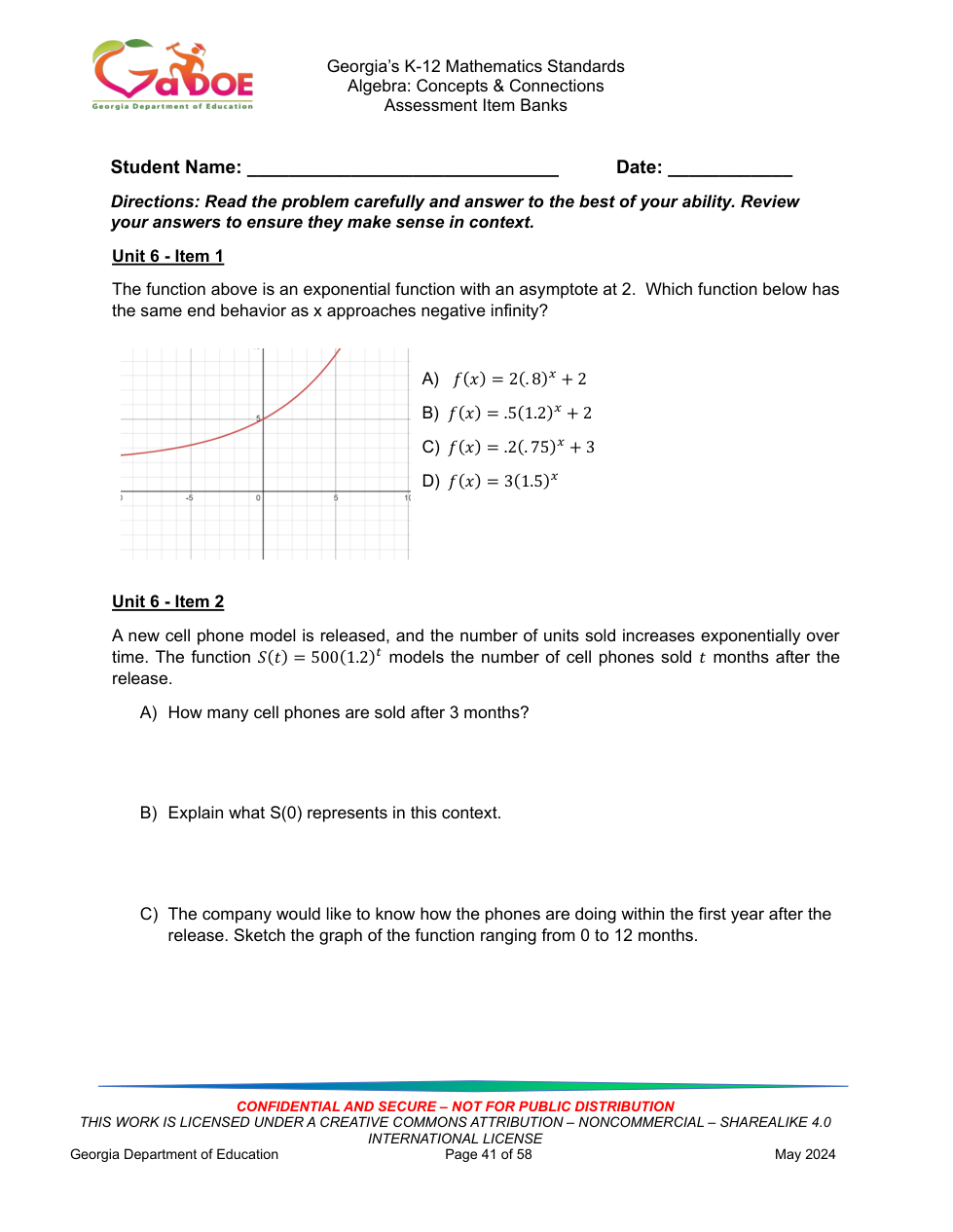
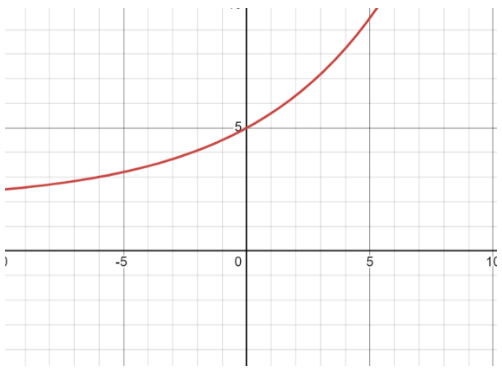
The function above is an exponential function with an asymptote at 2. Which function below has the same end behavior as x approaches negative infinity?
A.FGR.9.1
1
A.FGR.9.1
Unit 6 - Item 2

A new cell phone model is released, and the number of units sold increases exponentially over time. The function S(t) = 500(1.2)^t models the number of cell phones sold t months after the release.

1
Asemmisa {{asɛmmisaAhyɛnsode}}
3.

How many cell phones are sold after 3 months?

A.FGR.9.1
1
Asemmisa {{asɛmmisaAhyɛnsode}}
4.

Explain what S(0) represents in this context.

A.FGR.9.1
1
Asemmisa {{asɛmmisaAhyɛnsode}}
5.

The company would like to know how the phones are doing within the first year after the release. Sketch the graph of the function ranging from 0 to 12 months.

What is the domain and range of the function based on the first year after the release? (Round to the nearest whole number)

A.FGR.9.1

Unit 6 - Item 3

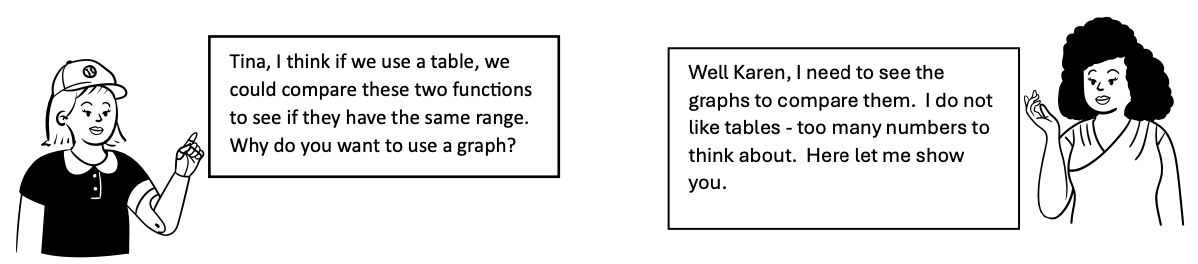
Tina and Karen were doing their homework together. They are trying to compare the ranges of 𝑓(𝑥) = 1 − 2𝑥 𝑎𝑛𝑑 𝑔(𝑥) = 2𝑥 − 1.

1
Asemmisa {{asɛmmisaAhyɛnsode}}
6.

Complete the table below.

A.FGR.9.1
1
Asemmisa {{asɛmmisaAhyɛnsode}}
7.

Sketch a graph of both functions

A.FGR.9.1
1
Asemmisa {{asɛmmisaAhyɛnsode}}
8.

Compare the ranges of both functions

A.FGR.9.1

Unit 6 - Item 4

1
Asemmisa {{asɛmmisaAhyɛnsode}}
9.

Who is correct? Explain

A.FGR.9.1
1
Asemmisa {{asɛmmisaAhyɛnsode}}
10.

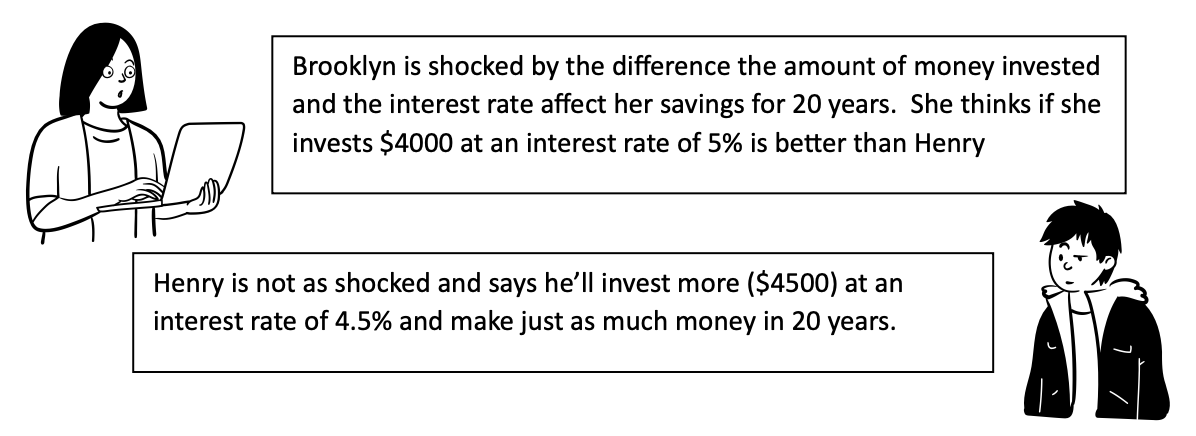
Research 5 banking institutions to see what the annual interest rate is today for a savings account. Simulate $4000 and $4500 at each institution for 20 years to see which institution would be the best to invest your money

A.FGR.9.1

Unit 6 - Item 5

Imagine a small company that sells an innovative product online. The company tracks the number of units sold each month and uses this data to forecast future sales. The initial sales data shows an exponential growth pattern. The company uses the function 𝑆(𝑡) = 2𝑡 to model the number of units sold 𝑡 months after the product launch.

1
Asemmisa {{asɛmmisaAhyɛnsode}}
11.

Sketch the initial model: 𝑆(𝑡) = 2^𝑡.

A.FGR.9.1
1
Asemmisa {{asɛmmisaAhyɛnsode}}
12.

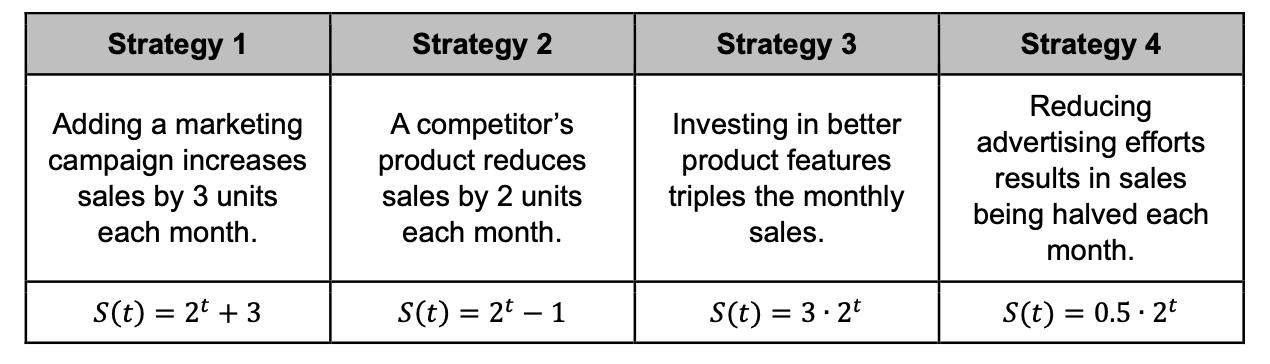
The company wants to analyze how different marketing strategies could affect their sales.

How is the initial model 𝑆(𝑡) = 2𝑡 affected by each of the strategies. Be sure to describe what happens to the graph.

A.FGR.9.1
1
Asemmisa {{asɛmmisaAhyɛnsode}}
13.

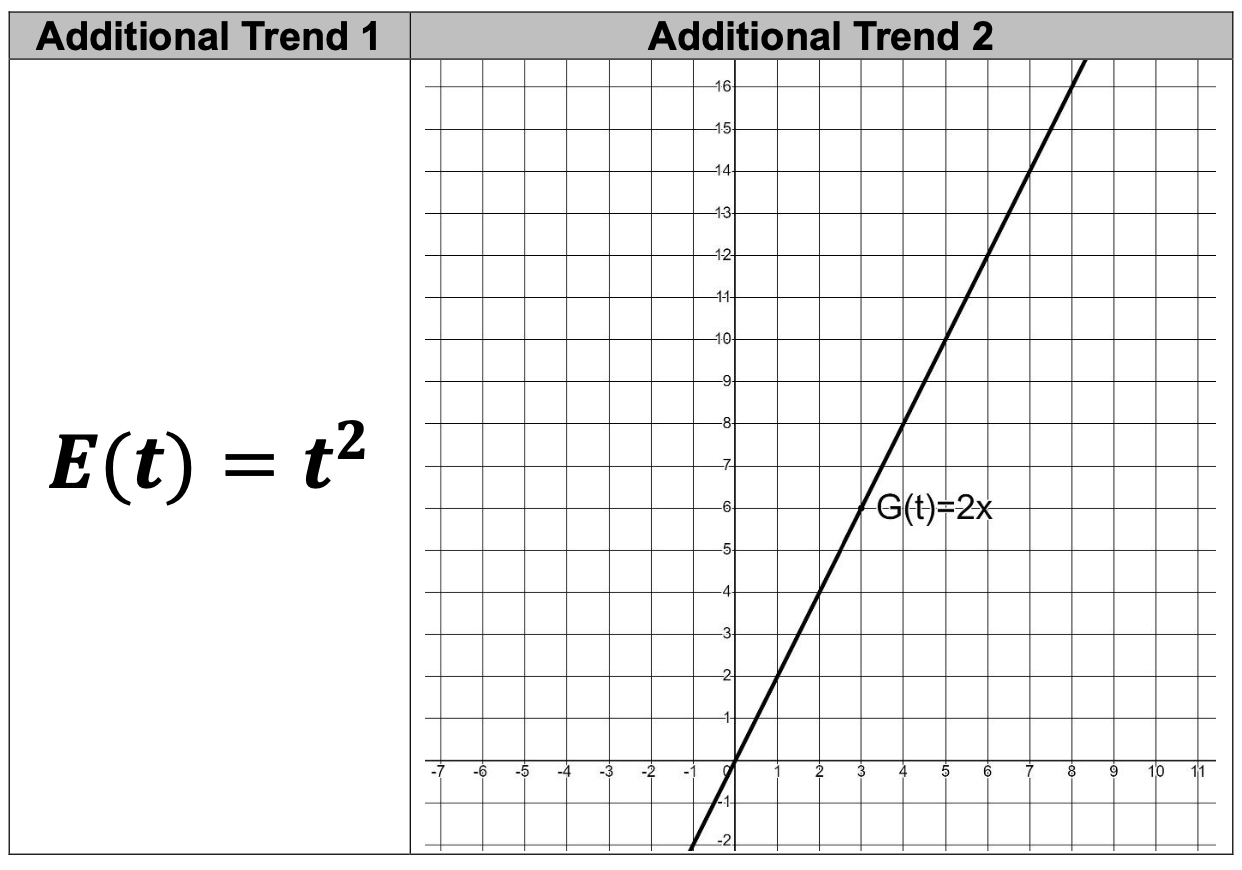
To understand the broader market trends, the company also compares their sales growth with two other trends below. Compare the initial value, type of function, general shapes of the graphs, and determine which of the additional trends produces more units.

A.FGR.9.1

Unit 6 - Item 7

A population of bacteria in a petri dish is modeled by the exponential function below where 𝑡 is time in hours: 𝑷(𝒕) = 𝟓𝟎𝟎(𝟏. 𝟐𝟎)𝒕

1
Asemmisa {{asɛmmisaAhyɛnsode}}
15.

What is the population of the bacteria initially when the bacteria is placed in the petri dish?

Explain.

A.FGR.9.1
1
Asemmisa {{asɛmmisaAhyɛnsode}}
16.

Is the bacteria increasing over time or decreasing over time. Explain.

A.FGR.9.1
Asemmisa {{asɛmmisaAhyɛnsode}}
2.

Unit 6 - Item 2

A new cell phone model is released, and the number of units sold increases exponentially over time. The function S(t) = 500(1.2)^t models the number of cell phones sold t months after the release.