Serenity went to the store to buy a new pair of shoes. After using her $1.10 discount, she paid $15.90 for the shoes.
How much was the original price of Serenityβs new shoes? Write and solve a single-step
equation using the variable d to represent the original price of Serenityβs new shoes
1 point
1
Question 3
3.
Unit 5 β Item 3
Saraβs dad sent Sara to the store to get 3 identical erasers. Sara told her dad that she would need no more than $1.80 to buy the 3 erasers. Which one of these inequalities would best represent how much each eraser might cost?
A.
B.
C.
D.
1 point
1
Question 4
4.
Unit 5 β Item 4
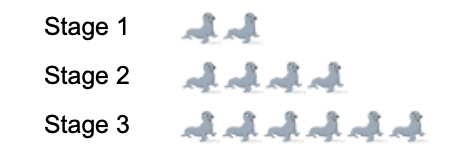
The number of seals increases at the same rate for each stage below.
What stage will have 22 seals. Explain your reasoning.
1 point
1
Question 5
5.
Unit 5 β Item 5
Complete the chart below.
1 point
1
Question 6
6.
Unit 5 β Item 6
Esther buys four bags of Star brand dog food that weigh a total of 10 pounds. How much does one bag of Star brand dog food weigh?
Unit 5 β Item 7
A cereal manufacturer needs to design a cereal box that has a volume of 156 cubic inches and a height that is no more than 13 inches. The designers know that the volume of a rectangular prism can be calculated by multiplying the area of its base and its height.
1 point
1
Question 7
7.
PART A
Write an equation that shows how the area of the base, A, would be affected by changes in the height, h, for different rectangular prisms with volume 156 in^3.
1 point
1
Question 8
8.
PART B
What is the area of the base of the cereal box that has a height of 13?
1 point
1
Question 9
9.
Unit 5 β Item 8
You are planning a road trip and need to calculate how many miles you can travel with a certain amount of gas. Your car's average mileage is 25.4 miles per gallon. If you have 11 gallons of gas, how far can you travel?
1 point
1
Question 10
10.
Unit 5 β Item 9
Planning a Road Trip
You are planning a road trip with friends and need to calculate how far you can travel with spending the least amount in gas. Your car's average mileage is 25.4 miles per gallon. You have 11 gallons of gas.
Vehicle decisions:
Explore the fuel efficiency of 3 vehicles you can rent for the trip.
Consider how you can pay the least for the best vehicle for the trip.
2. Calculation and Analysis:
Explore gas prices in your region. How much would you pay for a full tank of gas
for the selected car? How do you know?
How far could you travel on the full tank?
3. Scenario Planning:
Identify three potential destinations within the calculated range. Provide the distance to each destination.
Consider and discuss factors that could affect your fuel efficiency, such as terrain, driving speed, and weather conditions. How might these factors impact your trip? Adjust your calculations accordingly.
4. Optimization and Decision Making:
Develop a travel plan that maximizes your enjoyment and minimizes costs, including fuel consumption. Include considerations for refueling stops, potential sightseeing spots, and overnight stays.
Justify your choice of destination and travel plan based on the calculations and factors discussed.
5. Reflection and Justification:
Reflect on how unexpected changes (e.g., road closures, detours) could affect your plan. How would you adjust your travel plan in response to such changes?
Write a brief justification of your final travel plan, explaining how you balanced fuel efficiency, destination preferences, and potential challenges.