Unit 2 – Item 1
1
DOK 3
AA.DSR.2.3
+2
1
DOK 3
AA.DSR.2.3
+2
1
DOK 3
AA.DSR.2.3
+2
1
DOK 3
AA.DSR.2.3
+2
1
DOK 3
AA.DSR.2.3
+2
Unit 2 – Item 1
Unit 1 – Item 8
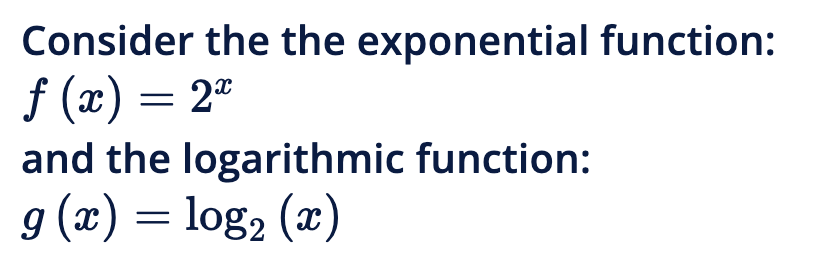
Consider the functions
Unit 2 - Item 3

If the initial population
is 1,000 bacteria. Find the population funtion.
PART B
Determine the time it takes for the population to double.
Unit 2 - Item 4
A sample of a radioactive substance has an initial mass of 150 grams. The substance
decays exponentially over time according to the equation

where
Part A
Determine the half life of the substance
Part B
After 15 years, find the remaining mass of the substance
PART C
If the remaining mass of the substance is 75 grams, calculate the time it took for this amount to decay.
Unit 2 - Item 5
The population of a city is modeled by the exponential growth function
PART A
Determine the annual growth rate of the city's population
PART B
After how many years will the population reach 10,000 residents?
PART C
If the population of the city is projected to triple, find the time it will take for this to happen.
Unit 2 – Item 8
The population of a species of bacteria is modeled by the exponential growth function
PART A
Create a table to represent the population of bacteria for 𝑡 = 0, 1, 2, 3, 4 hours.
Part A:
Find the inverse of the exponential function
Part B:
Find the inverse of the logarithmic function
Part C
Create tables to show the values of
Part D
Graph the function
Verify algebraically that
PART A
Graph both functions on the same set of axes for the domain 0 < x < 5.
PART B
Determine the domain and range of each function
PART C
Identify any points of intersection between the graphs
PART D
Discuss the behavior of each function as x approaches positive infinity
PART E
Compare and contrast the growth rates of
behavior.
PART C
After 10 hours, the population is measured to be 2500 bacteria. Calculate the initial population
Part D
If the population reaches 4,000 bacteria, find the time it takes for the population to be reached
PART B
Use the exponential equation to calculate the population at 𝑡 = 5 hours
PART C
Algebraically, find the time (𝑡) it takes for the population to reach 3000 bacteria.
PART D
Graph the exponential function and analyze the behavior of the population over time