1
1
1
1
1
1
1
1
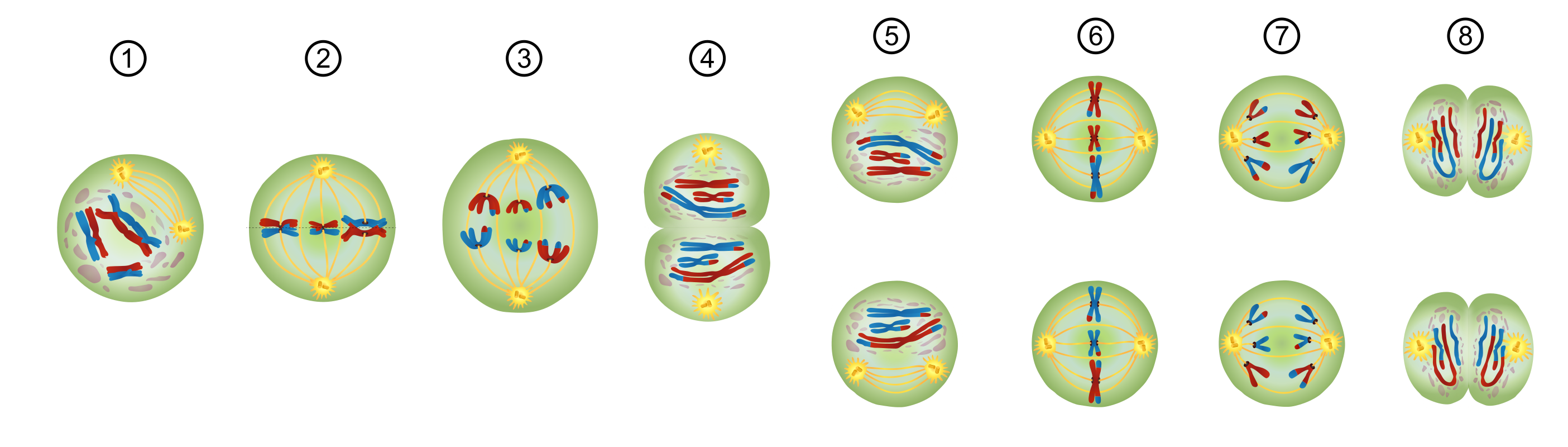
#11 How many cells are there at the end of meiosis I. (use a number for your answer)
#15. How many cells do you have at the end of meiosis II? (use a number for your answer)
#16. Are the cells at the end of meiosis II haploid or diploid?
Are the cells at the end of meiosis II identical or different?
| Draggable item | arrow_right_alt | Corresponding Item |
|---|---|---|
Recessive | arrow_right_alt | a form of a gene; genetic variety that can give phenotypic variety |
Allele | arrow_right_alt | a section of DNA that contains the directions for synthesizing a protein |
Genotype | arrow_right_alt | the form of a gene that can mask the other |
Homozygous | arrow_right_alt | the form of a gene that can be covered up when present with another form |
Heterozygous | arrow_right_alt | the way an organism looks |
Phenotype | arrow_right_alt | the genetic make up of an individual |
Dominant | arrow_right_alt | having two of the SAME version of a gene (dominant or recessive) |
Gene | arrow_right_alt | having two DIFFERENT versions of a gene |
What would be the genotypes and phenotype for the homozygous red plant?
What would be the genotypes and phenotype for the homozygous yellow plant?
Perform a Punnett square and then find the probability of each predicted genotype and phenotype appearing in the F1 generation.
What is the probability of the parents in cross above resulting in a tomato plant offspring that is homozygous?
Some diseases are passed from parents to offspring through their genes, these are considered genetic diseases. Some of the inherited disorders that fall into this category include Tay-sachs disease, sickle-cell anemia, hemophilia, and cystic fibrosis. A child can suffer from one of these diseases only if both parents pass on a recessive gene for the disease. Cystic Fibrosis results in the body producing abnormally thick, sticky mucus which clogs the lungs leading to recurring infections.
If an individual has the genotype FF will they have cystic fibrosis?
If an individual has the genotype Ff will they have cystic fibrosis?
If an individual has the genotype ff will they have cystic fibrosis?

Draw the cross between a snail that is heterozygous for white shell and a snail with a black shell.
If a snail with heterozgyous for white shell and a snail with a black shell are crossed. What percent of the offspring will have a white shell?

Blue body color (B) is dominant to purple body color (b). Round eyes (R) is dominant to oval eyes (r). How many offspring in the cross will be blue with round eyes (B_R_).
What is the name of this phase?
What is the name of this phase?
What is the name of this phase?
What is the name of this phase?
What is the name of this phase?
What is the name of this phase?
What is the name of this phase?
What is the name of this phase?
Blue body color (B) is dominant to purple body color (b). Round eyes (R) is dominant to oval eyes (r). How many offspring in the cross will be blue with oval eyes (Bbrr or BBrr)?
Blue body color (B) is dominant to purple body color (b). Round eyes (R) is dominant to oval eyes (r). How many offspring in the cross will be purple with round eyes?
Blue body color (B) is dominant to purple body color (b). Round eyes (R) is dominant to oval eyes (r). How many offspring in the cross will be purple with oval eyes?