Lesson 5.7 Ionization Energy and Effective Nuclear Charge
star
star
star
star
star
Last updated 12 months ago
20 questions
Note from the author:
Required
1
Required
1
Required
1
Required
1
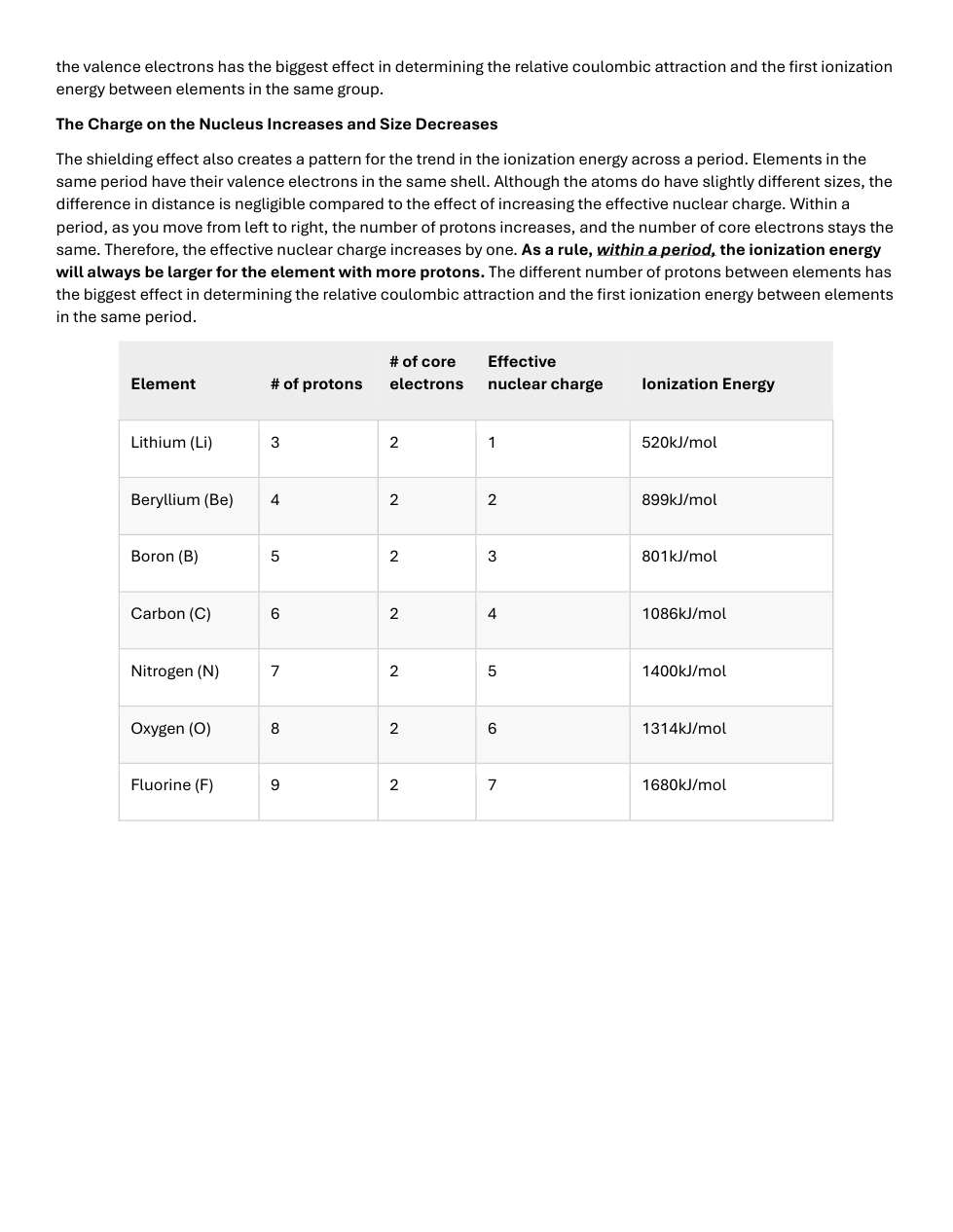
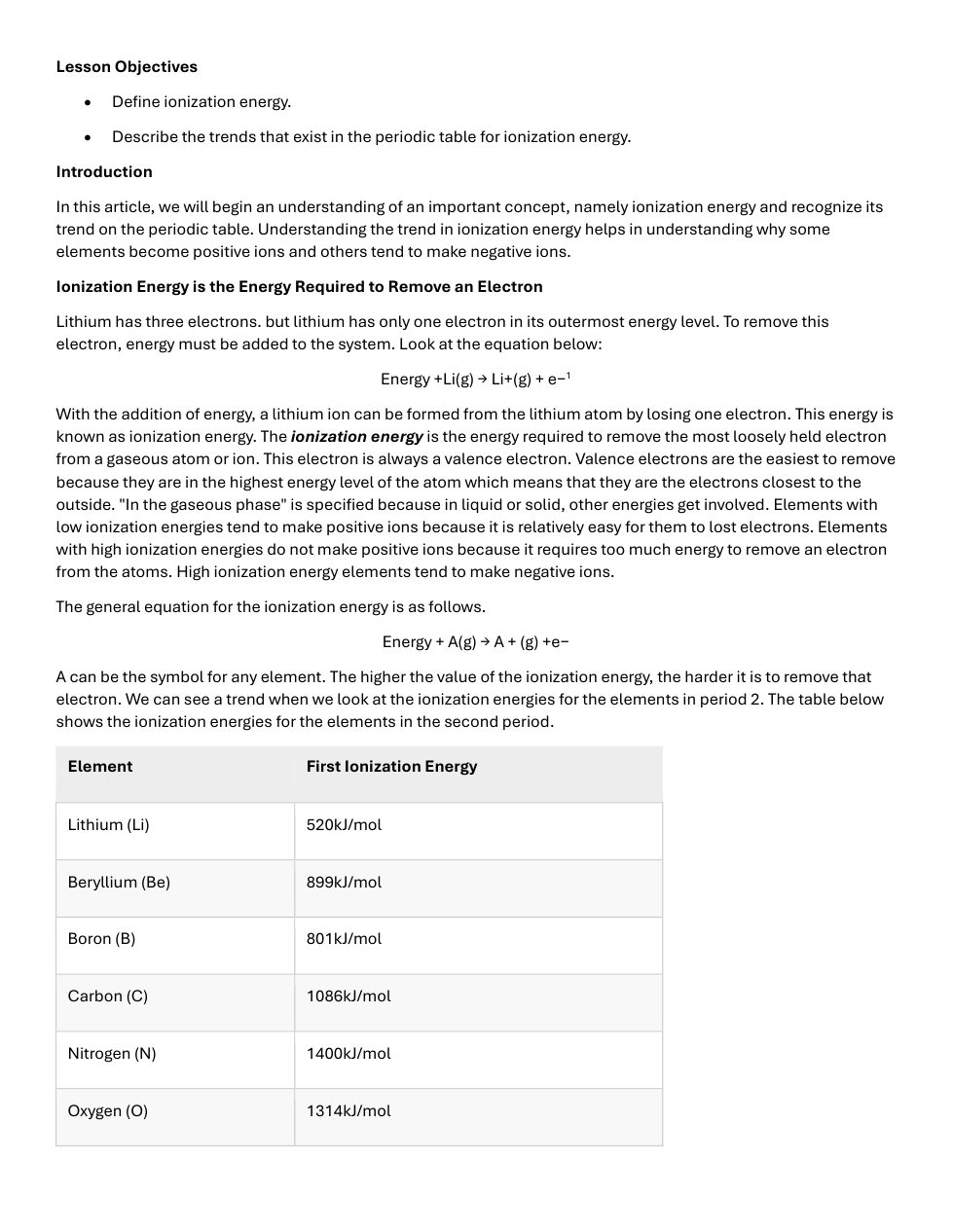
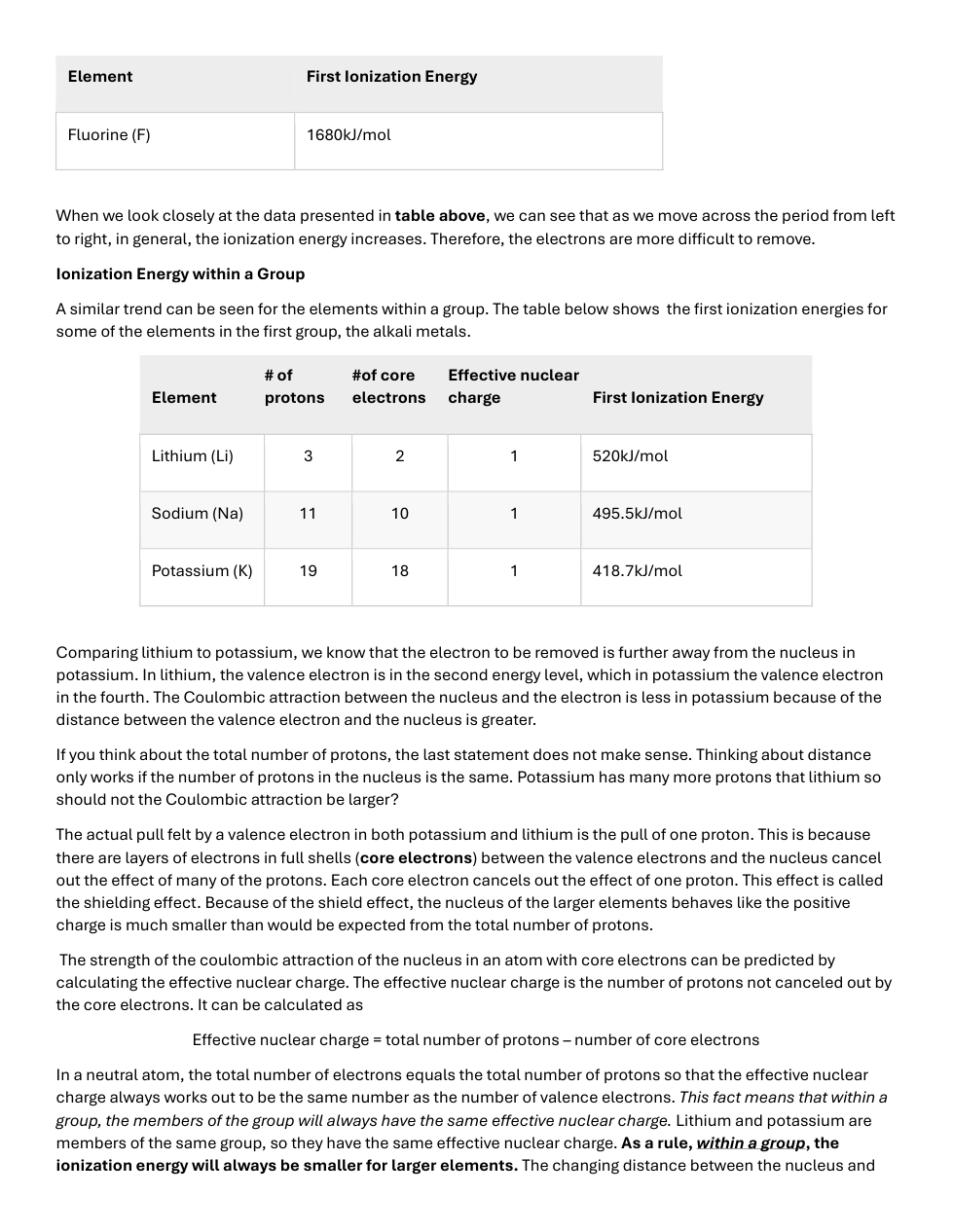
Read the article first and then do the questions
Required
1
Required
1
Required
1
Required
1
Required
1
Required
1
Required
1
Required
1
Required
1
Required
1
Required
1
Required
1
Required
1
Required
1
Required
1
Required
1
Use the picture below to answer the following questions
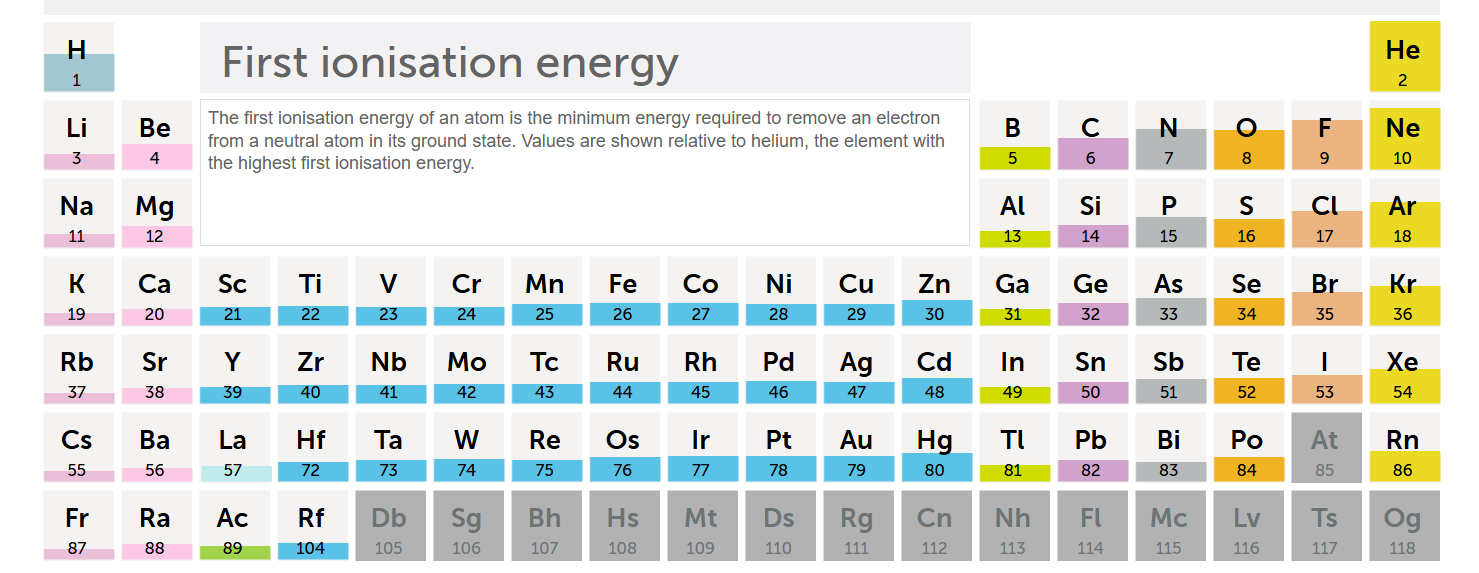
If you want to see the image fill screen, you can open the link https://www.rsc.org/periodic-table/trends
and click on first ionisation energy in the panel that says "select a trend to display"
Yes. They spell ionization as ionisation. It's because the website is British.
Question 17
17.
Question 18
18.
Which group of elements is always found as positive elements. Use evidence from the image to explain your answer!
Question 19
19.
Which group of elements is the group that is always found as negative ions? When thinking about your answer be sure to consider that the noble gases (He, Ne, ..... Radon) do not make ions. Use evidence from the image to justify your answer!
Question 20
20.
The rules that the article discusses are called trends because there are elements that don't follow the pattern that ionization energy increases as go from left to right and decreases and you move down a column. Look carefully and find at least two elements that violate the rules. What are the elements and where are they in the periodic table?
Question 1
1.
Question 2
2.
Question 3
3.
Question 4
4.
Question 5
5.
Question 6
6.
Question 7
7.
Question 8
8.
Question 9
9.
Question 10
10.
Question 11
11.
Question 12
12.
Question 13
13.
Question 14
14.
Question 15
15.
Question 16
16.
Which element has the highest ionization energy?
helium
hydrogen
radon
cesium
What is a trend in science?
a question
something that people do after watching TikTok videos
a pattern that can be used to make predictions
a fact
What is ionization energy?
The energy required to remove the most loosely held electron from an atom
The energy needed to split an atom into ions
The energy required to add an electron to an atom
The energy released when an electron is removed from an atom
What type of electron is removed during ionization?
proton
valence electron
core electron
neutron
A group is
a column in the periodic table
elements with similar chemical properties
elements with similar physical properties
a row in the periodic table
You can use the periodic table to figure out the number of core electrons for the first 56 element by
looking at its atomic number
rounding the decimal number to a whole number
counting over from the left
looking at the atomic number of the last element in the row above the row that the element is in
The distance between the nucleus and the valence electrons is larger in potassium because
it has more neutrons
it has more protons
it's name starts with a p
it has more completely filled energy levels
Coulombic attraction is stronger when the proton and the electron are closer.
True
False
Coulombic attraction between the valence electron and the nucleus depends in potassium is reduced because
the protons in potassium repel each other
potassium has 18 core electrons
potassium has a lot of neutrons
only one energy level is completely filled with electrons
The shield effect refers to
lower coulombic attraction than predicted by the number of protons
lower coulombic attraction than predicted by the number of electrons
higher coulombic attraction than predicted by the number of protons
higher coulombic attraction than predicted by the number of electrons
The effective nuclear charge of sulfur is
32
16
10
6
The effective nuclear charge of calcium is
20
18
40
2
Why does the shield effect increase as atoms get larger?
larger atoms has more neutrons
larger atoms have more valence electrons
larger atoms have more core electrons
larger atoms tend to have fewer protons than electrons
Why does shielding not increase across a period?
The number of core electrons remains constant
The distance between the nucleus and valence electrons decreases
the number of protons stays the same
The number of valence electrons decreases
Which element has the highest effective charge nuclear charge in period 2?
fluorine
lithium
oxygen
carbon
Which element in period 2 is most likely to be found as a positive ion?
lithium
fluorine
beryllium
carbon
Which element in period 2 is most likely to be found as a negative ion?