Read the question carefully. Then enter your answer in the box provided.
What is the most likely reason the author wrote the selection? Support your answer with evidence from the selection.
Judson wants to combine the ideas in sentences 17 and 18. In the space provided, write a new sentence that combines these ideas in a clear and effective way.
Read the selection and choose the best answer to each question.
Luana is writing a paper to argue that kids should take breaks from screens. Read this paragraph from the beginning of Luana’s paper and look for corrections she needs to make. Then answer the questions that follow.
Read the selection and choose the best answer to each question.
Marcel is writing a story about a boy who learns a new skill from his grandmother. Read the first two paragraphs from Marcel’s story and look for corrections he needs to make. Then answer the questions that follow.
Read the selection and choose the best answer to each question.
by Scott Witmer Rules
1 Modern sports started in Britain in the 1700s, when many of the first written rules were recorded. Sports played by the upper classes, such as golf and cricket, were among the first to become established. The upper classes had more free time than others, and therefore more time to develop their sports. Other sports would become better known as the middle classes gained more political and economic power in the 1800s.
2 Most sports sociologists1 consider rules to be the first major characteristic of modern sports. Rules were officially agreed to and written down. This was done to avoid arguments over regional differences in how a game was played. A single set of rules allowed teams and players from different areas to compete in a common form of the game. Rules changed and improved over time, making games fairer and more challenging. The rules of many sports continue to develop even today.
3 As sports cultures grew and rules became established, this led to the creation of leagues and other organizations. A league is a group of sports teams organized to compete against one another. Rules and leagues are generally controlled by an organization that directs the development of a sport. These innovations in sports culture make up what we now know as modern sports.
Records
4 Modern sports are also defined by several other characteristics, such as achievement and record breaking. Records and statistics are a measure of value in sports. Today, scores are even awarded to sports that do not involve making goals, such as gymnastics. Individuals score points given out by a panel of judges who rate the quality of the performance.
5 Records serve as a scale to evaluate performance over time. Athletes not only compete with one another, but also with everyone who has ever competed in that sport. This aspect of sports culture is a reflection of modern culture, which favors measurable progress and winning. In this way, sports confirm the cultural values of modern society.
World sports cultures
6 Some of the earliest modern sports cultures developed as a result of industrialization. This was a change brought to different societies as new technologies were developed. The Industrial Revolution that began in the late 1700s greatly changed Britain and gradually spread to Europe and the United States. Their economies became based on manufacturing, or making things (especially in factories).
7 The kind of work available in industrialized societies, such as factory work or machine operation, was often boring and repetitive. Industrialized work created a sharper distinction between work time and “free time,” or leisure, for the middle classes. People turned to sports for a high-energy release from boredom.
8 Industrialized societies also had modern school systems, which provided sports training and playing fields for students. Modern sports culture directly resulted from the popularity of sports in British schools and universities at the end of the 1800s. As more young men began to seriously compete in sports, athletics became an important element of social status. Games also began to attract more spectators and to spread to other countries.
1 Sports sociologists study the relationship between human social behavior and sports. From SPORTS AND SOCIETY by Scott Witmer, Heinemann Library. © 2012
What is the controlling idea of the article?
Which statement best explains the organizational pattern used in the article?
Based on paragraph 3, what inference can be made about sports leagues?
Which key idea about sports is supported by the details in the section “Records”?
Read this sentence from paragraph 5.
This aspect of sports culture is a reflection of modern culture, which favors measurable progress and winning.
The author refers to sports culture as “a reflection of modern culture” most likely to —
What is most likely the author’s purpose for presenting the information in paragraphs 1 through 3 in logical order?
How does the author’s use of language in paragraphs 3 and 5 contribute to the voice of the article?
Read the selection and choose the best answer to each question.
1 In a tiny Chinese restaurant, the menu on the wall includes some Chinese characters. At one table, a family speaks Spanish. At another table, the waiter taps his foot along to an internationally popular French song. This kind of scene is common in some parts of America. After all, the United States has been called “a nation of immigrants.” While English may be the language used most commonly in school, the truth is that many Americans are bilingual. This means they can communicate in two languages!
2 Even for those who did not grow up speaking multiple languages, learning a second language is powerful. It helps people communicate with others from different countries. It also helps people improve their memory and problem-solving skills, according to several research studies. Since scientists suggest that language learning is easiest for young children, learning a second language at a younger age seems like a great place to start.
Younger Is Better
3 The brain of a baby is built to learn languages. As toddlers, humans take in words and remember the way they are accented even before they speak. Accents are different pronunciations of the same word, such as saying “heah” instead of “here.” People who learn words in a second language often carry over accents from the original language they grew up hearing. This can dramatically change the sound of words, potentially creating challenges between speaker and listener.
4 The ability to form accents is easiest for young kids. In a 1975 study, children ages 6–15 learning English as a second language were given a speaking test. The younger children scored highest in the ability to correctly form a particular accent. Learning a new language at a young age may help adults avoid the confusion that can arise from different accents.
But Can Young Kids Understand?
5 There are some experts, however, that argue maturity is more important to the learning process than age. Professor Sorace of the Bilingualism Matters Centre claims young children are not as prepared as older learners for studying in a classroom. Still, a sense of teamwork and excitement can drive kids at any age to success.
Continuing to Learn
6 Children can use different methods to learn. Younger kids may not understand relationships between countries, but their desire to communicate can be increased by a single person instead. For example, they can build a friendship through exchanging letters with a real person from a different country in a pen pal project.
7 Another method is called “immersion.” Immersion imitates the experience of a person moving to a new country. Studies show that foreign students who were put in an all-English-speaking environment learned English as a second language quickly. Students in an immersion program find themselves surrounded by a different language, and they often are unable to fall back on the comfort of the language they normally use. They must use problem-solving skills to communicate even when they do not have the words. Once they have learned many new words, children in an immersion program can absorb grammar rules by hearing those words used a certain way over and over again.
8 In the classroom version of immersion learning, everything is spoken in the new language. This includes asking to use the bathroom or talking with friends during breaks. Immersion makes the new language useful. It also gives more opportunities for children to practice their skills.
A Future of Possibility
9 Strategies and abilities aside, learning a new language changes people. In today’s world, many Americans no longer have to travel internationally to be exposed to different cultures. By learning languages at a young age, kids can acquire a new way to communicate. They may also increase their interest in people from different countries and cultures around the world. Finally, language learners even develop their memory and thinking skills as they learn a new language.
Read the following paragraph. Many people in the United States speak at least two languages. Learning a foreign language gives students new ways to communicate, but mastering an accent can be difficult. There are many ways to learn a new language, but the immersion method is especially effective. Classrooms using this method require students to use only the language they are learning. Besides the ability to communicate, children who learn a new language also improve their memory and thinking skills. Which sentence should be included in this paragraph to create a complete summary of the selection?
The author most likely included the anecdote about the restaurant in paragraph 1 —
Read the dictionary entry.
acquire \ə-ˈkwī(-ə)r\ verb
1. to buy for oneself 2. to gain a reputation for 3. to locate and hold a desired object 4. to achieve through one’s own efforts
Which definition best matches the meaning of acquire in paragraph 9?
How does the author support the claim that learning a new language can teach students about other cultures?
Based on the information throughout the selection, the reader can conclude that —
What is the main claim the author makes in the selection?
Read the next two selections. Then choose the best answer to each question.
Best friends Chip and Luther are exploring the Old Place, an abandoned farm in their town.
by Rosa Jordan
1 Beyond the bramble-filled pasture was ten acres of woods. Once Chip and Luther had tried to explore back there, but they hadn’t gone more than a dozen yards when they hit a swampy area and sank up to their knees in mud. Then, while trying to get their feet out of the mud without losing their sneakers, they’d seen a coral snake. Luther had wanted to look at it up close, but Chip knew it was poison by the order of the colored bands. He’d taught Luther this verse on the spot: “Red by black, don’t worry, Jack. Red by yellow, kill a fellow.”
2 After that Chip and Luther referred to the woods as “the Jungle” and never went back. Instead, they checked out other things on the Old Place, like rabbit burrows in the thorn patch, the orange tree where a mockingbird always built her nest, and the barn owls that nested in the barn loft.
3 There were two good ways to count rabbits. Either you could climb the rickety ladder up into the loft and spot them from above, or you could lie in the grass in what had been the old cow pen and wait for the rabbits to come out into the open. The original Miz Rabbit wasn’t afraid of the boys, and maybe she told her babies that these humans wouldn’t hurt them. The young ones were wilder than Miz Rabbit, but if Chip and Luther put out a few handfuls of grain and waited, they would come nibble at it.
4 The only trouble with trying to count rabbits, either from the ground or the loft, was that there were so many and they looked so much alike. All were either white like Miz Rabbit or brown like their swamp rabbit papa. Since they hopped all over the place, after a while you’d get mixed up, not sure which ones you had counted and which ones you hadn’t.
5 Chip and Luther first climbed up into the loft to check out the view. This part of South Florida was about as flat as land could get. Looking through holes where boards had fallen off the walls, they could see the fields all around, as far as the Wilson place in one direction and, in the other direction, as far as Chip’s house and the highway. What they didn’t see on this particular afternoon was a lot of rabbits. A few dozen at most. Normally they’d see way more than that on a nice day like this.
6 After about fifteen minutes in the loft, Luther started sneezing from all the dust. “Let’s get out of here,” he said. “If we put out grain, more will come.”
7 They climbed back down the ladder and went into the old cow pen. Luther dug into his pocket for the goat feed he’d brought along for just this purpose. After making a line of feed on the ground, the two boys sprawled on the grass and waited. Within a few minutes rabbits started hopping up. Soon there were about thirty-five, in all sizes, nibbling at the grain.
8 “Not as many as usual,” Luther commented.
9 “More will come,” Chip said. More always did if they waited long enough.
From THE LAST WILD PLACE by Rosa Jordan, Peachtree Publishing Company, Inc. © 2008.
How does the flashback in paragraph 1 of the excerpt from The Last Wild Place contribute to the plot?
Read this sentence from paragraph 5 of the excerpt from The Last Wild Place.
This part of South Florida was about as flat as land could get.
What is the most likely reason the author uses a simile in this sentence?
How does the author’s use of language in paragraphs 7 through 9 of the excerpt from The Last Wild Place contribute to the mood in the story?
What characteristic of realistic fiction does the author of the excerpt from The Last Wild Place include in the story?
Xavier’s actions in lines 1 through 4 of the poem “A Wave of a Day” are significant for Abby because they show that Xavier —
In line 20 of the poem “A Wave of a Day,” the word propelled means —
What does the break between lines 24 and 25 in the poem “A Wave of a Day” help the reader understand?
How are the settings of the excerpt from The Last Wild Place and the poem “A Wave of a Day” SIMILAR?
Select TWO correct answers.
How is the relationship between the characters in the poem “A Wave of a Day” DIFFERENT from the relationship between the characters in the excerpt from The Last Wild Place?
Read the sentence from paragraph 5 of the excerpt from The Last Wild Place.
Chip and Luther first climbed up into the loft to check out the view.
Which lines from the poem “A Wave of a Day” contain a SIMILAR idea?
How is the main activity in the poem “A Wave of a Day” DIFFERENT from the main activity in the excerpt from The Last Wild Place?
ESSAY: Write your essay in the empty box below.
Read the excerpt from The Last Wild Place and the poem “A Wave of a Day.” Based on the information in both selections, write a response to the following:
Explain how Chip in the excerpt from The Last Wild Place and Xavier in the poem “A Wave of a Day” behave SIMILARLY to each other.
Write a well-organized informational composition that uses specific evidence from the selections to support your answer.
Remember to —
clearly state your controlling idea
organize your writing
develop your ideas in detail
use evidence from the selections in your response
use correct spelling, capitalization, punctuation, and grammar
Manage your time carefully so that you can —
review the selections
plan your response
write your response
revise and edit your response
Write your response in the box provided.
Read the selection and choose the best answer to each question.
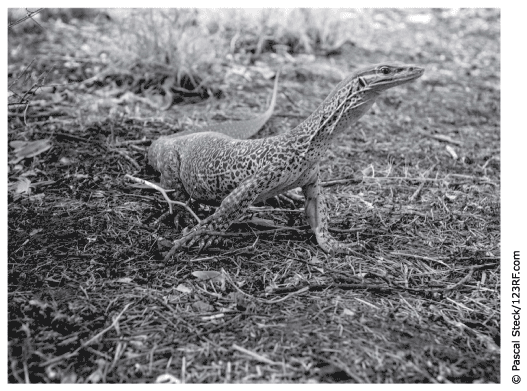
Aidan read about a recent discovery involving an Australian animal and wrote this paper to share what he learned. Read Aidan’s paper and look for revisions he needs to make. Then answer the questions that follow.
Which of these can replace sentence 8 to express a more effective controlling idea for this paper?
Aidan wants to use a more appropriate phrase than a super dry in sentence 15. Which phrase should replace a super dry in this sentence?
What revision, if any, should be made in sentence 18?
Which sentence can BEST follow and support sentence 20?
What is the MOST effective revision to make in sentence 22?
Read the selection and choose the best answer to each question.
Judson wrote this paper about a special collection he has. Read Judson’s paper and look for revisions he needs to make. Then answer the questions that follow.
Judson has included a sentence that does not belong in the first paragraph (sentences 1–6). Which sentence should he remove from this paragraph?
Judson has not used the most effective transition at the beginning of sentence 14. Which phrase should replace In the meantime in this sentence?
What revision, if any, should be made in sentence 25?
Which sentence should replace sentence 32 to bring this story to a more effective close?
What change needs to be made in sentence 2?
What change needs to be made in sentence 3?
What change needs to be made in sentence 5?
What change needs to be made in sentence 6?
What is the correct way to write sentence 2?
What change needs to be made in sentence 3?
What change, if any, needs to be made in sentence 8?