Using data from the table below, and compare to an HR diagram. Which of the stars is a red giant?
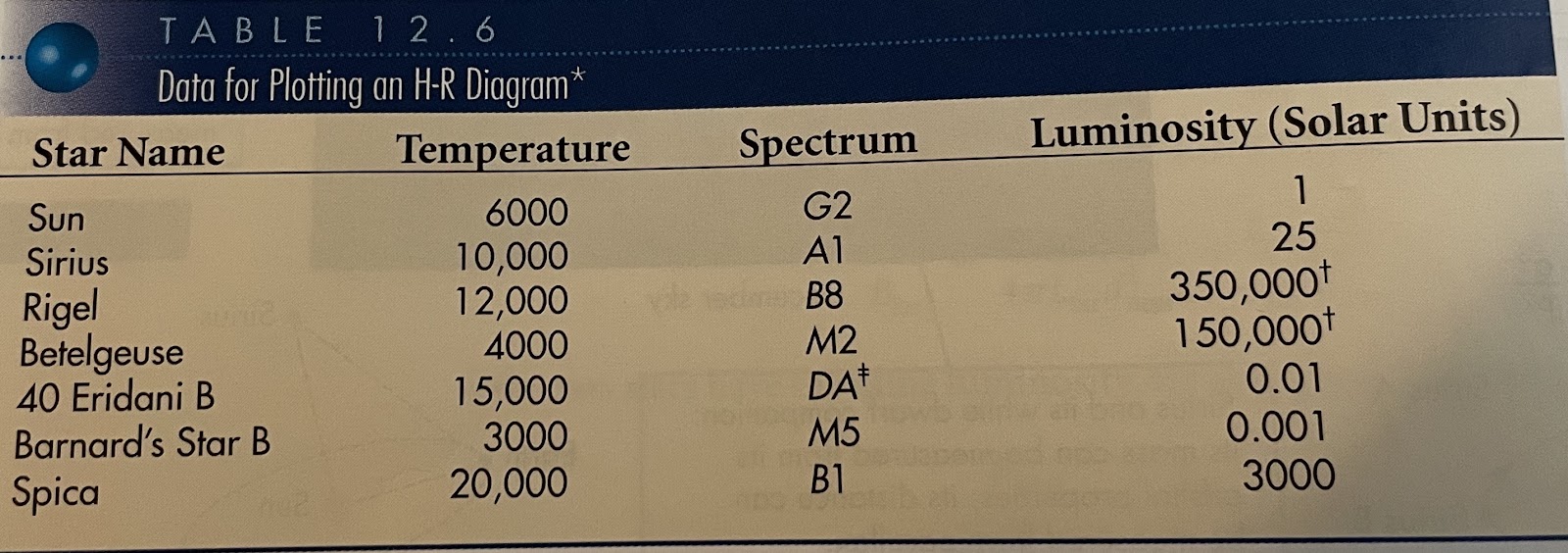
Using data from the table below, and compare to an HR diagram. Which of the stars is a red giant?
Define Prominences:
What is Solar Wind?
What is the sun mostly made of?
If the sun has an iron core, it is likely to be extremely small. Why is that?
Our sun would sit on the H-R diagram in a stripe running from the lower right to the upper left. What is this stripe called?
What happens when a star runs out of hydrogen to fuse?
imagine pushing a kid on a sled. you are near the top of a small hill, if you can push a kid hard enough, the kid will go up to the top of the hill and then slide down the other side. You only get one big push, if you don't push hard enough, the kid will just go up the hill a bit and then slide back down towards you. In this case the potential barrier is
Quantum tunnelling explains why fusion happens in stars despite the pressure and temperature being less than what is required to overcome the potential barrier between protons. The potential barrier refers to
does a star need more less gravity to fuse helium compared to hydrogen?
Sunspots are dark because
I'm just going to give the answer to that last one away. It's the first one. explain here various things wrong with the answer "they contain 10x more iron as the surrounding region"
Explain what is wrong with the answer "nuclear reactions occur in them more slowly than in the surrounding gas"
A star that is red and luminous must
Using data from the table below, and compare to an HR diagram. Which of the stars is a red giant?
What is the relationship between mass and luminosity?
In Math we talk about having 2 equations and 2 unknowns etc. If the number of unknowns is the same as the number of equations, you can sometimes find solutions. If there are more unknowns that equations, there will be infinite solutions. In astronomy, when learning about different types of stars we can use this. Our unknowns are things we cannot measure directly - Temperature, radius, distance, luminosity.
what is a list of things we can directly measure that can lead us to solve for these unknowns?
Please don't try to look up this answer, just answer as best you can. I'm trying to ascertain what you already know, not whether you have done the reading properly. What is the life cycle of a star the size of our sun?