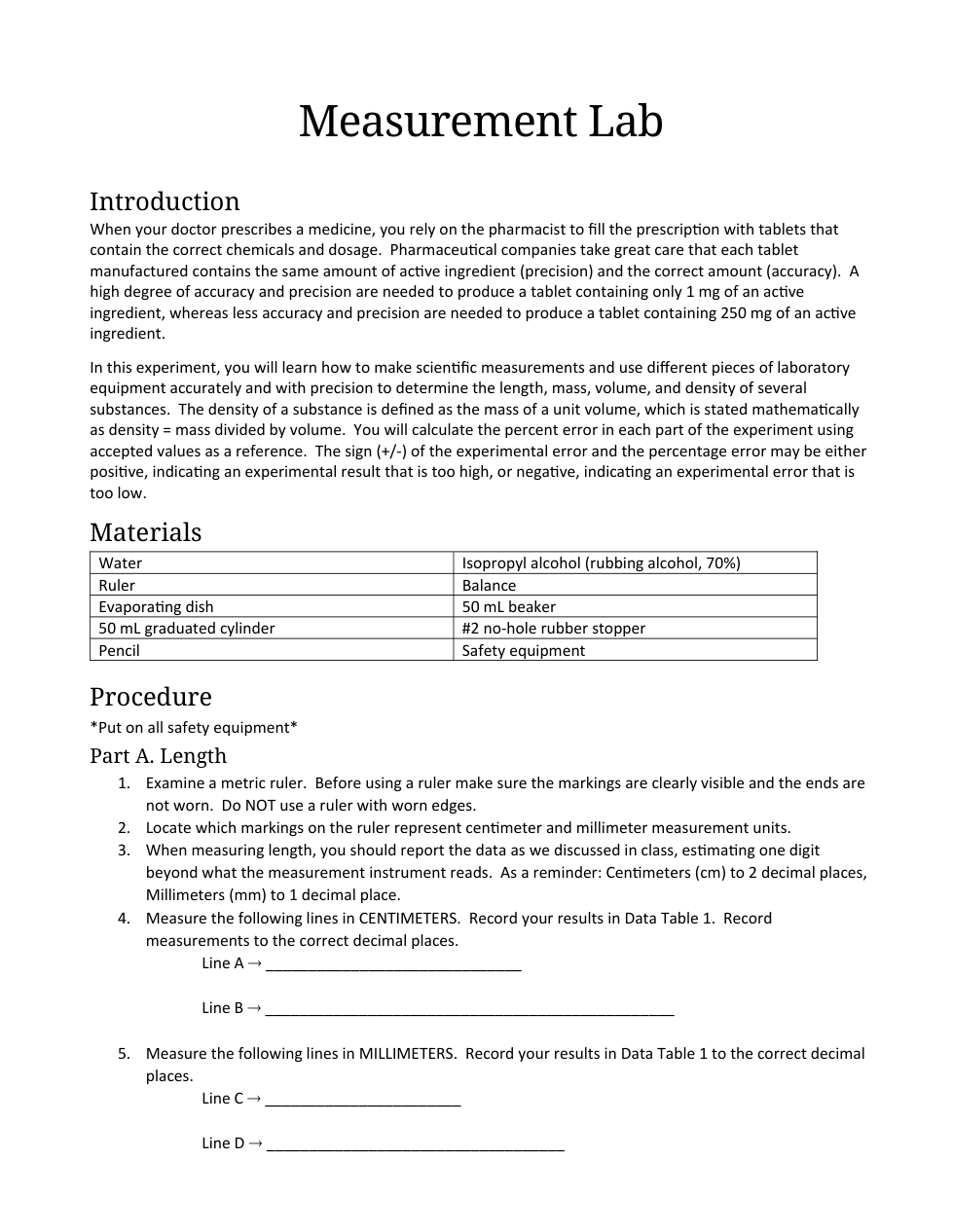
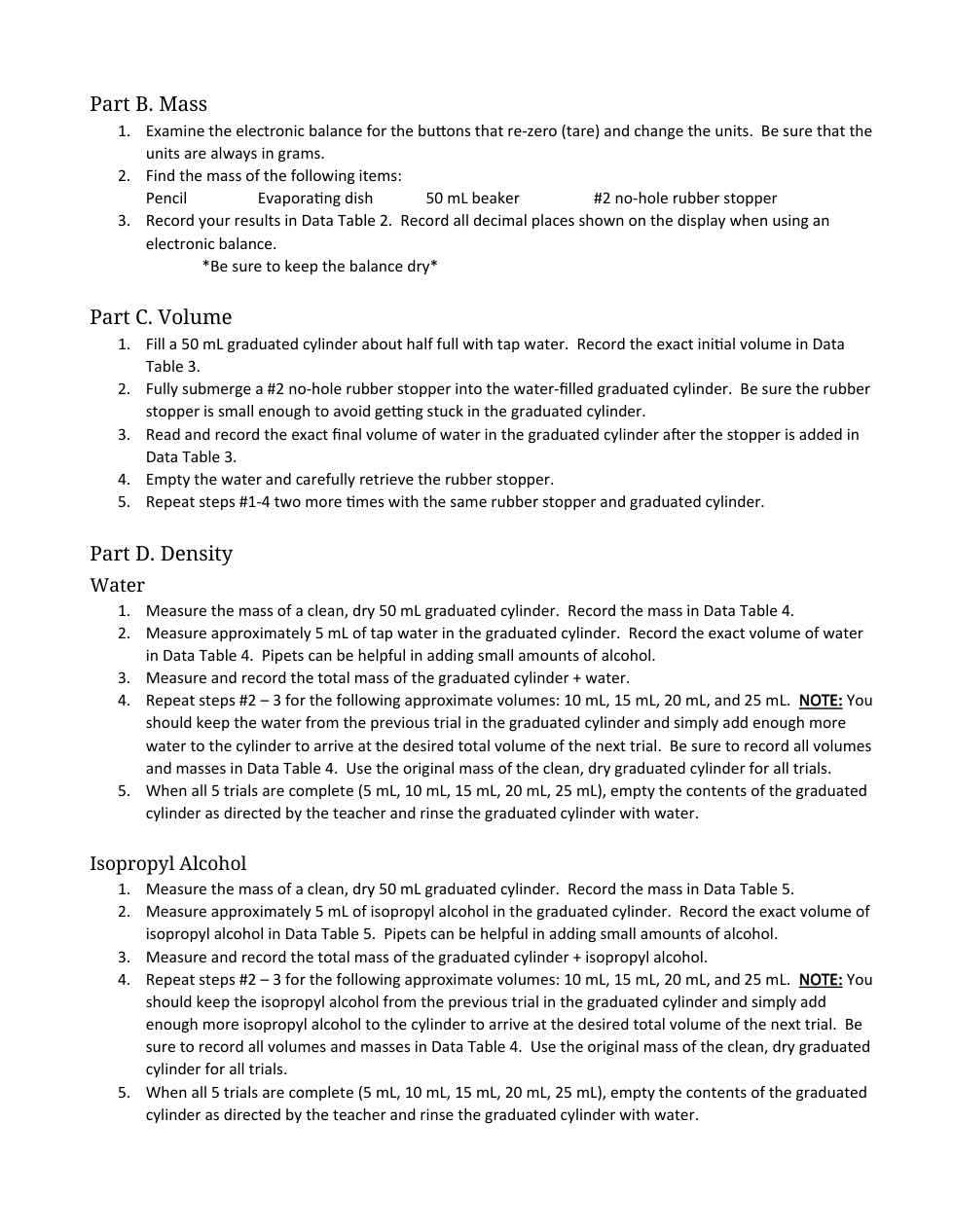
Part 1 & Part 2: Length and Mass
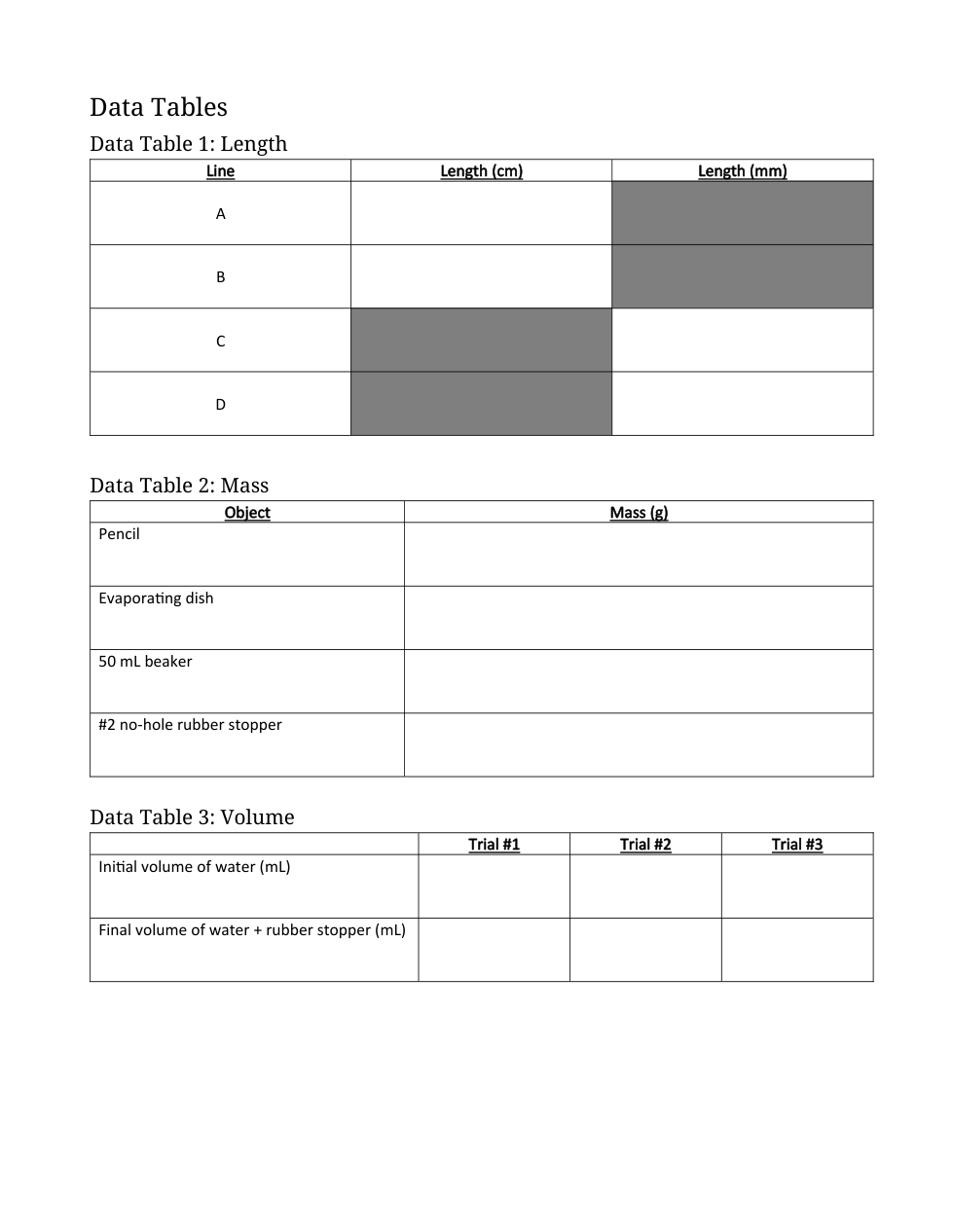
a. Complete the mesurements for Length and Mass, tables 1 & 2.
b. Upload a picture of your completed Data Tables showing your measurements for Length and Mass.
Part 3: Volume
a. Calculate the volume of the rubber stopper from each trial.
b. Calculate the average volume of the rubber stopper.
Part 4: Density
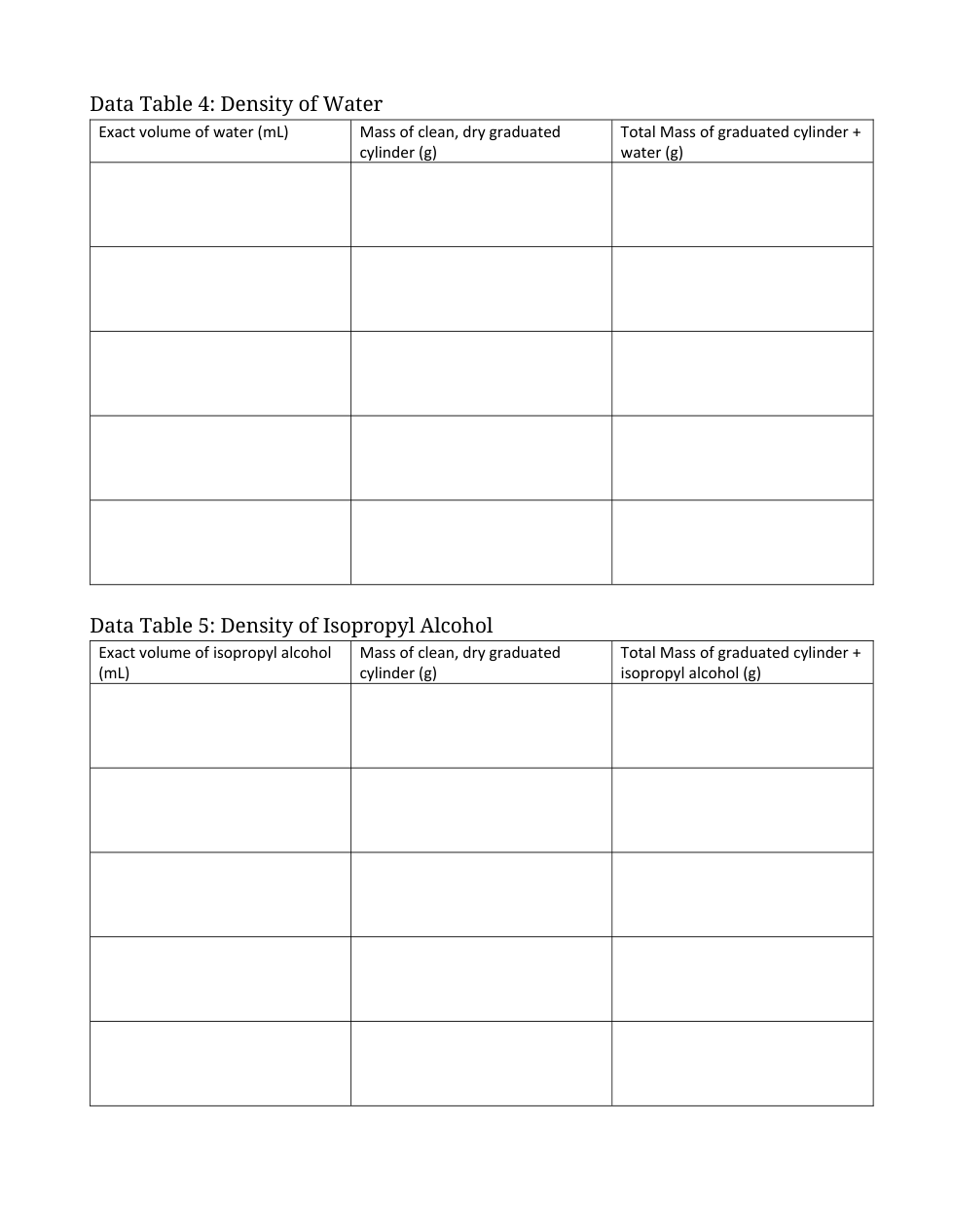
a. Complete the table below for water.
b. Show one example of your calculations for determining the mass of water, density of water, and the average density.
Part 4: Density
The accepted value for the density of water is 1.00 g/mL at room temperature.
Calculate the percent error in your experiment. Record to two decimal places.

Part 4: Density
a. Complete the table below for isopropyl alcohol.
b. Show one example of your calculations for determining the mass of isopropyl alcohol, density of isopropyl alcohol, and the average density.
Part 4: Density
The accepted value for the density of isopropyl alcohol is 0.787 g/mL at room temperature. Calculate the percent error in your experiment. Record your answer to two decimal places.

Part 4: Density
a. Construct a graph of the mass of water (y-axis) vs. the volume of water (x-axis).
b. Plot the graph and draw a line of best fit.
c. Calculate the slope of the line of best fit.
d. Circle the points on the graph that you used to determine the slope.
What are two important things to remember before placing anything on the balance to measure mass?
How is a derived quantity, like density, obtained?
Compare the average density of water that you calculated in your analysis with the slope of the line that best fits on the graph. Are they similar or different? Why do you expect this is so?
Using your graph, determine the mass of 22.5 mL of water. Show your work for how you obtained this value.
Discuss the precision of your volume measurements for the rubber stopper.
When cutting the legs of a table to make it lower, precision is usually more important than accuracy. Explain why this is so.
During dental work or minor surgery, a local anesthetic such as procaine or lidocaine is used to dull or nullify the pain in a small area of the body. Although both are approximately equally effective in numbing pain, procaine is eight times more toxic than lidocaine.
With which anesthetic is it more important to be accurate and precise? Explain.
Identify (list) FOUR pieces of equipment that you used in this laboratory experiment.