ELA 6 Testlet 003 - Reading Informational Text
star
star
star
star
star
Last updated 6 months ago
8 Nsɛmmisa
Into the Deep
In Eastern Europe, a hole in the ground leads to the world’s deepest known cave. The cave is called Krubera Cave, and it’s over 7,000 feet deep. It took a team of explorers nearly a month to reach the bottom.
A month may seem like a long time to go little more than a mile. But 7,000 feet inside a cave is not like 7,000 feet anywhere else. First, of course, the explorers were exploring. That means that at every turn, they had to decide which way to go. There were lots of dead ends. And like most caves, Krubera Cave is absolutely dark. It’s cold too—just above freezing.
Plus, water is everywhere. It rushes in underground streams. It pours over waterfalls. It collects in deep, dark pools that block the way down. Many passages are so tight that the explorers had to crawl, barely able to wiggle through.
But the explorers were ready for these challenges. They carried powerful lights, ropes, and even little boats. They brought food and tents and set up camps on ledges inside the cave.
It took 56 explorers working together to reach the bottom of Krubera Cave. While some people helped from the underground camps, others kept going down. Finally, one diver reached the bottom. It was a record for the deepest cave ever explored.
Deepest, Biggest, Longest
Krubera may be the deepest known cave in the world, but it’s not the biggest. That honor goes to a cave in Vietnam called Hang Son Doong. It has a room so big that a 40-story building could stand inside and still not scrape the ceiling. Because of holes in the cave’s roof, light reaches parts of Hang Son Doong, and a jungle grows inside it. Visitors are awed by Hang Son Doong Cave’s size and beauty.
The world’s longest cave is Mammoth Cave in Kentucky. There, explorers have mapped nearly 400 miles of passages! Mammoth Cave is a National Park. That means visitors can take a tour and see parts of it for themselves.
It may seem surprising, but some animals live even in the deepest caves. Most are small, like spiders or beetles. Many have no eyes: after all, they don’t need them in the darkness. Instead, long antennae help them find their way. For humans, these deep, dark caves can be extreme and dangerous places. For a few strange creatures, however, they are home sweet home.
At the Bottom of the Ocean
The very deepest places on Earth’s surface aren’t inside caves at all. They are at the bottom of the ocean.
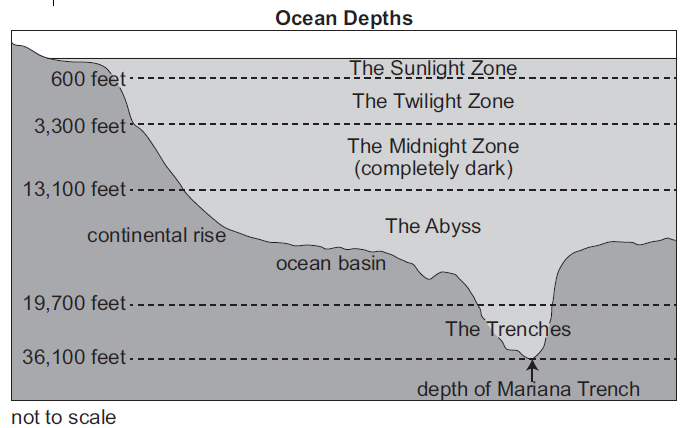
The section of the ocean at the surface, called the sunlight zone, receives plenty of light and heat. It teems with life. Below that is the twilight zone. Very little light reaches the twilight zone. Below the twilight zone is the midnight zone, which reaches an average depth of 12,000 feet. That’s about two and a half miles down. The midnight zone is completely dark and really cold. It’s hard to imagine any place deeper.
But in a few places, the ocean plunges even deeper. Those zones are called trenches. They can be over six miles deep!
What are conditions in such a deep part of the ocean like? First, the pressure of all that water is over 1,000 times what we experience at the surface. It would crush ordinary animals. Absolutely no light ever reaches this zone. Temperatures are just barely above freezing. Amazingly, over 400 species live in these deep trenches.
To survive the great pressure, fish that live in the deepest parts of the ocean have flexible skeletons so they aren’t crushed. Some even have a chemical that keeps all the cells in their bodies flexible. There are fish that glow in the dark to attract prey. Other deep-sea creatures eat debris that filters down from above.
Deepest of the Deep
The deepest trench of all is the Mariana Trench. Located in the western Pacific Ocean, it is almost seven miles deep. Scientists have been fascinated with the Mariana Trench for over one hundred years. They’ve measured its depth using sound waves, and they’ve explored it with special undersea vessels. So far, three people have actually visited the bottom of the Mariana Trench. In 1960, two men descended into the deepest part of it using a special submarine. In 2012 another explorer reached its depths. Getting down there took him less than three hours.
Scientists and explorers have discovered incredible things. They’ve found fish living five miles underwater. They’ve discovered giant shrimp and unexpected microscopic organisms. Videos even show life in action at the very bottom of the ocean. Samples brought back give scientists on the surface a hands-on look.
Despite all we’ve learned, Earth’s deepest caves and oceans are still dark, mysterious places. Who knows what the scientists and explorers might find next.
Read the sentences from the passage.
'It took a team of explorers nearly a month to reach the bottom. Many passages are so tight that the explorers had to crawl, barely able to wiggle through. They carried powerful lights, ropes, and even little boats.'
Which idea do the sentences develop?
The author justifies the explorers’ taking a month to travel 7,000 miles inside Krubera Cave. Which evidence from the passage supports this claim?
Select the sentence numbers of the two sentences in the paragraph that best support the idea that animals have adapted to living in a cave habitat.
1It may seem surprising, but some animals live even in the deepest caves. 2Most are small,
like spiders or beetles. 3Many have no eyes: after all, they don’t need them in the darkness.
4Instead, long antennae help them find their way. 5For humans, these deep, dark caves can
be extreme and dangerous places. 6For a few strange creatures, however, they are home
sweet home.
How does the information in the section "At the Bottom of the Ocean" help the reader to better understand the passage?
How does the diagram contribute to the meaning of the passage? Choose two answers.
This question has two parts. First, answer part A. Then, answer part B.
Part A:
What claim does the author make in the section "Deepest of the Deep"?
Part B:
Which evidence from the passage best supports the answer to part A?
What is the author’s purpose and how is it conveyed in the passage?
Read the partial summary of the passage. Explorers and scientists have explored deep caves and oceans around the world. They have found interesting formations and different forms of life. Choose the sentence that best completes the summary.