Tracking Earhart
Charlotte scanned the newspaper, which her dad had left neatly folded on the kitchen table. Her eyes lit up as she saw the large black letters near the bottom of the page. “Amelia Earhart to Fly in Bendix Trophy Race,” the headline read, and beside it was a photo of Earhart standing next to her plane. Charlotte dropped into a chair to read the story.
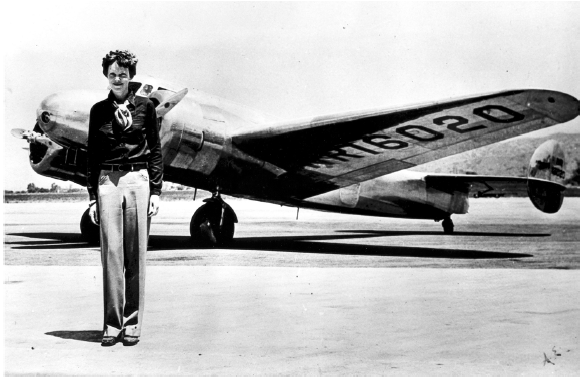
In an upcoming race in 1935, Earhart would become the first woman to fly in the Bendix Trophy Race. The race had been established in 1931 to let daring pilots use experimental plane technologies to fly faster and higher. Aviation had progressed extensively since the Wright brothers flew the first aircraft in 1903, and each year, designers invented new instruments to improve communication, flight, and weather tracking. A handful of skillful pilots were pushing the boundaries of what was possible in flight, and of those, a few women had risen to prominence. Perhaps the most famous was Amelia Earhart, who had broken several records already. In 1932, she became the first woman and the second person to fly solo across the Atlantic Ocean.
Carefully, Charlotte clipped the article out of the newspaper, carried it to her room, and pasted it into her scrapbook. She flipped through the pages, glancing at the newspaper clippings she had collected over the past three years. These articles described Earhart’s flying exploits and her personal life. On Charlotte’s wall, a map pierced with pins marked where Earhart had flown. Charlotte’s father joked that Charlotte was “tracking Earhart” like a detective or a trail finder, and she supposed that this was true. Maybe one day the trail will lead to me sitting in a cockpit of my own, soaring through the open blue skies, Charlotte thought, but then she shook her head. In her small town of Beachwood, Ohio, no one that she knew flew planes. How could she ever learn how to fly?
Charlotte flipped back to the current article to see where the Bendix Trophy Race would take place. Suddenly, she leaped up and ran to the yard, where her father was trimming the shrubs.
“Dad, Amelia Earhart is going to be flying from Los Angeles to Cleveland next Friday! Please, can we go see the finish of the race? She’s never been so close to us before.” Charlotte’s eyes shone with longing as her dad grimaced.
“Charlotte, why do you persist in this silly pursuit, when there are far more important things to consider, like your schoolwork?” he said.
“I achieved top grades all last year,” Charlotte protested. “Please, Dad, Cleveland is not too far away.”
Charlotte’s dad sighed. “All right, we’ll make a day of it.”
* * *
At the airfield the following Friday, massive crowds were gathered, enjoying various festivities related to flight racing. Everyone cheered as the first planes in the Bendix Race landed. Then, at last, Charlotte gasped with delight as Earhart’s familiar airplane came roaring through the clouds. Charlotte watched Earhart land smoothly and climb out of her plane as reporters pressed in around her, snapping photos and firing off questions.
When the next plane in the race landed, the reporters drifted away. Charlotte tugged at her dad’s sleeve. “I want to go and speak with her,” she announced bravely, her heart hammering in her chest.
Charlotte’s dad sighed again. “Of course you do,” he muttered, but he nodded and waved Charlotte forward.
Charlotte approached Earhart, who was making some adjustments to her plane’s propeller.
“That was a spectacular landing,” Charlotte blurted out, her voice trembling nervously. Earhart turned and grinned at Charlotte.
“I’ve done vastly better, but I was experiencing turbulence issues,” she replied cheerfully. “Do you fly too?”
Charlotte’s eyes widened. “Oh no, that’s just a dream for me, Miss Earhart,” she said firmly. “I’m Charlotte, by the way.”
“Well, ‘Charlotte-by-the-Way,’” Earhart said, winking, “it was once just a dream for me. Hardly anyone was doing it, but now flight continues to improve, and more opportunities are opening. If I could accomplish my dreams, then you can do so much more.”
“Do you really think so?” Charlotte stammered. “I mean, I don’t know anyone personally who can fly.”
“Well, you do now,” Earhart replied. “I’ll bet there’s someone near your home who can teach you too.”
Suddenly Charlotte’s dad spoke up from behind them. “Ed Anderson’s brother flies planes,” he said. “We could probably get you lessons!”
Charlotte whirled around. “Truly? Oh, thank you, Dad,” she exclaimed.
“See there, Charlotte,” Earhart said, laughing. “You’re already on your way!”
Speech by Amelia Earhart
This is an excerpt from a speech Earhart gave sometime between 1935 and 1937; the exact date is unknown.
Flying is perhaps the most dramatic of recent scientific attainment. . . . The pilot when he is way above the earth at 200 miles an hour, talks by radio telephone to ground stations or to other planes in the air. . . . He is guided by radio beams and receives detailed reports of conditions ahead gleaned through special instruments and new methods of meteorological calculations. He sits behind engines, the reliability of which . . . is all but unbelievable. I myself still fly a Wasp motor1, which has carried me over the North Atlantic, part of the Pacific, to and from Mexico City, and many times across this continent.
1Wasp motor— popular airplane engine produced by the Pratt & Whitney Aircraft Company