Math 8 Testlet 006 - Effect of Dilations, Translations, Rotations, and Reflections 8.GM.A.3
star
star
star
star
star
Last updated 3 months ago
8 questions
Required
1
8.GM.A.3
Required
1
8.GM.A.3
Required
1
8.GM.A.3
Required
1
8.GM.A.3
Required
1
8.GM.A.3
Required
1
8.GM.A.3
Question 5
5.
Question 6
6.
Required
1
Question 7
7.
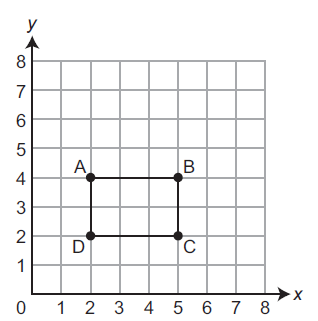
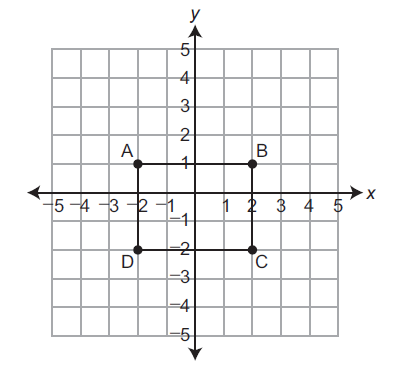
Rectangle ABCD is shown on the coordinate plane.
Rectangle ABCD is dilated by a scale factor of 2 centered at the origin to create rectangle A'B'C'D'. What are the coordinates of point B'? (_______ ,_______ )
8.GM.A.3
Required
1
Question 8
8.
Rectangle ABCD is shown on the coordinate plane.
A dilation centered at the origin is applied to rectangle ABCD. After the dilation, the image of point A is at
(-6, 3).
What is the scale factor used to create the image of rectangle ABCD?
8.GM.A.3
Question 1
1.
Question 2
2.
Question 3
3.
Question 4
4.
The vertices for two triangles on the coordinate plane are shown:
Triangle MLK: M(–3, 6), L(0, 9), K(3, 3)
Triangle M'L'K': M'(–1, 2), L'(0, 3), K'(1, 1)
Which transformation maps triangle MLK onto triangle M'L'K'?
a translation of 0 units to the right and 6 units up
a translation of 2 units to the right and 4 units up
a dilation with a scale factor of 1/3 centered at the origin
a dilation with a scale factor of 3 centered at the origin
Casey performs a transformation on a pentagon graphed on a coordinate plane using a dilation with a scale factor of 4 centered at the origin. What should Casey do to determine the coordinates of the image?
Casey should subtract 4 from each coordinate.
Casey should divide each coordinate by 4.
Casey should add 4 to each coordinate.
Casey should multiply each coordinate by 4.
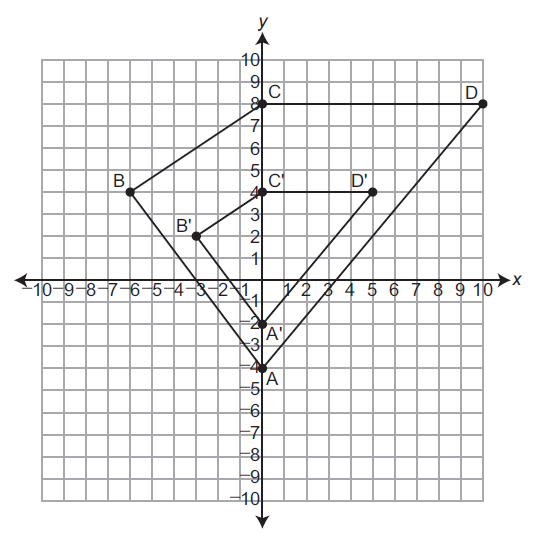
Quadrilateral ABCD is dilated by a scale factor centered at the origin to create quadrilateral A'B'C'D' as shown on the coordinate plane.
What is the scale factor of the dilation?
\frac{1}{2}
-2
2
-\frac{1}{2}
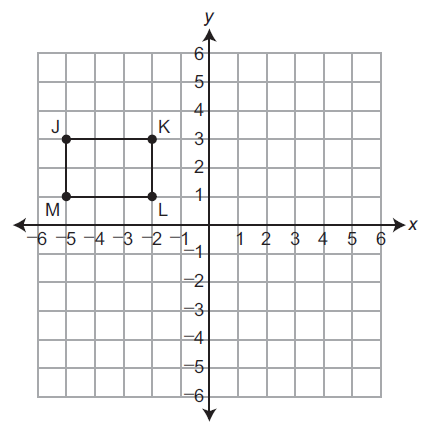
Rectangle JKLM is shown on the coordinate plane.
Rectangle JKLM is reflected over the y-axis to create J'K'L'M'. What are the coordinates for point K'?
(–2, –3)
(3, 2)
(–3, –2)
(2, 3)
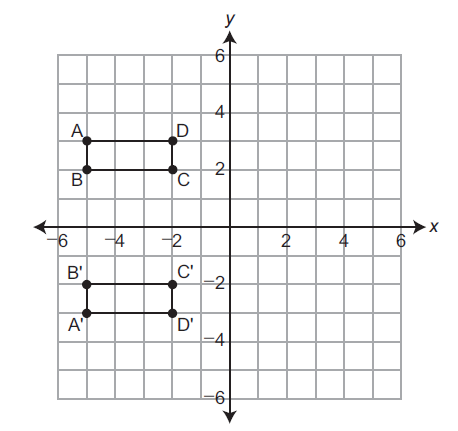
Rectangle ABCD and its image, rectangle A'B'C'D', are shown on the coordinate plane.
Which transformation can be used to map rectangle ABCD to rectangle A'B'C'D'?
A translation 4 units down
A reflection across the y-axis
A reflection across the x-axis
A 270° rotation clockwise about the origin
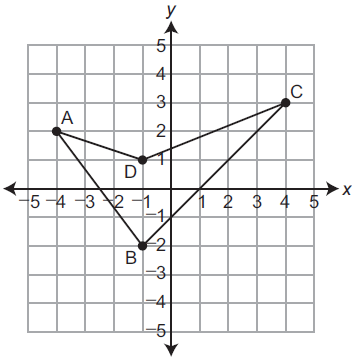
Polygon ABCD is shown on the coordinate plane.
Polygon ABCD is translated 4 units up and 2 units to the left to create polygon A'B'C'D'. What are the coordinates of point B'?