Log in
Sign up for FREE
arrow_back
Library

Science 8 - Testlet 005- Physical Science

star
star
star
star
star
Last updated about 5 hours ago
7 questions
Required
1
6-8.PS2.A-2
MS-PS1-2
Required
1
6-8.PS1.A-4
MS-PS1-4
Required
2
MS-PS2-3
Required
1
MS-PS2-3
Required
1
6-8.PS1.A-2
MS-PS1-2
Many of us have seen fireworks at a holiday celebration.

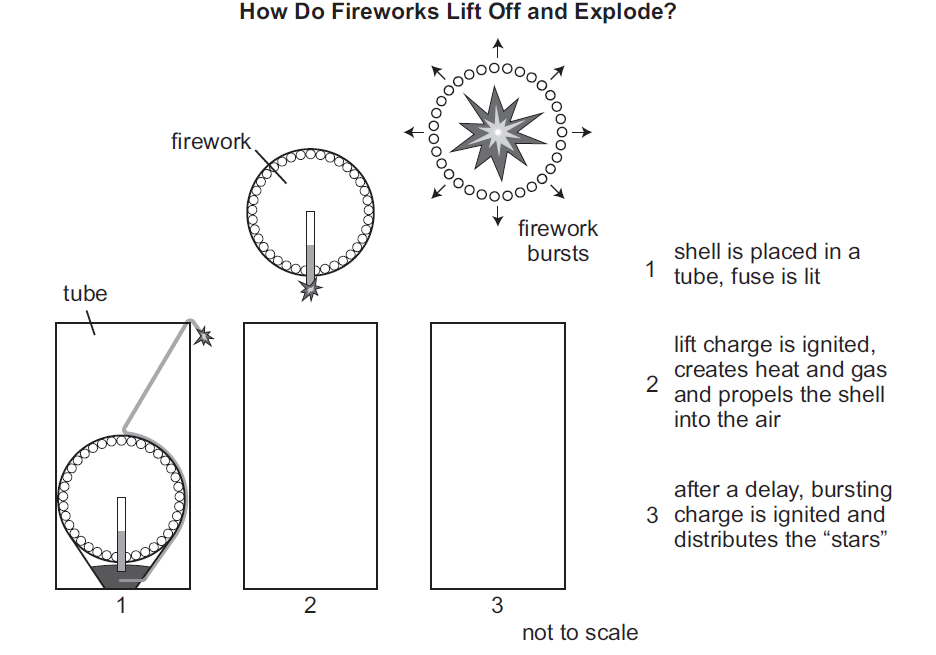
A group of students learned that fireworks that are launched from the ground into the air are called aerial fireworks. The basic structure of an aerial firework is shown in this diagram.
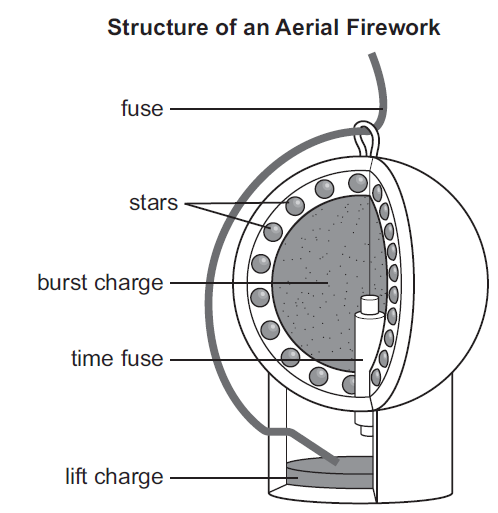


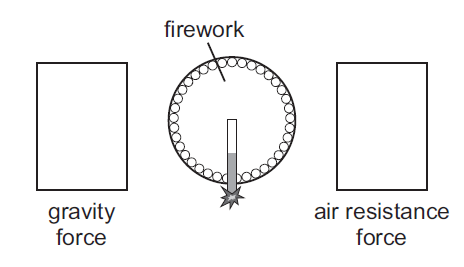
Fireworks are launched from a tube using a lift charge on the bottom of the shell. The lift charge only applies force to the firework while it is inside the tube. Once the firework is in the air, the only forces on the firework are from gravity and from air resistance. The firework decreases in speed as it rises into the air.
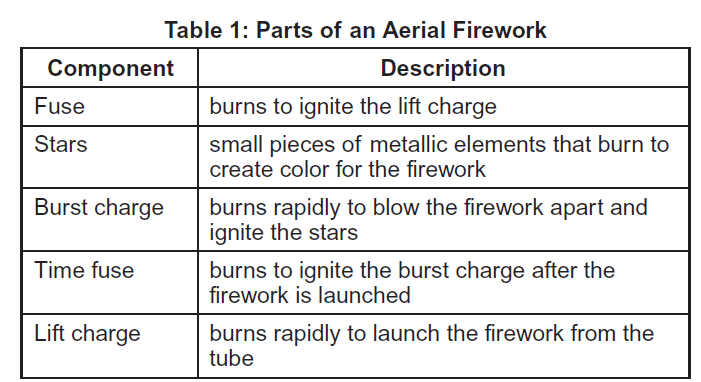

When lit, the burst charge produces heat that explodes the stars outward, creating the firework’s light display. The metallic elements chosen for the stars determine the color of the firework. The metal chemically combines with oxygen gas (O2) and a flame with a distinct color can be seen. For example, copper (Cu) produces a blue flame, magnesium (Mg) produces a bright white flame, and strontium (Sr) produces a red flame.
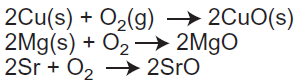
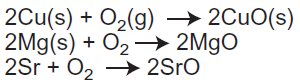
The chemical equations below show what happens when each of the three metallic elements in firework stars react with oxygen.

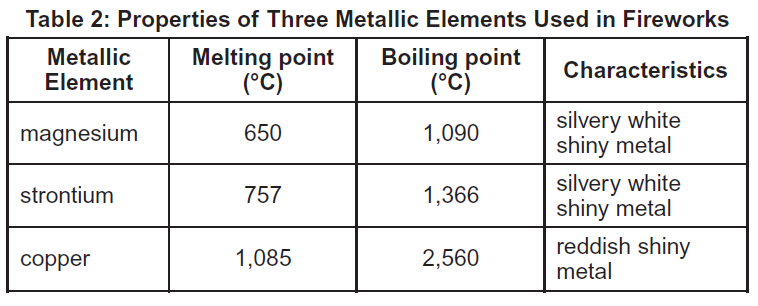
The data table below shows the properties of these metallic elements.
Question 1
1.
The diagram shows how a modern firework is launched from a tube and bursts to release the stars.


Draw an arrow in each box in the model to best show the forces acting on a firework while it is rising into the air after being launched. Arrows may be used more than once, and some arrows will not be used.
Other Answer Choices:
➡️
⬇️
⬆️
⬅️
Question 2
2.

When a firework explodes, the burst charge adds thermal energy to the metals in the firework.
Which model best represents the change in particle motion of the metals in a firework when thermal energy is added?

This question has two parts.

A student makes the following claim about a firework.

Student Claim: The kinetic energy of a firework increases when it bursts, and then
kinetic energy is transferred from the firework to its surroundings.
Required
1
Question 3
3.

MS-PS3-5
Required
1
MS-PS3-5
Question 5
5.
Choose the word in each set of options to describe the reaction.

The copper and oxygen on the left side of the chemical equation are the __________ and the copper oxide on the right side of the chemical equation is the __________. Also, the __________ of copper and oxygen on the left side of the chemical equation will equal the __________ of copper oxide on the right side of the chemical equation.
Question 6
6.
Refer to the chemical equation for when magnesium combines with oxygen from the passage.


Choose a word or phrase in each set of options to describe the chemical reaction.
Because the number of __________ is the same before and after the reaction, the mass must __________ before and after the reaction.
Question 7
7.

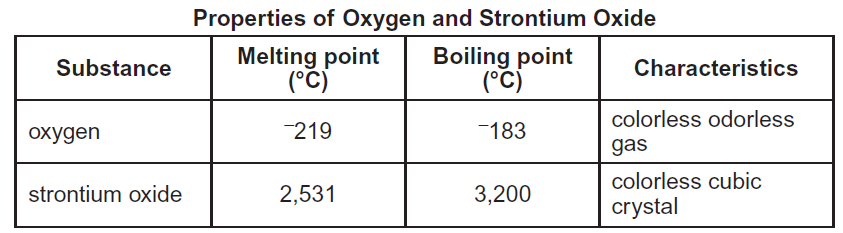
The data table below shows some properties of oxygen and strontium oxide, which is produced when strontium burns.


Explain why the information in Table 2 and the table above supports the claim that a chemical reaction occurs when strontium is mixed with oxygen to form strontium oxide.

Part A: Is the student’s claim correct?
yes
no
Question 4
4.

Part B: Select the three types of energy that kinetic energy is transferred to when the firework bursts.

light
sound
electricity