Science 8 - Testlet 009 - Earth & Space Science
star
star
star
star
star
Last updated 6 months ago
5 Nsɛmmisa
Missouri is part of the New Madrid Seismic Zone (NMSZ), which is an active earthquake area. Earthquakes have been shaping the land in the NMSZ for millions of years. Hundreds of earthquakes shake Missouri every year, even though you might not feel them. Earthquakes in this area are produced within a tectonic plate, far from the boundaries between tectonic plates. The earthquakes occur under layers of soft river sediments and sedimentary rock, making them difficult to study. Scientists measured the locations of hundreds of earthquakes to map over 200 kilometers of buried active faults as shown below.
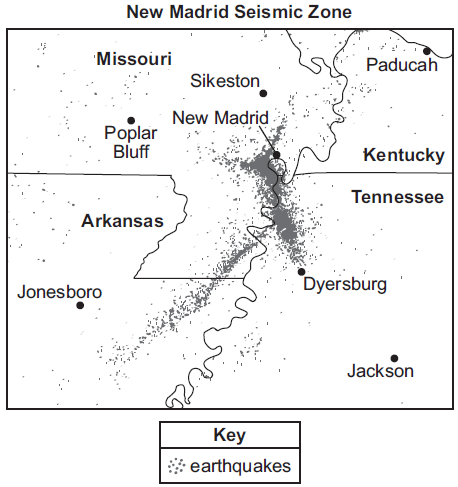
The list below includes information about earthquake activity at the NMSZ. Magnitude is a measurement of the strength of an earthquake.
New Madrid Seismic Zone Earthquake Information
A 1.0-magnitude earthquake occurs hundreds of times each year.
A 4.0-magnitude earthquake occurs about every 18 months.
A 5.0-magnitude earthquake occurs about every 10 years.
A 6.0-magnitude earthquake occurs about every 80 years.
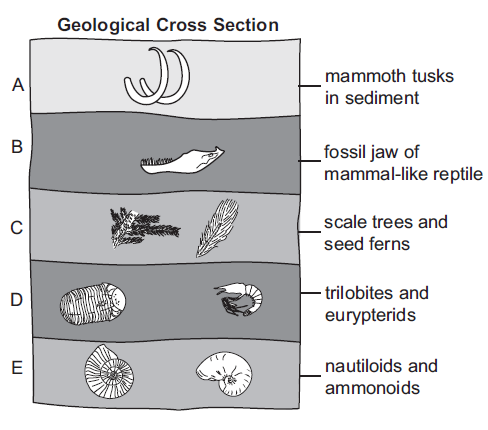
Compression forces cause earthquakes in the NMSZ in relation to rock layers formed during the Paleozoic and more recent Cretaceous time periods. Fossils of trilobites, corals, and aquatic shelled organisms have been found throughout older Paleozoic rock layers in Missouri. Fossils of dinosaurs, leaves, flowering plants, and marine reptiles have been found in more recent Cretaceous rock layers.
Using information and data in the passage, choose the word or phrase in each set of options to best describe the New Madrid Seismic Zone (NMSZ).
Most earthquakes that occur in the NMSZ have magnitudes 5.0.
Earthquakes with a magnitude of 4.0 occuroften in Missouri than earthquakes with a magnitude of 5.0.
Based on information in the passage, a student claimed that dinosaur fossils are older than the trilobite fossils discovered in Missouri. Choose the word in each set of options to correctly complete the sentences evaluating the student’s claim.
The student is . Dinosaur fossils formed during the Cretaceous period are located trilobite fossils formed during the Paleozoic period.
A group of students developed the following statements to describe the Geological Cross
Section in the passage.
Statements by Students
Fossils in layer C are older than fossils in layer B.
Fossils in layer A are the youngest.
Layer A took the longest to form because it is the tallest layer.
Layers A and B are the same age because both layers contain land-based organisms.
Which pair of statements best describes the Geological Cross Section?
Using the Geological Cross Section in the passage, list each fossil type in a box to show the order of the fossils from oldest (top) to youngest (bottom):
Nautiloids
Eurypterids
Scale trees
Mammoths
Fossils of nautiloids are found only in layer E of the Geological Cross Section in the passage. Describe one possible conclusion that can be made about nautiloids based on this observation.