The following sets of coordinates are located on the Coordinate Plane. Determine whether each set of coordinates on a coordinate plane can create figure is a trapezoid, a parallelogram, a square, a rhombus, or a quadrilateral.
1 point
1
Question 1
1.
Shape 1: (-6, -2), (-6, -4), (-4, -4), (-4, -3)
1 point
1
Question 2
2.
Shape 2: (-2, 2), (-2, -1), (3, -1), (4, 2)
1 point
1
Question 3
3.
Shape 3: (1, -3), (3, -5), (5, -5), (7, -3)
1 point
1
Question 4
4.
Shape 4: (4, 6), (5, 2), (7, 2), (6, 6)
1 point
1
Question 5
5.
By changing one coordinate point in Shape 2, what additional shapes can you make?
Unit 2 – Item 2
For your 16th birthday, your parents have said they will match whatever money you can make from your new business to put towards buying a car. You have high expectations for your car so you know you need to make as much money as possible. Marketing is a key component of growing your business and while you have some business, you would like to step it up a notch. In order to do this, you decide to create a logo. This logo will hopefully catch the eye of potential customers on social media. The company you will work with to put the logo on merchandise is also a start-up and requires you to use distinct geometric shapes. You need to create a design on a coordinate grid, and it needs to have the following components in order for it to be successfully printed.

9 points
9
Question 6
6.
Unit 2 -- Item 3
In a city planning project, an architect is designing a new park. The park includes a large circular fountain at its center, surrounded by a decorative landscape, also in the shape of circle that shares the same center as the fountain. The architect wants to place four identical statues equidistant from each other as part of the decorative landscape, such that the statues form a square. If the diameter of the fountain is 20 meters, calculate the distance between each statue and the nearest edge of the fountain, and prove that the statues indeed form a square.
1 point
1
Question 7
7.
Unit 2 – Item 4
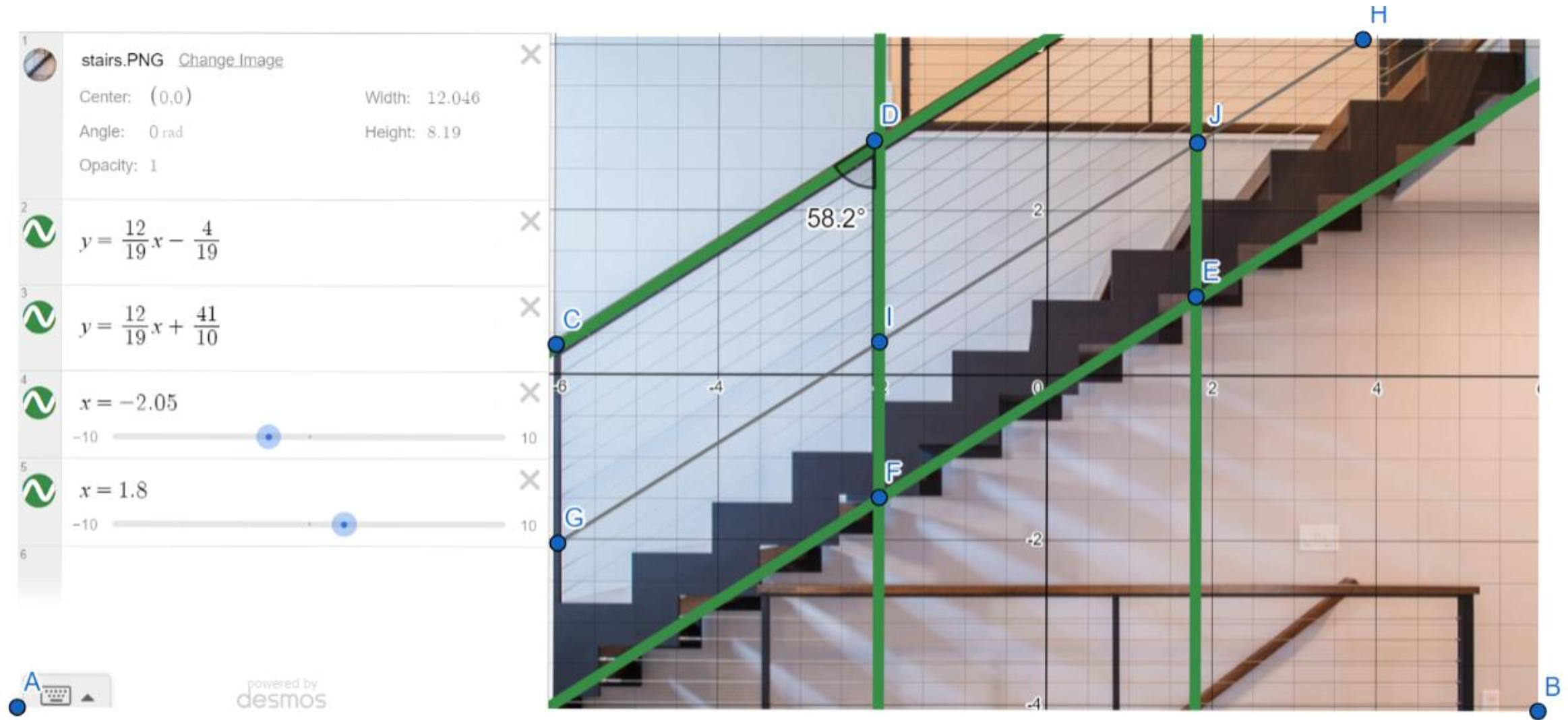
Architects and Interior Designers often work together to create a staircase suitable for their client’s home or other building. Below is an example of a staircase that utilizes parallel lines and
transversals. Using the image below, name 4 angles and identify their measurements, proving
them using your knowledge of angle theorems.
1 point
1
Question 8
8.
Unit 2 – Item 5
In a city planning meeting, a designer is proposing a new park layout. The park includes a rectangular playground area with a diagonal path cutting through it. The designer wants to ensure that the path does not intersect any of the playground equipment structures. Using your knowledge of lines and angles, prove that the diagonal path will not intersect any of the playground equipment structures if it is placed correctly.
1 point
1
Question 9
9.
Define the playground area as a rectangle with known dimensions.
1 point
1
Question 10
10.
Draw the diagonal path from one corner of the rectangle to the opposite corner.
1 point
1
Question 11
11.
Identify the angles formed by the diagonal path and the sides of the rectangle.
1 point
1
Question 12
12.
Use theorems about angles in a rectangle to prove that the diagonal path will not
intersect any of the playground equipment structures.
Unit 2 – Item 6
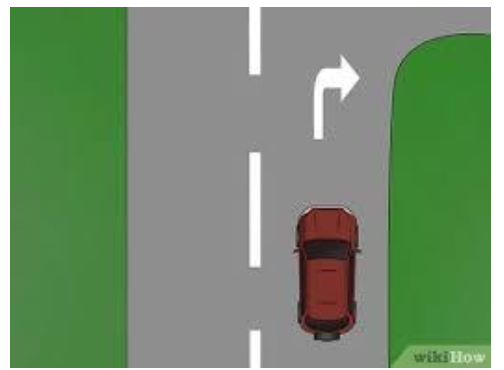
A city planner is designing a new intersection for a busy intersection. The intersection needs to include a right turn lane that is perpendicular to the main road. Using your knowledge of geometric constructions, create a formal construction to draw a perpendicular line to the main road, indicating where the right turn lane should be located.
Tasks
Use a ruler and compass to draw a line representing the main road.
Construct a perpendicular line to the main road, indicating the right turn lane.
Label the intersection point where the perpendicular line meets the main road.
Verify that the constructed perpendicular line meets the main road at a 90-degree angle.
9 points
9
Question 13
13.
Unit 2 – Item 7
The snack industry is overflowing with snacks in the shape of quadrilaterals. Select your favorite quadrilateral-shaped snack and answer the following questions.
1 point
1
Question 14
14.
Step 1: Select a picture that allows you to prove the type of quadrilateral the company is producing.
1 point
1
Question 15
15.
Step 2: Put the picture on a coordinate plane. You can do this using GeoGebra, Desmos or a paper copy by cutting and pasting the image on a piece of graph paper.
1 point
1
Question 16
16.
Step 3: Determine the type of quadrilateral the snack is. Prove the snack is this shape using geometric theorems using sides, angles and/or diagonals
Unit 2 – Item 9
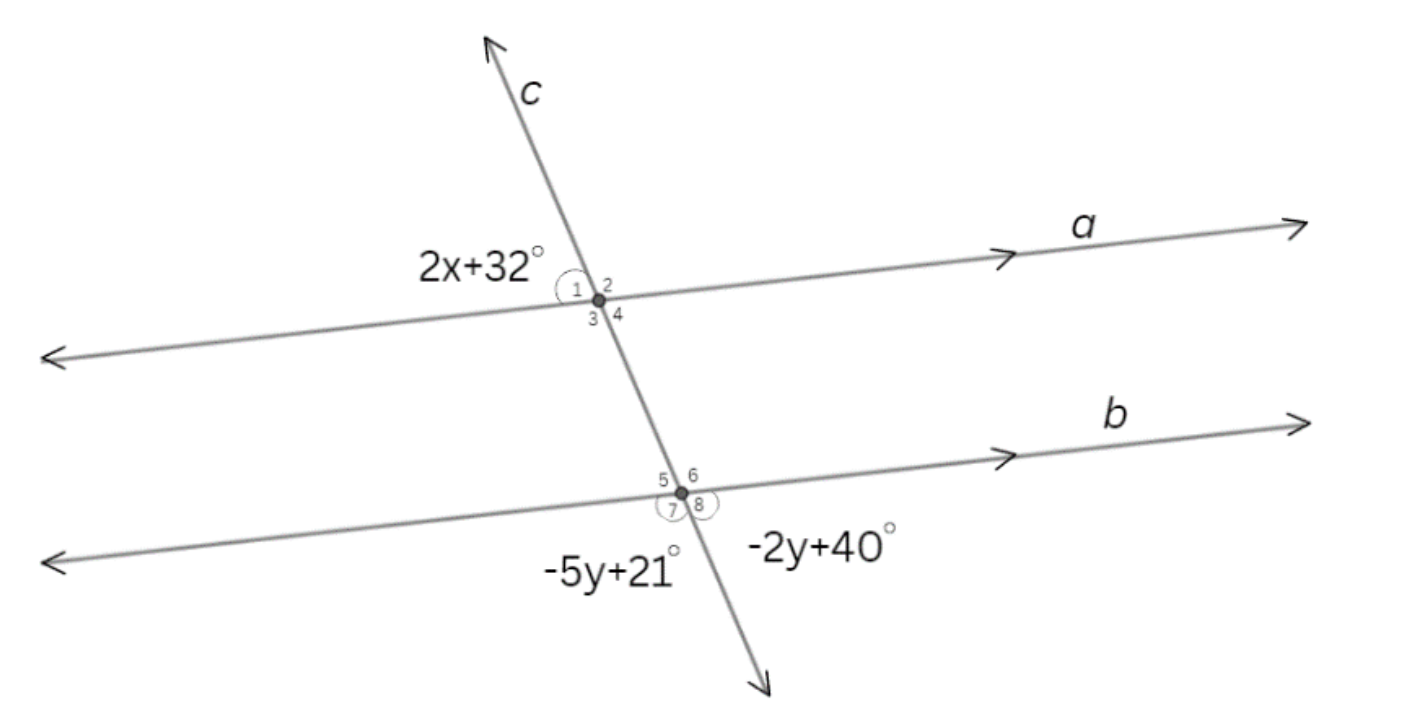
Using your knowledge of parallel lines and transversals, answer the following questions to answer the math riddle below.
Given: Lines a and b are parallel.
1 point
1
Question 17
17.
List the congruent angle pairs and how you know.
1 point
1
Question 18
18.
List the supplementary angle pairs and how you know.
1 point
1
Question 19
19.
Which angles are acute? What is the angle measured in degrees?
1 point
1
Question 20
20.
Which angles are obtuse? What is the angle measured in degrees?
Suppose your teacher has asked you to add a line d that is parallel to lines a and b. A student at
your table suggests using a ruler, lining it up with line b and dragging it down the paper an inch, and drawing a line to create the line d. Decide if your table mate’s strategy is the most mathematically correct. If not, describe the steps you would take to construct line d that is parallel to lines a and b.
Unit 2 – Item 10
One of your friends in your geometry class has been absent the last few days. Your friend missed an important lesson on proving and applying theorems about lines and angles to solve problems. Your teacher has paired the two of you up and asked you to help explain the following problems to your friend. For each problem, explain in two to three sentences how you would explain it to your friend.
1 point
1
Question 21
21.
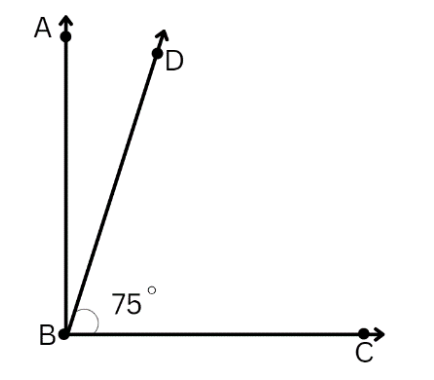
How can you prove the m<ABD, given the M<DBC is 75 degrees and AB is perpendicular to
BC?
1 point
1
Question 22
22.
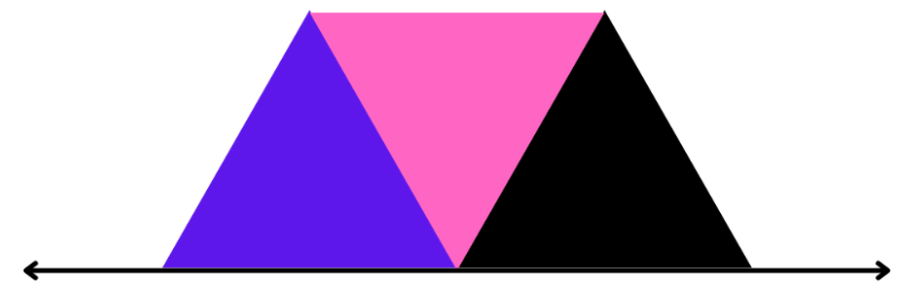
Based on the image below and the given information that all three triangles are congruent, provide an argument using geometric theorems such as parallel lines cut by transversals,
angle-angle criterion and/or the sum and exterior angle of triangles to prove they form a