Log in
Sign up for FREE
arrow_back
Library

C07 EOTT - What are the atmosphere and hydrosphere?

star
star
star
star
star
Last updated about 3 hours ago
36 questions
1
1
1
1
1
1
1
1
1
1
1
1
1
1
1
1
1
1
1
1
1
1
1
1
1
Question 1
1.

What is the atmosphere?

Question 2
2.

What gas makes up 78% of the atmosphere?

Question 3
3.

What gas makes up 21% of the atmosphere?

Question 4
4.

Carbon dioxide gives the atmosphere the ability to trap ___________.

Question 5
5.

Why is some air pollution invisible?

Question 6
6.

What temperature will a liquid evaporate at?

Question 7
7.

The boiling point of a substance is the ________________ it boils at.

Question 8
8.

A substance is heated and bubbles are observed all through the liquid. What is happening?

Question 9
9.

Where does evaporation of a liquid happen?

Question 10
10.

The holds between particles in a liquid are ________.

Question 11
11.

How does temperature affect the rate of evaporation?

Question 12
12.

What are clouds made of?

Question 13
13.

What physical process forms clouds?

Question 14
14.

The _______________ is made of all the water on or near a planets surface

Question 15
15.

Where is ground water stored?

Question 16
16.

What are the main stores of salt water?

Question 17
17.

Where is water stored as ice on Earth?

Question 18
18.

How is water stored in the Earth's atmosphere?

Question 19
19.

What is potable water?

Question 20
20.

Ground water is an important resource because it is a supply of _____________ water.

Question 21
21.

Why can a source of pollution contaminate large areas of ground water?

Question 22
22.

Is the water cycle caused by a chemical or physical process?

Question 23
23.

Water circulating the Earth in a massive planet wide system is called the ___________ ___________.

Question 24
24.

How is water transferred into the atmosphere?

Question 25
25.

________ surface and ground water flows towards the sea.

The atmosphere is a mixture of substances which are mostly in their gaseous state.
1
Question 26
26.

Match up the substances to the percentage of them that is found in the atmosphere.

Draggable itemarrow_right_altCorresponding Item
Nitrogen
arrow_right_alt
21%
arrow_right_alt
arrow_right_alt
5
Water is constantly circulating around the Earth in a massive planet wide “water system” called the water cycle.
2
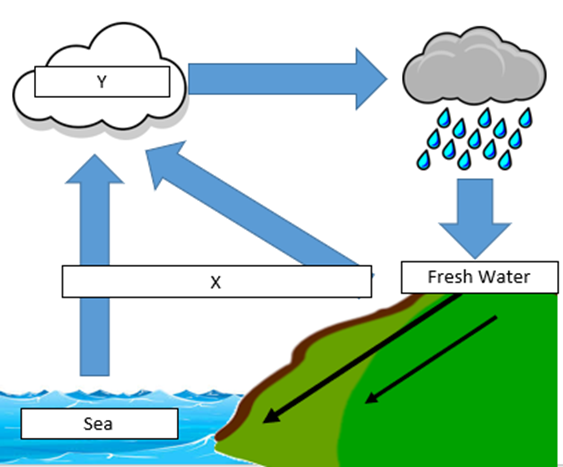
Question 28
28.
X _______
Y _______
2
Question 29
29.
Use the words below to complete the paragraph to explain how clouds are formed. You will not need to use all words.

Evaporate, solid, gaseous, vapour, condense, liquid, sub-microscopic.

Water vapour in the air can _______ around tiny _______ particulates in the air. These tiny _______droplets can form large groups we call clouds.
We call all the water on or near the Earth’s surface the hydrosphere.
5
Question 30
30.

Where are the five main stores of water on Earth?

1
Question 31
31.

About 0.65% of the water on earth is stored as groundwater. Some of the groundwater is stored in rocks.

Draw on the picture where ground water in rocks is stored.

1
Question 32
32.

In many places ground water is an important resource because it is a source of potable water.
1
Question 33
33.

What is potable water?

1
Question 34
34.

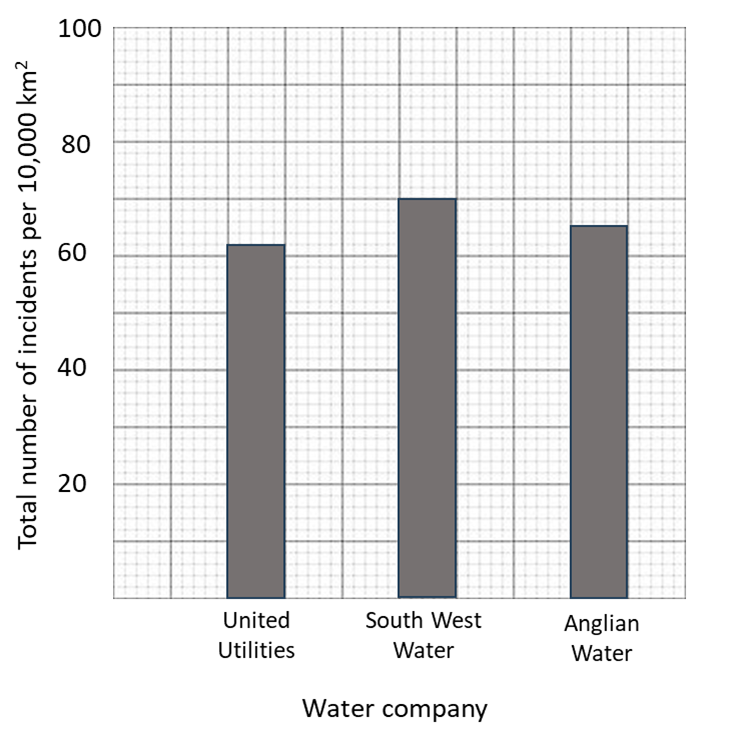
Human activities can contaminate groundwater stores. Sometimes contamination is caused by the sewage and waste from homes, which is managed by water companies.

The graph below shows the sewage and waste pollution in the UK by different water companies.

Which water company had 65 incidents per 10,000 km2?

1
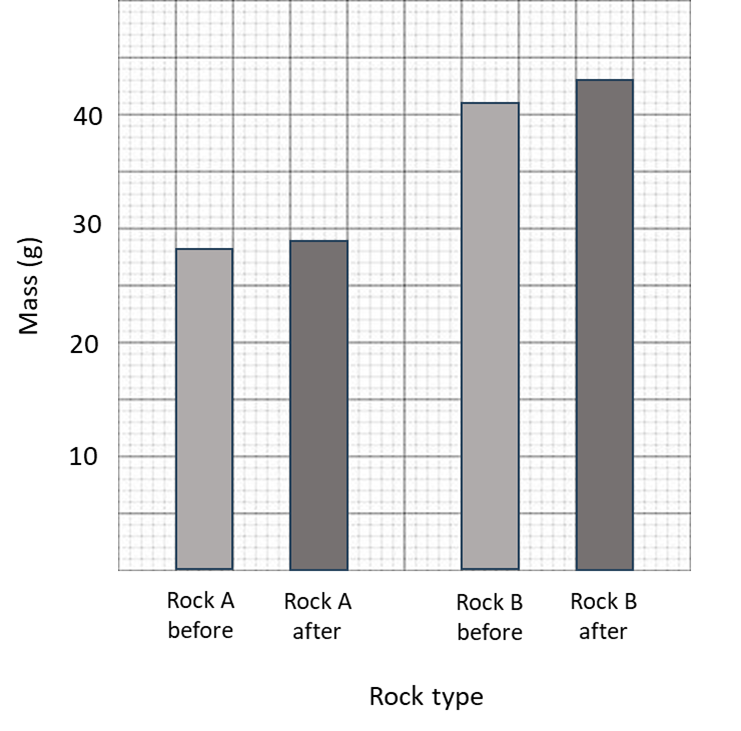
Some groundwater is stored in rocks. A student was interested in the permeability of different rocks and how this can affect the amount of water that they can store.
4
Question 36
36.

The graph below shows the mass of rocks before and after being put in a beaker of water.

Calculate the percentage change in mass of rock B.

Percentage change in mass = (change in mass ÷ initial mass) x 100

Oxygen
0.04%
Carbon dioxide
78%
Question 27
27.

Air pollution can be visible or invisible. Carbon dioxide is an invisible pollutant that is released into the atmosphere from combustion of fossil fuels.

Complete the pie chart from the table of data showing carbon dioxide emissions.

Where does all ground water flow slowly towards?
Question 35
35.

How many incidents per 10,000 km2 did United Utilities have?