Log in
Sign up for FREE
arrow_back
Library
8D Quick quiz
By Katie Bruce
star
star
star
star
star
Share
share
Last updated 5 months ago
22 questions
Add this activity
1
1
1
1
1
1
1
1
1
1
1
1
1
1
1
1
1
1
1
1
4
3
Question 1
1.
Two kingdoms that contain many unicellular microorganisms are:
viruses and bacteria.
animals and plants.
yeast and fungi.
prokaryotes and prototists.
Question 2
2.
One feature of all prokaryotes is that they:
have chloroplasts.
do not have nuclei.
do not respire.
do not have cytoplasm.
Question 3
3.
Bacerial cells contain:
a strand of genes and a protein coat.
a cellulose wall
a strand of fats and a gene coat.
a peptidoglycan cell wall
Question 4
4.
Multicellular organisms need transport systems to carry materials to their cells because:
diffusion is not fast enough to do this.
diffraction is not fast enough to do this.
dissolving is not fast enough to do this.
dispersion is not fast enough to do this.
Question 5
5.
Which of these is a food often made using yeast?
chips
cheese
bread
yoghurt
Question 6
6.
Which of these shows the correct word equation for anaerobic respiration in yeast?
oxygen + glucose → carbon dioxide + water
carbon dioxide + water → oxygen + glucose
glucose → carbon dioxide + ethanol
glucose + carbon dioxide → oxygen + water
Question 7
7.
Three resources needed by all bacteria for growth are:
warmth, food and moisture.
light, carbon dioxide and glucose.
oxygen, nitrogen and mould.
darkness, moisture and nitrogen.
Question 8
8.
A product of fermentation of milk by bacteria is:
ethanol.
oxygen.
glucose.
lactic acid.
Question 9
9.
The drawing shows a bacterium.
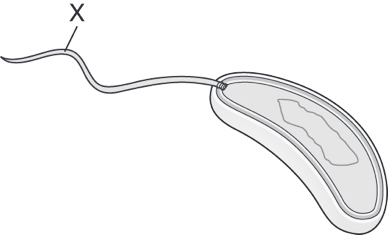
What is the part labelled X called?
tail
chromosome
cilium
flagellum
Question 10
10.
Yeast reproduce by:
binary fission
binary fusion
fermentation
budding
Question 11
11.
The graph shows the growth of a population of yeast.
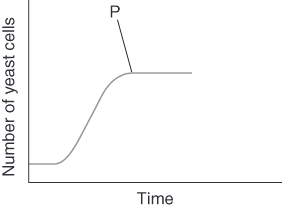
At point P the graph becomes level. One reason for this might be that:
the yeast cells can only grow to a certain size.
the food for the yeast has started to run out.
it has got dark and there is not enough light for the yeast to grow.
the carbon dioxide for the yeast has started to run out.
Question 12
12.
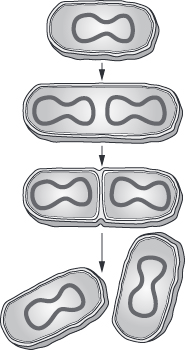
What process is shown in the diagram?
globulisation
globalisation
binary fission
glandibular separatisation
Question 13
13.
Three resources needed by algae are:
carbon dioxide, darkness, food.
water, warmth, light.
nitrogen, salt, water.
oxygen, glucose, darkness.
Question 14
14.
In total, the organisms that contain the most energy in a food web are the:
producers.
secondary consumers.
primary consumers.
top predators.
Question 15
15.
The drawing shows an
Amoeba
.
What does it use the parts labelled Y for?
photosynthesis
moving substances in and out of the cell
controlling the cell
storage
Question 16
16.
Why is light important for photosynthesis?
It transfers energy from the Sun.
It lets the organisms see.
It warms up the ground.
It contains chlorophyll.
Question 17
17.
A decomposer is:
an organism that spends a lot of its time asleep.
an organism that is used to remove poisons from contaminated soils.
an organism that breaks down dead organisms and animal wastes.
an organism that has ten legs.
Question 18
18.
Examples of organic compounds include:
sodium chloride, magnesium oxide and ammonium nitrate.
fish, meat and eggs.
water, oxygen and carbon dioxide.
glucose, proteins and fats.
Question 19
19.
Decomposers are important because they:
allow recycling of compounds
do not produce very much carbon dioxide.
can move very fast and escape from predators.
produce oxygen.
Question 20
20.
Which pair of processes both release the same products?
fermentation and photosynthesis
photosynthesis and aerobic respiration
photosynthesis and combustion
aerobic respiration and combustion
Question 21
21.
Select the statement that applies to bacterial or plant cells
Bacterial cells
Plant cells
Contains plamsids
contains cellulose cell wall
flagella used for movement
contains chlorplasts
Question 22
22.
Explain why yeast is suitable for making bread