Answer all the questions.
Identify the statement that best describes artificial intelligence.
Identify the programming language that is not used when programming AI systems.
Identify the correct description of a heuristic approach.
Match each description to either Machine learning or Deep learning.
Deep learning | Machine learning | |
|---|---|---|
needs only a small amount of training data | ||
problems are solved in an end to end manner | ||
enables machines to make decisions with the help of artificial neural networks | ||
has clear rules to explain how decisions were made | ||
makes use of modular approach at design and training stages | ||
needs vast amounts of data during training and development | ||
enables machines to make decisions on their own based on past data | ||
makes decisions based on its own logic so the reasoning may be difficult to interpret |
Describe three features you would associate with:
i) reinforcement learning [3]
ii) supervised learning. [3]
Explain why these applications are regarded as artificial intelligence.
i) Chat bots [2]
ii) Search engines [2]
iii) Photographic enhancement applications [2]
Explain the difference between the A* algorithm and Dijkstra’s algorithm.
The following graph (network) shows how long it takes (in seconds) to walk between ten hotels in a city.
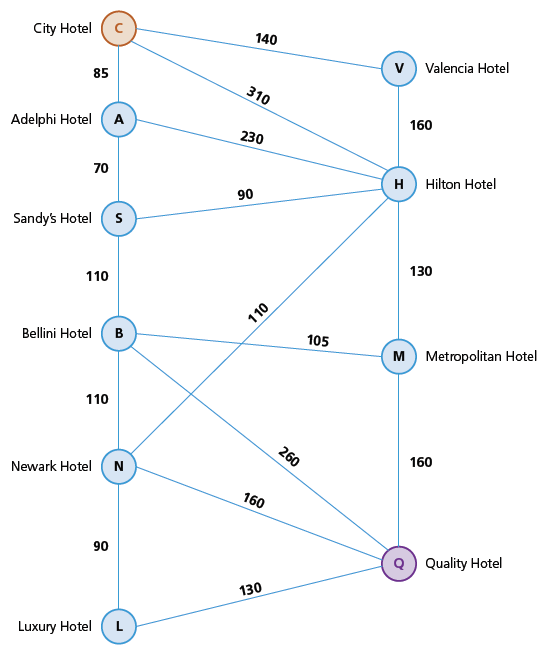
Using Dijkstra’s algorithm, show the shortest time to walk from the City Hotel (C) to the Quality Hotel (Q).
Give the route corresponding to your answer in question 9 above.
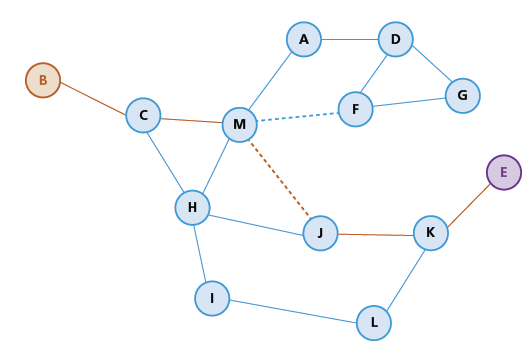
Tom is using a GPS device to navigate from point B to point E.
Tom’s GPS uses the A* algorithm to find the shortest route:
B → C → M → J → K → E
This route is shown in orange on the diagram.
However, due to some major flooding, routes M to J and M to F have been closed, making the original path no longer possible.
Describe how the GPS system will use the A* algorithm to find an alternative
route from B to E.