LR257.4.1: Formative Heredity and Traits

Last updated 11 months ago
33 questions
Required
1

Look at the mother and daughter in this picture. What similarities are there between them? (choose 2)

The mother and her daughter look the same in many ways. They both have brown, curly hair. Move to the next page to learn why the mother and daughter have so many similarities.

Heredity


This mother and daughter share many characteristics, including hair type and eye color. A parent's son or daughter is known as that person's offspring. A specific characteristic that an organism can pass to its offspring is a trait. This child's mother and father both passed down traits to her. The passing of traits from parents to offspring is called heredity.


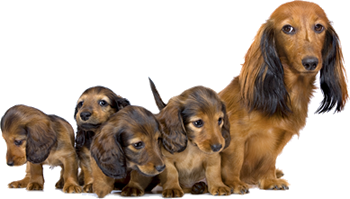
This dog and her puppies share similar traits such as the color of their fur and their floppy ears.


When an organism gets traits from their parents or ancestors, we call those traits inherited traits.
Required
1

Which of these traits might Frank have passed down to his son Jeffrey? (choose all the inherited traits)

An inherited trait is a specific characteristic that an organism can pass down to its offspring. Shirt color is not a trait that can be passed down from parent to offspring. Hair color, type of hair, eye color, and nose shape are all examples of traits that can be passed down to an organism's offspring.
Required
1
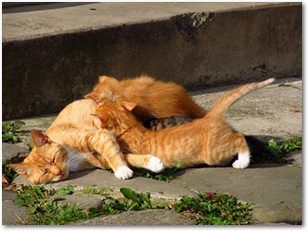
These kittens have the same fur color and short ears as their mother. Their mother passed down these physical traits to her kittens. This is an example of__________.
Required
1
Match the offspring to its parent plant.
Other Answer Choices:
A parent basil plant and its offspring share similar traits, like their slightly rounded leaves. The parent sunflower and its offspring also share similar traits, like their long stems.
There are other types of traits. The environment and education can cause an organism to have new or different traits. These traits are called acquired traits because they are acquired, or gained, by living in a specific environment.
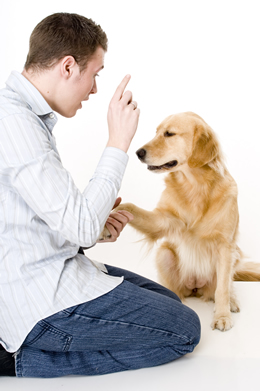
Dogs can learn how to shake hands. This is an acquired trait. The dog is not born able to shake hands, and will not pass down the knowledge to its offspring.
Required
1

Do you think organisms pass on acquired traits to their offspring?

Acquired traits are not passed to an organism's offspring, unlike inherited traits.
Required
1

You just learned that an acquired trait is not passed on to offspring. Which of these is an acquired trait that a human might have?


The ability to read is an acquired trait. Our parents do not pass down the ability to read when we are born. Other people, such as teachers or parents, have to teach people how to read.

Check for Understanding:
Many factors can lead to acquired traits, including
1. education
2. food and diet for Understanding:

An inherited trait is a specific characteristic that an organism can pass to its offspring.
An acquired trait is a trait that you get through the environment

Heredity is the passing of traits from parent to offspring.
Required
1

You find a cat hiding under your porch. The cat is very small and skinny. You leave food out for it, and over time it puts on weight. Explain what caused the cat’s trait of small and skinny size.

Required
1

Will an over weight female dog give birth to all over weight dogs?

Required
1

Which of the following is an example of an animal using an acquired trait? (choose 2)

The chimp had to learn to use tools. The dog had to be taught to fetch the paper. The other animals are doing things they did not need to be taught.
Required
1

What is an acquired trait?

Required
1

What is an inherited trait?

Required
1
Marissa's Uncle Patrick became rich by working hard his whole life. He had millions of dollars by the time he died. When he died, he gave all his money to Marissa. The millions of dollars are similar to an__________trait for Uncle Patrick. The millions of dollars are similar to an__________trait for Marissa.
Required
1

Which of these is an acquired trait?

Mendel's Pea Plant Experiments

Many people have studied how traits are passed down from parents to offspring. The scientific study of heredity and variation in organisms is called genetics.


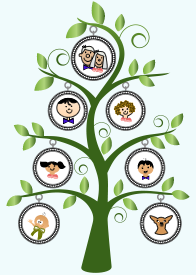
A family tree shows the relationship between people in several generations of a family. Many traits are passed down over several generations of offspring.


Much of what scientists know today about heredity comes from the experiments of Gregor Mendel. His experiments form the basis of modern-day genetics.
During the mid-1800s, Gregor Mendel tended a large garden with many pea plants. He wondered why different plants had different traits such as stem height, seed color, seed shape, and flower color. He observed that the pea plants’ traits sometimes matched those of their parents, but other times they differed.

Mendel’s pea plants did not all look the same. For example, some pea plants had longer stems than others, and some had different colored seeds.

To find out why different plants had different traits, Mendel conducted several experiments. Mendel studied traits that had different forms. For example, the size of a pea plant can be tall or short, and the color of a seed and pod can be green or yellow.
For his experiments, Mendel used true breeding plants, which are offspring that come from many generations of parents that share the same traits. For example, true breeding plants that produce yellow pods come from parent plants that produced yellow pods. Those parent plants also came from parents that produced yellow pods.

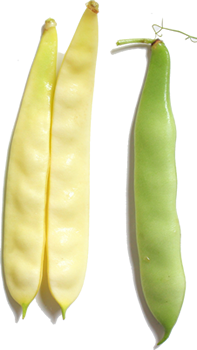
This is a true breeding plant that comes from many generations of plants with smooth, green pods.
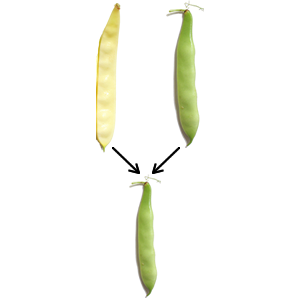
Usually, pea plants are self-pollinating. This means that pollen from a flower lands on the pistil of the same flower to begin the fertilization process. Instead of studying self-pollinating pea plants that have the same exact traits, Mendel developed a method called cross-pollination. Mendel took the pollen of one purebred plant and used it to fertilize another purebred plant with a contrasting form of a trait. For example, he paired a plant that produced yellow pea pods with a plant that produced green pea pods.

The first plants that Mendel cross-pollinated were the parent plants, or the parental generation (P). The plants that resulted from Mendel’s cross-pollination were called the first filial generation (F1). In his experiment, Mendel found that every single plant from the first generation produced green pods. It appeared to Mendel that the other trait, yellow pods, had disappeared.
Required
1
Mendel used true breeding plants in his experiments. These plants came from generations of plants that have__________form of a trait.
For his experiments, Mendel used true breeding plants, which are offspring that come from many generations of parents that share the same traits. For example, when Mendel studied how seed color is passed from parent to offspring, he used plants that came from generations of plants with the same seed color.
Required
1

Mendel’s experiments form the basis of __________, the scientific study of heredity and variation in organisms.

Genetics is the scientific study of heredity and variation in organisms. Mendel's findings form the basis of modern-day genetics.
Required
1

Mendel paired plants that produced yellow pods with plants that produced green pods. Which color pods did the resulting plants produce?

All the plants that resulted from the first experiment produced green pods.

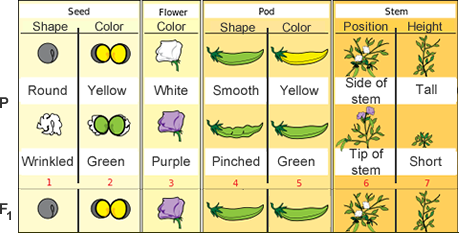
Mendel conducted similar experiments for other traits as well. In addition to pod color, he studied seed shape, seed color, flower color, pod shape, flower position, and stem height. He continued to pair contrasting traits and produced the following results:


As with the pairing of the green pea pod plants and yellow pod plants, all of the plants that resulted from the various pairings always produced only one form of each trait. For example, pairing a plant with a wrinkled pea shape and a plant with a rounded pea shape always resulted in plants that produced round-shaped peas in the first generation. Rounded pea shape, yellow seed color, smooth pod shape, green pod color, purple flower, flowers on the side of the stem, and tall stems were the traits that always showed up in the first filial generation, while the contrasting forms of these traits seemed to disappear.
Required
1

In his first round of experiments, which of the following did Mendel observe in the offspring?

Mendel observed that one trait was dominant and appeared in all of the offspring, while the contrasting forms of these traits seemed to disappear.
Required
1

What probably happened to the traits that were not present in the first filial generation plants?

Mendel conducted a second round of experiments and found that the traits that seemed to disappear in the first filial generation plants showed up again in some of the offspring of the later plants. The next slide tells how Mendel continued his experiments and his results.
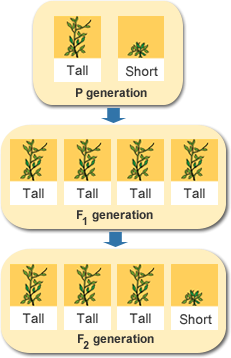
In his next round of experiments, Mendel let the full-grown first-generation plants self-pollinate. The offspring that resulted from the first-generation were called the F2 or second-filial generation. His results were even more surprising than they were in the first round. He found that the traits that had seemed to disappear in the first generation reappeared in a small amount of the plants in the second generation.

For example, when he paired a true breeding plant that produced green pods with a true breeding plant that produced yellow pods during his first round of experiments, the first-generation plants always produced green pods. However, when Mendel let the first-generation plants self-pollinate during the second round of experiments, he found that about three-fourths of the second-generation plants produced green pods. About one-fourth of the second-generation plants produced yellow pods. The yellow pod trait that had seemed to disappear in the first generation reappeared in the second generation!

Mendel found this to be true for all of the other traits he observed. Though the numbers were not exactly the same for every trait, he was able to observe a pattern: the trait that disappeared in the first-generation plants reappeared in about one-fourth of the second-generation plants.
For example, the first-generation plants all had tall stems, but when they were allowed to self-pollinate, one-fourth of the second-generation plants had short stems.
Required
1

Which plants that Mendel used in his experiments were true breeding?

During his first round of experiments, Mendel cross-pollinated true breeding plants. He cross-pollinated true breeding plants that had contrasting traits.
Required
1

True or False: After the first-generation plants self-pollinated, all of the second-generation plants had the same forms of the same traits.

Mendel noticed a pattern in the second-generation plants. The trait that had disappeared in the first generation reappeared in about one-fourth of the second-generation plants.
Required
1

During his first round of experiments, Mendel paired a true breeding pea plant with white flowers with a true breeding pea plant with purple flowers. The first-generation plants all produced purple flowers. Next, he let the first generation self-pollinate to create the second generation. Drag the flowers to the box to show how many second-generation plants would have purple flowers and how many would have white flowers.

The trait that seemed to be lost in the first-generation pea plants reappeared in about one-fourth of the second-generation plants. Mendel concluded that each plant must have two individual factors that control the inheritance of traits in peas. Each parent contributes one factor. One factor comes from the female parent, while the other factor comes from the male parent. Some traits can only be seen if the offspring received two factors of the trait, while other traits could be seen even if only one factor of the trait was present in the pair.

This offspring received two traits, one from each parent. It received one yellow pod trait and one green pod trait.


This means that some factors can dominate, or take over, other factors. For example, when Mendel observed the pea shape trait, all of the first-generation offspring produced round peas. The wrinkled pea trait seemed to disappear, and the rounded pea trait seemed to take over. This happened in each variation of the traits in the first-generation plants. One variation of the trait took over the other variation of the trait. Even though one form of a trait was not seen in the first generation, Mendel concluded that it was still passed on to the offspring.
Check for Understanding:

1. Genetics is the scientific study of heredity and variation in organisms.

2. Much of what is know about genetics comes from Gregor Mendel's experiments with pea plants.

3. To understand why pea plants displayed specific traits, Mendel cross-pollinated true breeding pea plants with contrasting traits.

4. In all of the first generation plants that results from the pairings, only one form of the trait appeared, with the other trait seeming to disappear.

5. When the first generations plants self-pollinated, the traits that seemed to disappear was produced in one-fourth of the second generation plants.

6. Mendel concluded that an offspring received two individual factors that control the inheritance of traits. One factor comes from each parent.
An offspring receives two individual factors that control the inheritance of traits. Today, scientists know that these “factors” are found in a person’s genes. Genes are segments of DNA that determine traits and are passed down from parents to offspring. This causes offspring to inherit certain traits from their parents. For example, eye color is determined by genes that people inherit from both parents, in the same way that seed color in Mendel’s experiments was determined by the genes that the pea plants inherited from their parent plants.

This mother and son have the same eye color. This is a trait the little boy inherited from his mother.
The form of a trait that is seen in an offspring is determined by alleles. Alleles are different forms of a gene that produce the variations in a genetically inherited trait. For example, there is an allele for yellow seed color and an allele for green seed color. A pea plant receives an allele for seed color from each parent. They might be alleles for the same seed color, or they might be alleles for different seed colors.

Some forms of a trait can dominate, or take over, the other form. A dominant allele is an allele that is always expressed in an organism's appearance and physical traits when the allele is present. The dominant allele takes over other alleles. A recessive allele is an allele that is only expressed when no dominant allele is present for that gene. It is only expressed when there is no dominant allele to take it over. Even if a recessive allele is taken over by a dominant allele in an organism, it can still be passed on to offspring.
For example, the rounded pea trait is the dominant allele that will always appear in a pea plant's physical traits when that allele is present in the organism. If that allele is present, the wrinkled pea trait is hidden.

In order for the recessive allele to be seen in an organism's physical traits, the organism must receive the recessive allele from both parents. For example, a plant must receive the white flower trait from both parents in order for it to be seen in its physical traits.

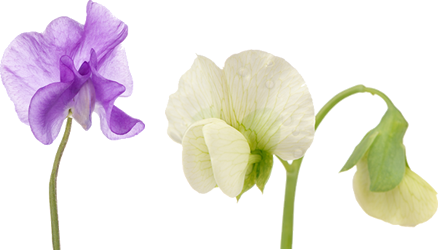
Purple flower color is the dominant allele. An offspring only needs to receive this allele from one parent in order for this trait to be present in its physical appearance. If an offspring receives two white flower alleles from its parents, it will produce white flowers.
Required
1
Fill in the blanks to complete the sentences below.

An offspring receives __________factor(s) from each parent, which help determine the offspring's traits.
Today, scientists call the DNA controlling a particular trait a __________. The "factors" that Mendel observed are different versions of a gene, which are called __________. These produce the variations seen in an inherited trait.
An offspring receives one factor from each parent, which help determine the offspring's traits. Today, scientists cal the DNA controlling a particular trait a gene. The "factors" that Mendel observed are different versions of a gene, which are called alleles. These produce the variations seen in an inherited trait.
Required
1
__________alleles are always expressed in an organism’s physical traits when the allele is present. However,__________alleles are hidden whenever the __________allele is present.
A dominant allele is an allele that is expressed in an organism's physical traits whenever the allele is present. On the other hand, a recessive allele is hidden whenever the dominant allele is present.
Required
1

In horses, a black coat is dominant over a chestnut coat. A purebred, or true breeding, black horse is paired with a purebred chestnut horse and produces first-generation offspring. Select the horse that looks most similar to what the first-generation offspring will probably look like.

Required
1

A male horse with one dominant and one recessive allele for coat color pairs with a female horse that also has one dominant and one recessive trait for coat color. If a black coat is the dominant trait, about how many of their offspring will have a chestnut coat?

About one-fourth of the offspring will have a chestnut coat. Only offspring that inherit two recessive alleles, one from each parent, will have a chestnut coat because the chestnut coat is recessive.

Check for Understanding:

1. An offspring receives two individual factors, one from each parent, that controls the inheritance of traits.

2. These individual factors called genes. Genes are segments of DNA that determine traits and are passed down from parents to offspring.

3. The form of a trait that is seen in an offspring is determined by alleles. Alleles are different forms of a gene that produce the variation in a genetically inherited trait. A dominant allele is an allele that is always expressed when the allele is present. A recessive allele is an allele that is only expressed when no dominant allele is present.

4. In order for the recessive allele to be seen in an organism's physical traits, the organism must receive the recessive allele from both parents.
Required
1

What is heredity?

Required
1

What is genetics?

Required
1

What are genes?

Required
1

Alleles are __________.

Required
1

A trait is __________.

Required
1

What is a dominant allele?

Required
1

What is a recessive allele?

Required
1

True or False: When a dominant allele is present, the recessive allele is gone forever.