Log in
Sign up for FREE
arrow_back
Library

Science 8- Testlet 002 - Physical Science

star
star
star
star
star
Last updated about 3 hours ago
7 questions
Required
1
6-8.PS1.A-4
MS-PS1-4
Required
1
6-8.PS1.A-4
MS-PS1-4
Required
1
6-8.PS1.A-4
MS-PS1-4
Required
1
6-8.PS1.A-2
MS-PS1-2

Snow Day

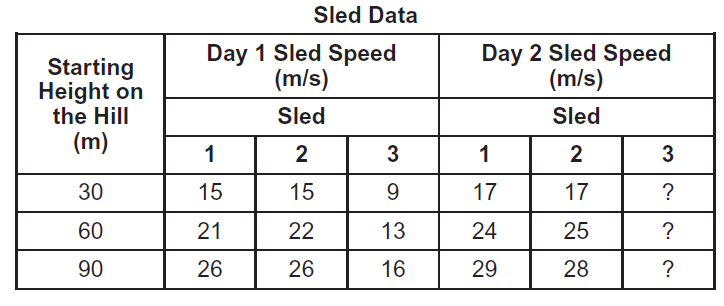
Some researchers were given the task of determining which factors affect downhill snow sledding speed at a public park. On Day 1, a sledder rode three different types of sleds down a snow-covered hill from starting heights of 30, 60, and 90 meters (m). The combined mass of the sledder and each sled was 80 kilograms (kg). The sledder wore a helmet for safety. On day 2, the sledder and researchers returned to the same hill to continue collecting data. The snow had melted slightly and then had frozen again overnight. The snow-covered area was more like a solid sheet of ice than the fresh snow from the day before. On day 2, the timing of sled three was not completed because heavy rain started. The table below shows the data collected on sled speed in relation to the different starting heights on the hill. Each sled speed indicates the average speed at which the sled traveled from the starting height on the hill to the bottom of the hill.
Required
1
6-8.PS3.A-2
MS-PS3-2
Required
1
6-8.PS3.A-2
MS-PS3-2
Required
1
Question 3
3.
6-8.PS3.A-2
MS-PS3-2
Question 4
4.
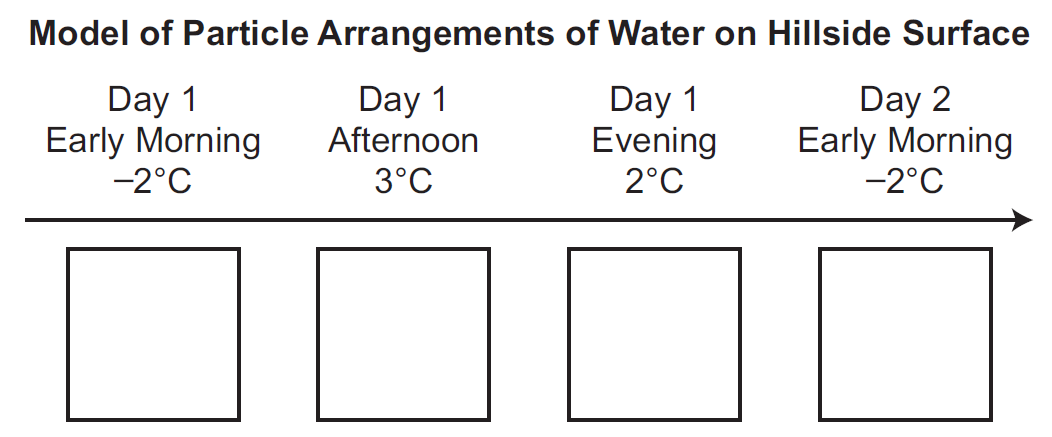
During the time between the first snow day and the second snow day, the temperature
changed.
Drag the correct picture in each box to best represent the water particle arrangement for each temperature. The pictures may be used once, more than once, or not at all.
Other Answer Choices:
Question 5
5.

Part A: How did the thermal energy of the water particles in the snow change as the temperature increased?

Question 6
6.

Part B: Explain how the motion of the water particles changed as the temperature increased.

Question 7
7.
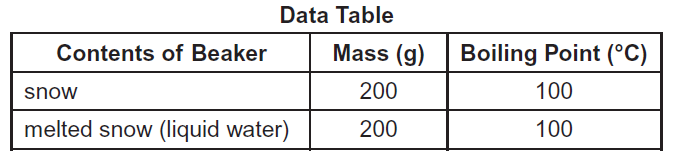
A group of students wanted to investigate whether the melting snow during the sledding day was a physical or chemical change. They followed these steps for the investigation.
  1. Collect a large clump of snow and place half of it into a container in a freezer.
  2. Place the other half of the snow into a container on a tabletop.
  3. After the snow on the tabletop melts, place 200 grams (g) of it into a beaker.
  4. Place 200 g of snow from the freezer into another identical beaker.
  5. Measure the boiling point of the contents of each beaker with a thermometer.
They recorded their measurements in the data table below.


The students determined the __________ of both the snow and liquid water.
The snow went through a __________ as it became liquid water.
Question 1
1.

Choose a phrase in the set of options to correctly complete the sentence based on the Sled Data table from the passage.

At the starting height of 90 m, the sledder:

Question 2
2.
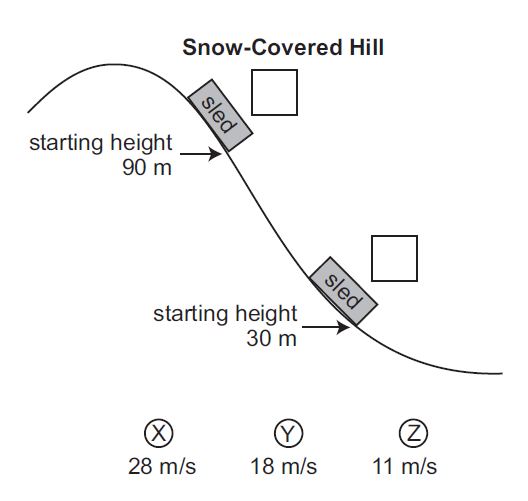
Based on information from the Sled Data table, write the letter of a label in each empty box to show the speed at which sled 3 would most likely have moved on day 2 from each starting height.
Other Answer Choices:
x
Y
Z
At the beginning of the test, the__________ force on the sled caused it to accelerate down the hill. When the sled reached the level snow-covered area, the__________ force caused the sled to slow to a stop.