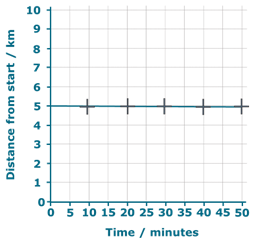
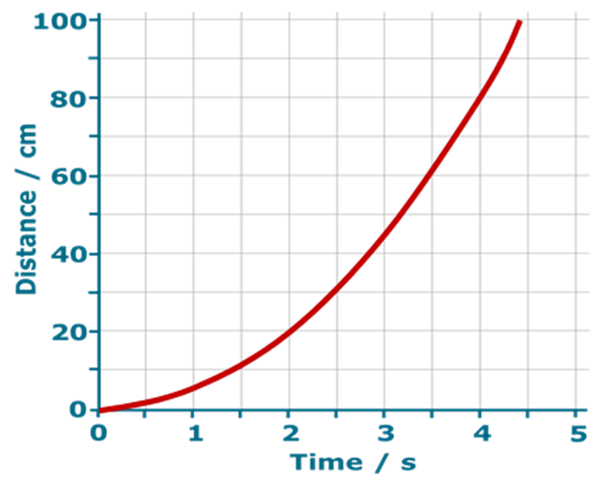
What is the graph showing?
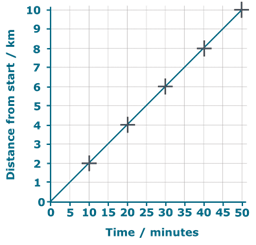
What is the graph showing?
Which of the following sets of equipment would be most useful for measuring the average speed of a slow moving object:
Which of the following sets of equipment would be most useful for measuring the instantaneous speed of a fast moving object:
Describe the motion of an object that is at equilibrium?
Which of the following objects is not at "equilibrium"?
Which of the following statements describes an object that has positive acceleration:
Which of the following statements describes an object that has negative acceleration (deceleration):
How does a distance-time graph (D-T graph) show the distance of an object from its starting point
How does a distance-time graph (D-T graph) show the speed of an object
How does a distance-time graph (D-T graph) show if an object is stationary
How does a distance-time graph (D-T graph) show if an object is moving towards its starting point
What is a fluid?
What force do fluids exert on a moving object?
Why do liquids produce more drag than gases?
What is relative motion?
How do we calculate the relative motion of two objects moving in opposite directions?
What is the correct equation for speed?
What is acceleration?
What is the graph showing?
What is the graph showing?
How does a resultant force change an objects motion?
Speed is a measure of how far an object has moved in a particular time.
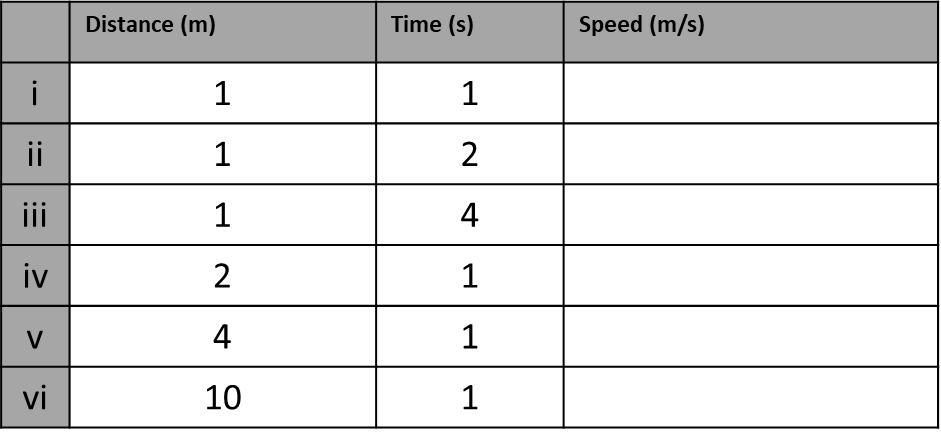
Use the equation speed = distance ÷ time to calculate the speeds of the objects i to vi in the table.
Object A takes longer to travel the same distance than object B.
Does object A have a higher or lower speed?
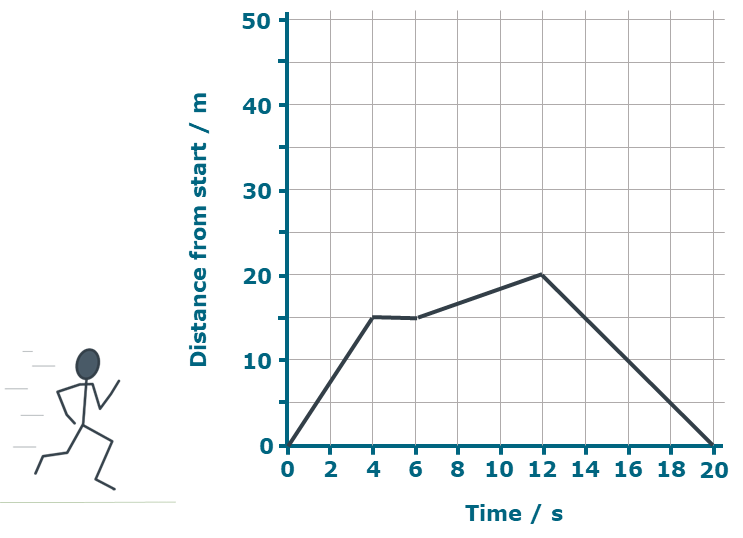
Devontae was running in the playground and made a distance time graph of his journey.
How far does Devontae move in the first 4 seconds?
What is happening to Devontae’s motion between 4-6 seconds?
Describe Devontae's motion between 12 and 20 seconds.
Include whether he is moving away from, or towards his starting point.
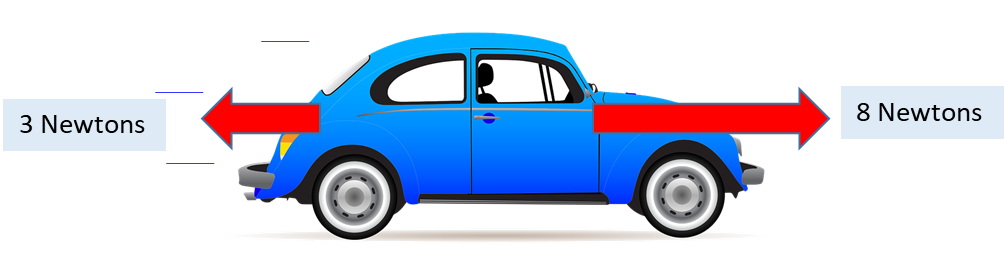
A car has two forces acting on it:
What is the resultant force on the car?
Describe how the distance – time graph shows the car is accelerating.
A plane is flying through the air at a high speed.
What force will be pushing back against the plane as it moves forwards.
What will happen to the size of the force pushing back if the plane starts moving faster?
Explain why the force pushing the plane back will change if it starts moving faster.
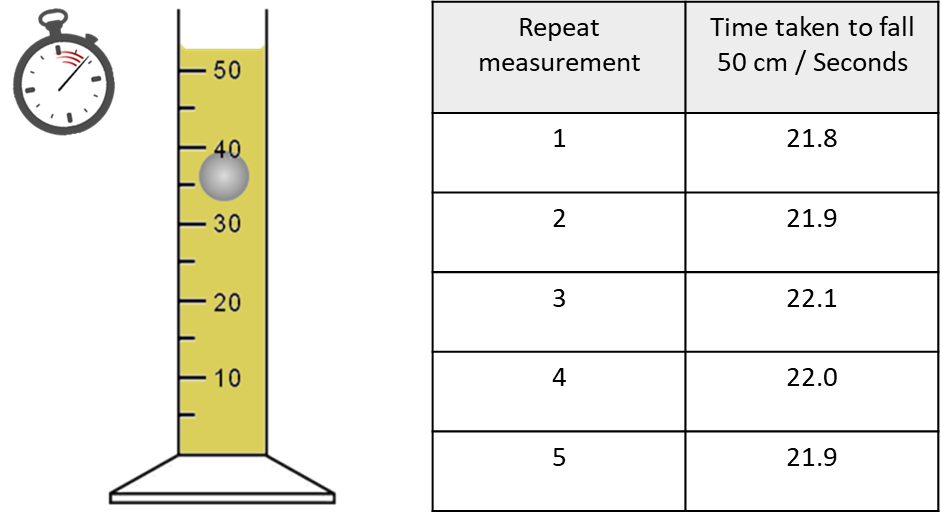
A student measures the time it takes a metal ball to fall through 50 cm of fluid.
The student measured a value that was slightly different each time. What sort of error is causing these small unpredictable differences?
Object A travels a larger distance than object B in the same amount of time.
Does object A have a higher or lower speed?
Describe the difference between average and instantaneous speed?
Is Devontae moving faster between 0-4 seconds or between 6-12 seconds?
Calculate the average time taken for the ball to fall 50 cm.
Explain why the student took repeat readings and calculated an average.