Office Etiquette: A Deep Dive - Lesson Description
This formative lesson, "Office Etiquette - A Deep Dive," is designed to help students analyze and apply professional workplace norms. Through a variety of activities, students will explore the key principles of office etiquette, practice responding to different workplace scenarios, and reflect on their own professional behavior. The lesson uses app.formative.com to facilitate student responses, collaboration, and reflection.
Here's a breakdown of the lesson's key components:
•
Provocative Opening: The lesson begins with a reflective question, prompting students to think about times they have witnessed or experienced a breach of office etiquette and the impact it had on the situation.
•
Guided Scenario Analysis: Students will analyze two different workplace scenarios.
◦
Scenario 1 involves a coworker taking credit for another's work.
◦
Scenario 2 presents a situation where a colleague makes discriminatory comments during a video call.
◦
For each scenario, students will identify the etiquette breaches, analyze the potential impact on team productivity and morale, and suggest professional ways to address the situation, explaining their reasoning using the principles of office etiquette discussed.
•
Collaborative Playbook Creation: Students will work in small groups to create a "Situational Office Etiquette Playbook." This playbook will include examples of common workplace situations, potential etiquette pitfalls, specific examples of good etiquette, and, if possible, brief role-play elements using the app's recording feature. This playbook should act as a practical resource for future workplace encounters.
•
Formative Assessment & Reflection:
◦
Students will review their peers' playbooks and identify a useful strategy.
◦
Students will reflect on a time they personally applied an office etiquette principle in a real-life situation and share the outcome.
◦
Students will complete video responses in app.formative.com to two different office etiquette scenarios: addressing a colleague's lateness, and offering assistance after finishing work.
•
Personal Action Plan: Students will develop a personal action plan, identifying one specific area of office etiquette they want to improve and outlining how they will monitor their progress.
•
Key Takeaways: The lesson emphasizes understanding expected workplace norms, the importance of verbal and non-verbal communication, how to show respect and professionalism, techniques for addressing disagreements, the importance of professional dress and appearance, and provides examples of good and bad office etiquette.
•
Assessment: Students will be assessed on their responses to the complex scenarios, their collaborative contributions to the playbook, their reflective activities, and their ability to analyze, apply, and reflect upon office etiquette principles rather than just recall knowledge.
•
Key Principles of Office Etiquette: The lesson emphasizes understanding workplace norms, the importance of verbal and non-verbal communication (including tone, body language, and active listening), showing respect for colleagues and workplace culture, conflict resolution, and appropriate dress and appearance. The lesson also gives examples of both good and bad office etiquette.
This lesson uses a variety of methods, including discussion, scenario analysis, role-playing, and reflection to ensure students develop a comprehensive understanding of office etiquette and how to apply it in their professional lives. It encourages students to think critically about the impact of their behavior on others and promotes a collaborative and respectful learning environment.
General Instructions
•
This lesson will help you understand and apply the principles of office etiquette1.
•
You will be asked to analyze scenarios, collaborate with your peers, and reflect on your own behavior.
•
Be honest and thoughtful in your responses [previous conversation].
•
Your work will be assessed on your ability to apply the principles of office etiquette, not just recall them [previous conversation].
•
Key areas include verbal and non-verbal communication, respect, professionalism, conflict resolution, and appropriate dress [1, previous conversation].
•
Use app.formative.com to complete your work [previous conversation].
Slide-Specific Instructions:
•
Slide 2: Opening - Let's Reflect
◦
Question: Think of a time you experienced or witnessed a breach of office etiquette. How did it affect the situation, and what could have been done differently?
◦
Instructions: Submit your reflection via app.formative.com.
•
Slide 3: Guided Analysis - Scenario 1
◦
Scenario 1: A coworker takes credit for your work in a meeting.
◦
Questions (in app.formative.com):
▪
What are the key etiquette breaches in this scenario?
▪
How would this behavior affect the team's productivity and morale?
▪
What would be the most professional way to address this situation?
▪
Explain the reasoning behind your chosen course of action using principles from our discussion on office etiquette.
◦
Instructions: Respond thoughtfully to the questions in app.formative.com.
•
Slide 4: Guided Analysis - Scenario 2
◦
Scenario 2: You observe a colleague making discriminatory comments during a video call.
◦
Questions (in app.formative.com):
▪
What are the key etiquette breaches in this scenario?
▪
How would this behavior affect the team's productivity and morale?
▪
What would be the most professional way to address this situation?
▪
Explain the reasoning behind your chosen course of action using principles from our discussion on office etiquette.
◦
Instructions: Respond thoughtfully to the questions in app.formative.com.
•
Slide 5: Collaborative Activity - Situational Office Etiquette Playbook
◦
Task: In small groups, build a "Situational Office Etiquette Playbook"2.
◦
Instructions: Using app.formative.com to create this "Playbook," include:
▪
Examples of common workplace situations (e.g., virtual meetings, project collaboration, dealing with difficult personalities).
▪
For each situation:
•
Describe the scenario.
•
Identify potential etiquette pitfalls.
•
Provide specific examples of good etiquette in that context.
•
Include brief role-play elements using app.formative.com recording feature, if possible, to demonstrate proper conduct.
◦
Note: This should be a practical, easily navigable resource for future workplace encounters.
•
Slide 6: Formative Assessment - Reflection and Application
◦
Questions (in app.formative.com):
▪
Review your peer's 'Situational Office Etiquette Playbooks.' Identify one strategy that you found particularly useful, and explain why.
▪
Describe a time you personally applied a specific office etiquette principle in a real-life situation. What was the outcome?
◦
Instructions: Respond with detailed, analytical responses via app.formative.com.
•
Slide 7: Closing - Personal Action Plan
◦
Question (in app.formative.com): Based on your work in this lesson, what is one specific area of office etiquette you plan to consciously improve? How will you monitor your progress?
◦
Instructions: Submit your personal action plan using app.formative.com.
Slide 9: Assessment
•
Instructions: You will be assessed on:
◦
In depth responses to complex scenarios within app.formative.com
◦
Your collaborative contributions to the “Situational Office Etiquette Playbook.”
◦
Reflective activities.
◦
Your ability to analyze, apply, and reflect upon the practical application of office etiquette principles rather than just recall knowledge.
Additional Points for Students
•
Remember that office etiquette involves both verbal and non-verbal communication1.
•
Pay attention to the key points of respect, professionalism and conflict resolution1.
•
Be aware of examples of good and bad office etiquette, such as interrupting someone, making fun of a coworker, and complaining3....
•
Your participation in creating the "Office Etiquette Guide" will demonstrate your understanding of the principles of office etiquette2.
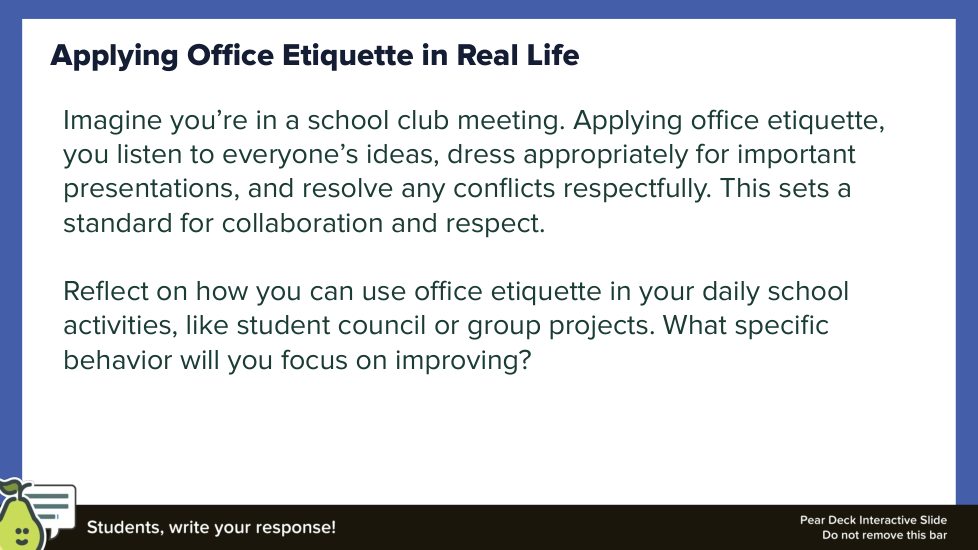
Reflect on how you can use office etiquette in your daily school activities, like student council or group projects. What specific behavior will you focus on improving?
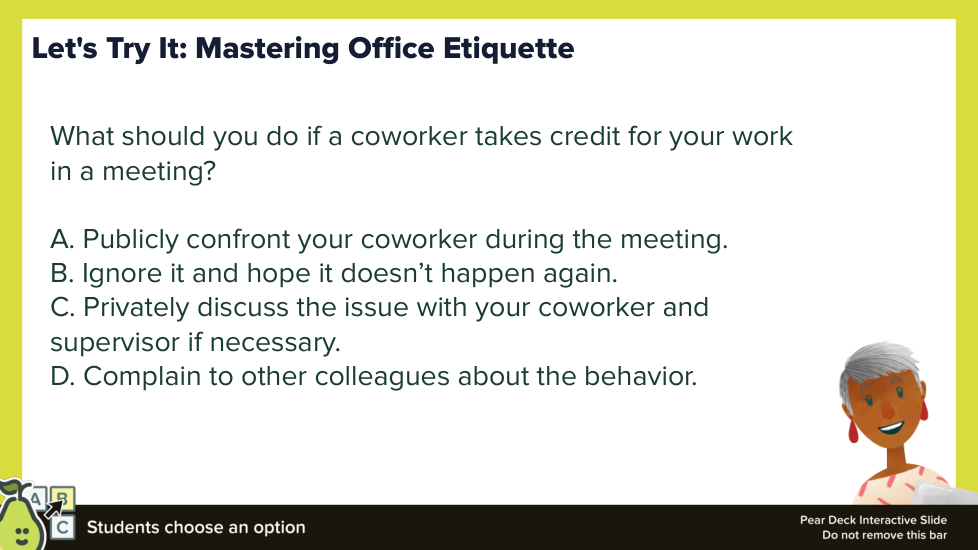
What should you do if a coworker takes credit for your work in a meeting?
Think of a time when you had to follow office etiquette in a group project. What did you do, and what was the result?
What is one thing you learned or one question you have about today's lesson? Write your response.
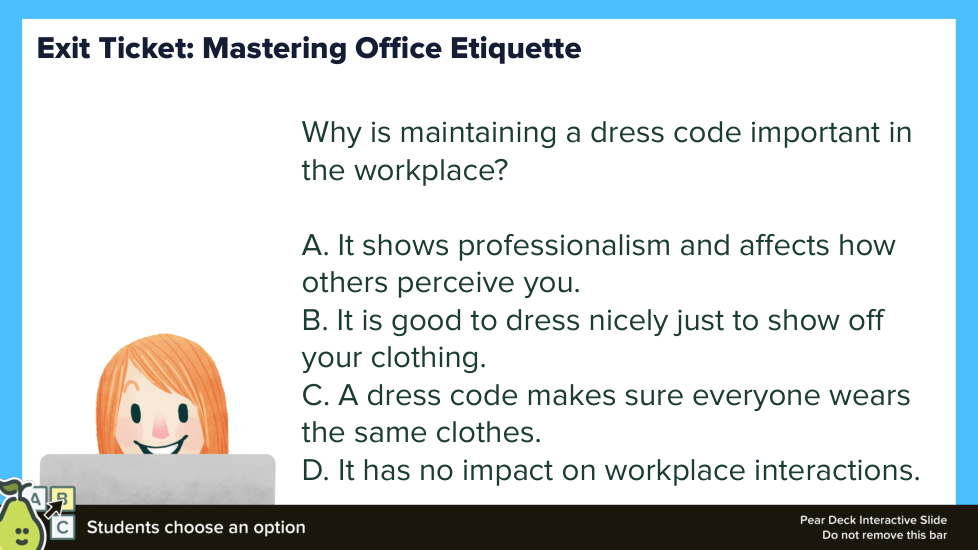
Why is maintaining a dress code important in the workplace?
B. It is good to dress nicely just to show off your clothing.