Log in
Sign up for FREE
arrow_back
Library

P06 EOTT - Making images

star
star
star
star
star
Last updated 1 day ago
30 questions
Required
1
Required
1
Required
1
Required
1
Required
1
Required
1
Required
1
Required
1
Required
1
Required
1
Required
1
Required
1
Required
1
Required
1
Required
1
Question 1
1.

Question 2
2.

Question 3
3.

Question 4
4.

Question 5
5.

Question 6
6.

Question 7
7.

Question 8
8.

Question 9
9.

Question 10
10.

Question 11
11.

Question 12
12.

Question 13
13.

Question 14
14.

Question 15
15.

This question looks at how a pin hole cameras produce an image.
Required
1
Required
3
Required
2
Required
1
Required
2
Required
2
Required
1
Required
2
Refraction happens when light passes through a boundary between two materials.
Required
1
Required
1
Required
3
This question is about lenses.
Required
4
Required
1
Required
2
Required
2
Which sentence best describes how light radiates out from a source
Light radiates out form all points on a source towards the detector
Light radiates out from a source towards the detector
Light is emitted in all directions from every point on a source
Light is emitted in some directions from every point on a source
What is a light ray?
an imaginary line showing one path light travels along
an imaginary line showing the only path light travels along
a single beam of light
a small group of beams of light
What does light transfer
energy and particles
energy only
energy, particles and information
energy and information
Describe the image formed from a pin hole camera?
bright, clear and inverted
dim, fuzzy and inverted
dim, clear and inverted
dim clear but not inverted
Which option describes the meaning of "inverted"
to make a reflected image of something
to make an image of something on a screen
to change the position of something, so the top of it is where the bottom of it normally is
To produce an image that is not very bright
What answer is a model of how light transfers information
source --> object --> detector
Object --> source --> detector
detector ---> object --> source
source --> detector --> object
Where does a reflection appear?
behind the mirror
on the mirror
in front of the mirror
Where is the reflection observed in the mirror produced?
By the object - the mirror
by the source of light
By the object that is seen in the mirror
By the detector - our eyes
What do we call a material light travels through
a medium
a optical material
a boundary
a fluid
What do physicists call the surface between two mediums?
a boundary
a optical material
a medium
a fluid
What can light do when it reaches a boundary?
reflect or be absorbed
Reflect, transmit, or be absorbed
reflect or transmit
Reflect only
Describe the surface of a lens
rough and curved
smooth and curved
rough and flat
smooth and flat
Which lens will refract light the most?
one with a larger surface area
one with the flattest surface
One with a more curved surface
one with a smoother surface
Which lens will refract light the least?
one with the flattest surface
one with a larger surface area
One with a more curved surface
one with a smoother surface
Images produced by lenses are
bright, fuzzy and inverted
bright, clear and inverted
dim, fuzzy and inverted
bright and clear but not inverted
Question 16
16.

Question 17
17.

Draw the rays of light from points A, B and C on the bear lamp that will reach the screen on the pin hole camera. (Use the straight line tool)

Question 18
18.

Describe the image of the bear produced by the pin hole camera.

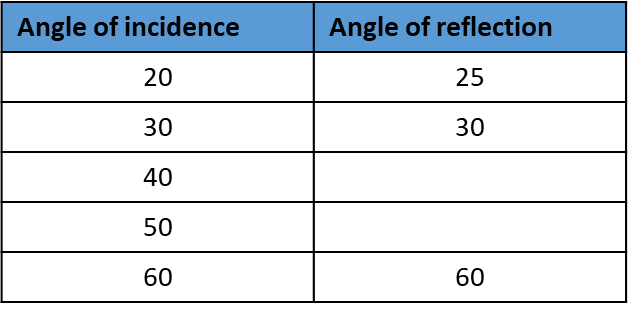
A student carries out an investigation into the law of reflection. They test 5 values of the angle of incidence and measure the angle of reflection each time.

Question 19
19.
The normal line is drawn at _______ degrees to the surface of the mirror.
Question 20
20.
Fill in the missing words to describe how the student should measure the angle of incidence:

We measure the angle of incidence from the _______ to the incident ray using a _______ .
Question 21
21.

Complete the table showing the results you would expect from this experiment

Question 22
22.

Question 23
23.

The student's experiment is reproducible. What does an experiment being “reproducible” mean?

Question 24
24.

Draw the light ray as it passes through the glass block using the straight line tool.

Question 25
25.

Describe what happens to the light ray as it passes from the air into the glass block.

Question 26
26.

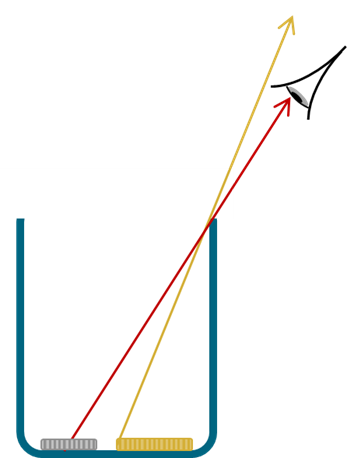
A student looking into the beaker can only see the silver coin. When the beaker of water is filled with water they can see the gold (second) coin as well. Explain why the student can only see the gold coin when there is water in the beaker.

Question 27
27.

Draw two rays of light from point a on the bear that pass through the converging lens and light up point b on the screen. i) one that passes through the point on the top of the lens ii) one ray that passes through the point on the bottom of the lens

Question 28
28.

What happens to light as it passes the surface of the lens?

Question 29
29.

What does a converging lens do to the light reaching it from one point on an object?

Question 30
30.

Why do lenses produce a brighter image then pin hole cameras?

Tick which image best shows how light is emitted from a bulb.
Which result from the table is an anomaly?


Angle of incidence 20, Angle of reflection 25
Angle of incidence 30, Angle of reflection 30
Angle of incidence 60, Angle of reflection 60