Mastering Basic Math Operations in Patient Care
star
star
star
star
star
Last updated about 1 month ago
42 questions
Add, subtract, multiply and devide
First up, addition! Let’s say a doctor prescribes two different medications for a patient. One medication is 250 mg, and the other is 150 mg. To find out the total dosage of medication the patient is supposed to take, you just add those two numbers together. 250 mg + 150 mg = 400 mg! Easy peasy!
Next, we have subtraction. Imagine a patient is supposed to take a total of 500 ml of fluid over the day, but they’ve already taken 200 ml. You’ll need to calculate how much is left for them to take. Just subtract: 500 ml - 200 ml = 300 ml remaining!
Now, multiplication comes into play! If a doctor orders a medication that needs to be taken three times a day for five days, you can find out how many total doses are needed by multiplying. That’s 3 doses/day * 5 days = 15 total doses.
Last but not least, let's talk about division. Picture this: You have a bottle of medication that contains 250 mg, and you need to divide it into 5 equal doses. How much does each dose have? Just divide! 250 mg ÷ 5 = 50 mg per dose!
1
If a patient has been prescribed 200 mg of one medication and 300 mg of another, what is the total dosage the patient will take? (don't forget the units)
1
A patient is scheduled to take medication 4 times a day for 7 days. How many total doses will they need?
1
A patient takes 2, 3, and 1 doses daily. Total?
1
Total tablets: 2 vitamin C, 1 D, 3 calcium. Total?
1
Morning BP 140mmHg/90mmHg, evening 130/85. how much did it decreaseDecrease?
1
Patient weighs 180 lbs, now 170 lbs. Weight lost?
1
A doctor prescribes 1200 mg of medication in 4 doses. Each dose is how many mg?
1
A patient needs 900 mL of IV fluid in 3 hours. How much per hour?
1
A nurse administers 40 mL of medication per hour for 6 hours. Total administered?
1
5 bottles of medication need 250 mL each. Total needed?
Ratios and fractions
Let's dive into the world of ratios and fractions, especially in healthcare, where they play a crucial role! Imagine you’re in a hospital. There’s a nurse for every four patients. That means the nurse-to-patient ratio is 1:4. This ratio helps ensure that each nurse has enough time to provide quality care to patients, making sure everyone gets the attention they need.
Now, why do we care about ratios? Well, they help us understand how many caregivers there are for patients. A smaller ratio (like 1:2) is better because it means more nurses per patient. This can lead to better health outcomes. If the ratio is too high (like 1:10), nurses might feel overwhelmed, and patients may not receive the care they require, which is a big concern!
Now, let’s talk about fractions! Imagine you need to take medicine, and the doctor prescribes a dosage based on your weight. If the medicine comes in a bottle labeled '100 mg per 10 mL', and you need only 5 mL, you're getting half the amount in the bottle. So that's a fraction of 1/2 of the total dosage—very important in ensuring that you are safe and getting just the right amount for your health.
1
What does a nurse-to-patient ratio of 1:4 indicate?
1
If a patient needs 5 mL of medicine from a 100 mg per 10 mL bottle, they are receiving 1/4 of the total dosage.
1
A patient needs 300 mg of medicine in 5 mL. What fraction is that?
1
If a nurse is on duty for 10 hours, how many patients can they see at a 1:4 ratio?
1
How much medication is needed for 4 doses of 250 mg?
1
What is the BMI of a 70 kg, 1.75 m tall patient? (weight/height) = BMI
1
If 80% of 100 patients benefit from medication, how many?
1
What is the nurse-to-patient ratio if three nurse cares for twelve patients?
1
If you need 5 mL of the given medication and the bottle is 100 mg of in 10 mL, what fraction do you take?
Averages, Metric system, and conversions
In the field of medicine, averages play a crucial role in understanding health trends and making informed decisions. Averages, such as the mean, median, and mode, help healthcare professionals analyze data from large groups of patients. For example, doctors may calculate the average body temperature of a population to determine what is considered “normal.” This information assists in diagnosing illnesses, as body temperatures that deviate from the average can indicate a fever or infection.
example:
1+14+15+8+19 = 57
57 divided by 5 = 11.4
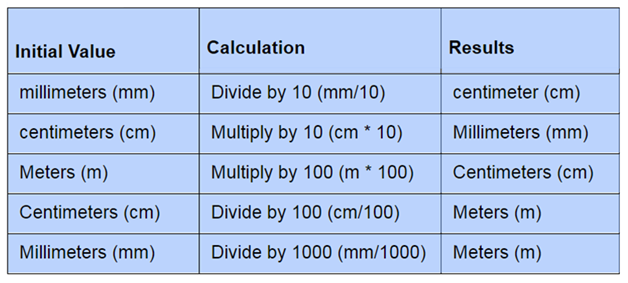
Another important tool in medicine is the metric system, which provides a universal language for measurements. The metric system uses units such as meters for length, liters for volume, and grams for weight. This system is favored in medical practice because it simplifies calculations and reduces the risk of errors. For instance, when prescribing medication, dosages are often given in milligrams or milliliters, ensuring clarity and precision. Because the metric system is consistent and universally adopted, it allows healthcare professionals from different countries to communicate effectively, improving patient care.
1
What is the average heart rate for 72, 68, 75, 70, 74 bpm?
1
Calculate the average blood sugar if it was taken twice, once at 90 and second at 120 mg/dL.
1
Why are averages important in assessing patient health?
1
What is the favored mesurment system used in medicine for measurement clarity?
1
Average Heart Rate: The average resting heart rate for adults ranges from 60 to 100 beats per minute (bpm). If a patient's heart rates over five days are 72, 68, 75, 95, and 65 bpm, what is their average heart rate?
1
A doctor prescribes 0.5 grams of medication. How many milligrams is this equivalent to?
1
A patient needs to receive 2 liters of IV fluid. How many milliliters is this equivalent to?
1
What is 37°C in Fahrenheit?
1
A patient's height is 1.75 meters. What is this in centimeters?
Understanding how to convert units of height, weight, and temperature is crucial in the field of medical sciences and in everyday life. These conversions help us communicate effectively and ensure accuracy, whether we’re weighing a patient, measuring a child’s height, or checking body temperature.
Let’s start with height. In the United States, people often use feet and inches. For example, a person who is 5 feet 10 inches tall is 68 inches in total (5 feet x 12 inches/foot + 10 inches = 70inches). To convert this height into centimeters, we can use the conversion factor: 1 inch equals 2.54 centimeters. Therefore, 70 inches x 2.54 cm/inch gives us approximately 177.8 cm.
Next, let's look at weight. In the U.S., weight is commonly measured in pounds. To convert pounds to kilograms (the more widely used metric unit), we can use the conversion factor where 1 pound equals 0.453592 kilograms. So if someone weighs 175 pounds, their weight in kilograms would be 175 x 0.453592, which is about 79.38 kg.
Finally, temperature is often measured in degrees Fahrenheit in the U.S., but in many scientific contexts, Celsius is used. The formula to convert Fahrenheit to Celsius can be expressed as C = (F - 32) x 5/9. For example, if the temperature is 33°F (normal body temperature), the conversion would yield approximately 0.5°C.
1
What is 5 feet 8 inches in centimeters?(only 2 decimal places)
1
Convert 150 pounds to kilograms. What is the weight?(only 2 decimal places)
1
How to convert 102°F to Celsius?(only 2 decimal places)
1
What is 2.54 cm in inches?
1
A person weighs 89 pounds. How many kilograms do they weigh? (only 2 decimal places)
1
A patient weighs 200 pounds. How much does this weigh in kg?
1
What is the total inches of 5'8" height?
1
How many centimeters is 68 inches?
1
What is 98.6°F in Celsius?
1
Convert room temperature: 77°F in Celsius?
Military time conversions
1
What is 3:00 PM in military time?
1
Convert 10:45 AM to military time.
1
What is 7:30 PM in military time?
1
Convert 12:00 AM to military time.