Explain one way thinning trees in a forest can increase the diversity of plants and animals that live there.
MS-LS2-4
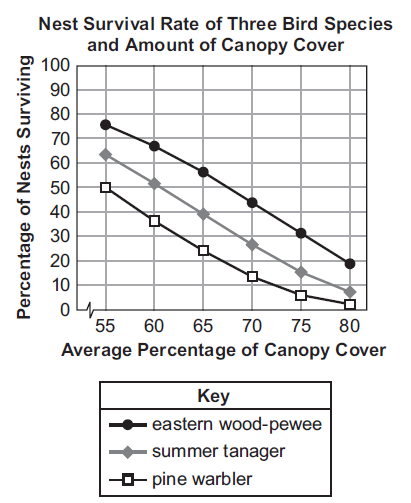
The graph below shows how the amount of canopy cover affected the nest survival rate of the three canopy-nesting bird species in the study. The canopy cover is the area occupied by branches and leaves at the tops of trees.
Required
1
Question 3
3.
As canopy cover increases, the nest survival rate __________.
This means that by reducing the number of trees, researchers should expect the population of canopy-nesting birds to__________.
MS-LS2-4
Question 4
4.
Controlled burns are used to improve the health of savanna-woodland ecosystems. One of the negative effects of controlled burns is increased air pollution. Scientists are studying the possible effects of air pollution from controlled burns on bird populations. The steps in the scientists’ investigation are listed below.
Investigation Steps
1. Count the number of bird nests in a small area before
a controlled burn.
2. Perform a controlled burn.
3. Count the number of bird nests in a different small area
of the ecosystem after the controlled burn.
In general, __________ trials provide data that are __________ and this improves scientists' confidence in their conclusions.
Question 5
5.
Cowbirds have adapted an interesting way to raise their young. The list below describes some of the characteristics of cowbirds.
Cowbird Characteristics
• Adult cowbirds lay their eggs in the nests of other birds,
including nests of shrub-nesting birds.
• Cowbird eggs hatch faster than the other eggs in the nest.
• Young cowbirds often toss out the other eggs before they hatch.
• Young cowbirds grow faster than the other birds in the nest.
Based on the results of the bird nest study and the information above, what is the relationship between cowbirds and shrub-nesting birds?
Question 6
6.
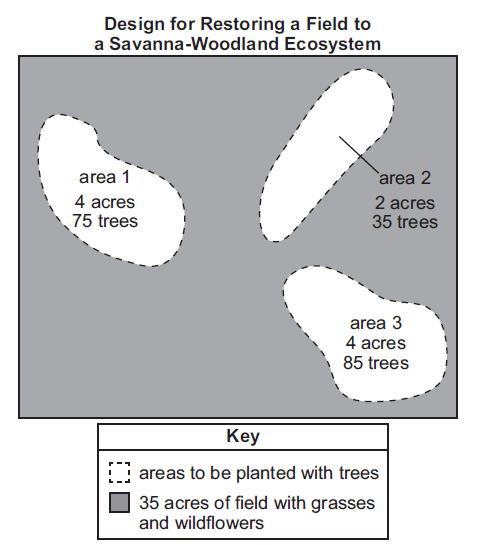
The model below shows one design for restoring an open field to a natural savanna-woodland ecosystem.
Add one check mark in each row of the table to identify whether the design would most likely increase or decrease each factor:
Influence of Design on Savanna-Woodlands Ecosystem
Protecting Missouri’s Bird Nests
Some ecosystems have both open grassland areas and forests. These are called savanna-woodland ecosystems. The variety of trees and other plants supports a wide variety of animals.
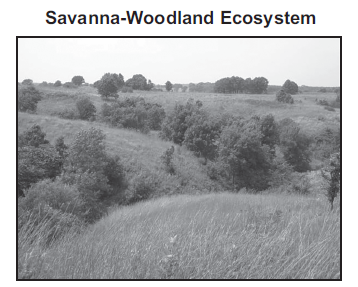
These ecosystems have decreased in Missouri due to humans using the land for other purposes. This has led to a decrease in many bird populations. Land managers are trying to restore the ecosystems by removing some trees (thinning) and using controlled burns. Thinning trees can increase the diversity of plants and animals in the area. Controlled burns are fires that are planned and contained. They are used to make a forest healthier as it recovers and new plants start to grow.
For two years, scientists investigated bird nest survival in an area that had recently experienced tree thinning and controlled burns. The scientists studied six bird species from two different groups: canopy-nesters and shrub-nesters. The canopy is the topmost layer of trees in a forest and is composed of branches and leaves. Shrub-nesting birds live in plants that grow close to the ground.
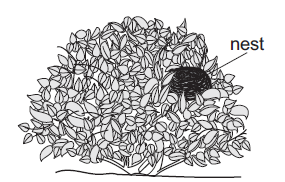
The drawing below shows a nest in a shrub.
The scientists watched over 400 nests, being careful not to disturb the birds as they built the nests, protected their eggs, and fed their young.
Bird Nest Study Results
Tree thinning had a strong impact on the nest survival of the shrub-nesting birds.
Controlled burns increased the nest survival of shrub-nesting and canopy-nesting birds.
The most common reason nests did not survive was predators eating the eggs.
Cowbirds took over 5 percent of the nests in shrubs by replacing the eggs with their own eggs.
Question 1
1.
Based on the passage, which factor most benefits shrub-nesting birds soon after a controlled burn?
Cowbirds are predators of shrub-nesting birds after they are born.
Cowbirds are parasites of shrub-nesting birds and use those birds to hatch their own eggs.
Cowbirds compete with shrub-nesting birds for sunlight.