Log in
Sign up for FREE
arrow_back
Library

Science 8 - Testlet 010 - Earth & Space Science

star
star
star
star
star
Last updated about 3 hours ago
9 questions
Required
2
6-8.ESS2.A-2
MS-ESS2-2
Required
1
6-8.ESS2.A-2
MS-ESS2-2
Required
1
6-8.ESS2.B-3
MS-ESS2-3
Required
1
Question 2
2.
Choose the word or phrase in each set of options to describe the Hawaiian Islands. Hawaii is the closest island to the hotspot.

Evidence suggests that Hawaii will continue to move __________ the hotspot over time because the __________ below it is moving to the northwest.
6-8.ESS2.B-3
MS-ESS2-3
Required
2
6-8.ESS2.A-1
MS-ESS2-1
This question has two parts.

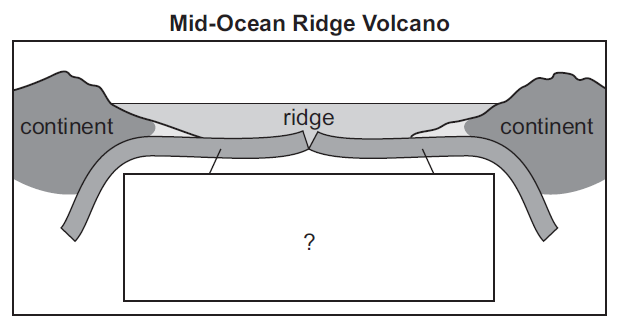
According to the theory of plate tectonics, the movement of tectonic plates starts at mid-ocean ridges, where long chains of volcanoes are located. A student needs to complete the following model to show how the mantle is responsible for the movement of tectonic plates.

Required
1
6-8.ESS2.A-1
MS-ESS2-1
Required
1
Question 5
5.
Part B: Choose the phrase in each set of options to best describe what the student should add to the missing section of the model.

Less dense material __________ the ridge and more dense material__________ the ridge.
6-8.ESS2.A-1
MS-ESS2-1
This question has two parts.

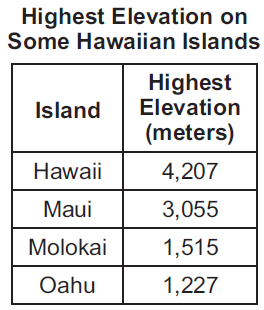
The table below shows the highest elevation on some of the Hawaiian Islands. A student is developing a graph to show the relationship between the age of each island and its elevation.

Required
1
6-8.ESS2.A-1
MS-ESS2-1
Required
1
Question 7
7.

Part B: Describe the processes that are responsible for the change in the elevation of each island over time.

6-8.ESS2.A-1
MS-ESS2-1
Question 8
8.

A student is comparing several processes that change Earth’s surface.

Select one choice in each row of the table to correctly describe how long each process takes to change Earth’s surface.

Happens Quickly
Question 9
9.

Which statement best describes why volcanic islands, like the Hawaiian Islands, are some of the most fertile places on Earth for plants and animals?

The Hawaiian Islands

The Hawaiian Islands are located in the center of the Pacific Ocean. These islands are continuing to be formed by a volcanic hot spot that is located in Earth’s mantle, below an oceanic tectonic plate called the Pacific Plate.

The Pacific Plate moves the islands 3–4 inches toward Japan each year in a northwest direction. Over time, erosion causes the islands to shrink and eventually be submerged under the Pacific Ocean. Below, the map shows the location of the Hawaiian Islands, and the diagram shows the formation of a chain of volcanic islands over a hot spot.
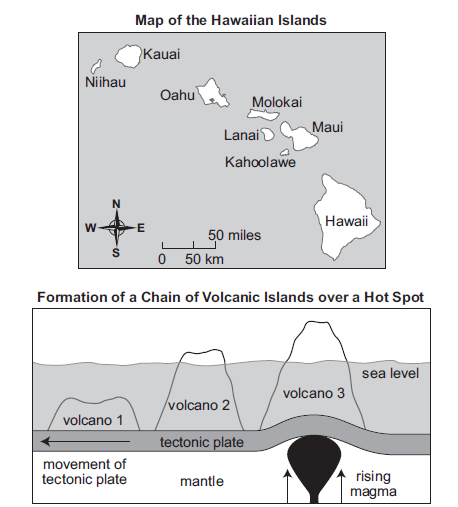

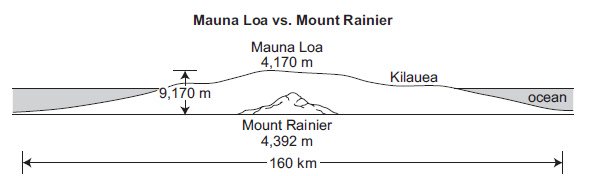
A group of students recognized that the movement of the Pacific Plate to the northwest moves the islands away from the active hot spot. The students also learned that the hot spot has created shield volcanoes that can erupt continuously for years. The Big Island of Hawaii is home to Mauna Loa volcano, Mauna Kea volcano, and the Kilauea Volcano, which has been erupting since 1983.

The students compared the height of Mauna Loa to Mount Rainier. The students recognized that both have a similar height when measured above sea level but that Mauna Loa actually starts 5,000 meters below sea level. Mauna Loa is also much wider than Mount Rainier. Mauna Loa measures 120 kilometers across, and Mount Rainier is only 16 kilometers across.
Question 1
1.

A student is developing a chart to compare the ages of some of the Hawaiian Islands. Using the map from the passage, write the name of each island in the chart to sequence the islands from youngest to oldest.
Age Comparison of Some Hawaiian Islands:
Youngest (top) to Oldest (bottom).

  1. Kauai
  2. Molokai
  3. Hawaii
  4. Oahu
Question 3
3.
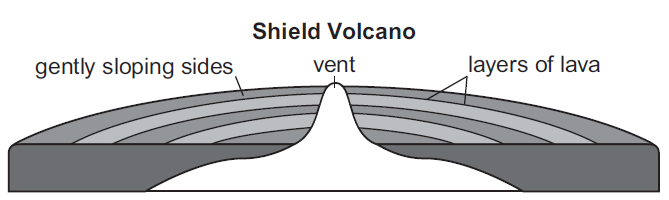
Volcanoes on the Hawaiian Islands are shield volcanoes. Shield volcanoes look like shields on the ground because they have broad, gently sloping sides.


Choose the word or phrase in each set of options to describe the formation of the shield
volcanoes on the Hawaiian Islands.

Heat from Earth’s __________produces areas with different densities within Earth’s
interior. Material that is __________rises to the surface.
Once on the surface, this material __________, forming layers of __________rock.
Question 4
4.

Part A: Which set of arrows should a student use to show the movement of the magma near the location labeled 'ridge'?

Question 6
6.

Part A: Which graph should the student use to show the relationship between island age and elevation?

Happens Slowly
volcanic eruption
erosion of a mountain
island chain formation
tectonic plate movement