Science 8 Testlets - 011 -Life Science
star
star
star
star
star
Last updated 6 months ago
8 Nsɛmmisa
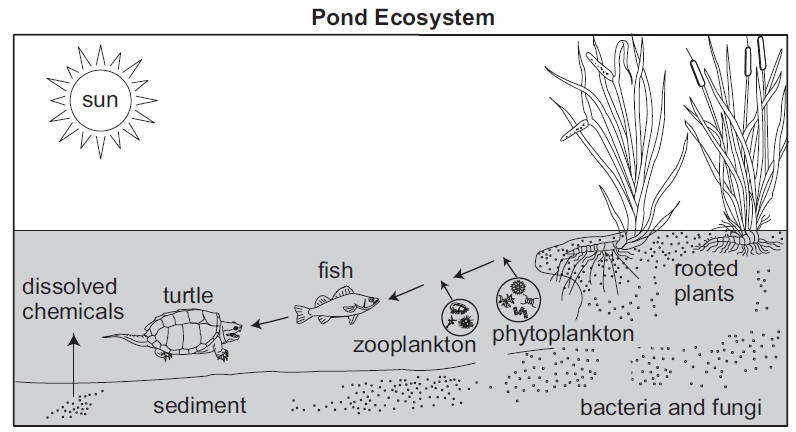
The model below represents a pond ecosystem.
When a pond freezes, the ice begins to seal the surface of the pond from the surrounding
environment. As the ice thickens, the pond no longer undergoes the normal exchange of gases between air and water. Aquatic plants, including microscopic algae and phytoplankton, continue to use the sunlight that passes through the ice for photosynthesis but at a slower rate. Elodea, a common water weed, produces only half the oxygen in winter that it does during summer.
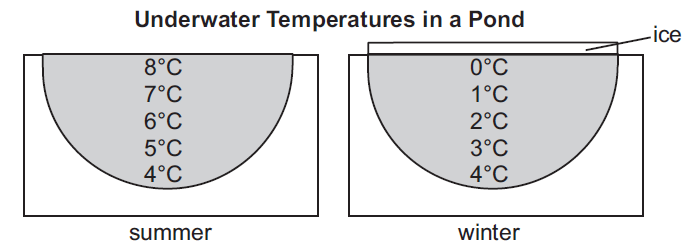
The ice on the pond also protects the pond life from the extremes of the cold weather. The temperature of the water under the ice hovers just above freezing. Some eggs, like those of wood frogs, have a protective gel that prevents them from freezing, and the eggs wait safely under the protective ice layer for spring.
Scientific studies have shown that for every 10°C drop in water temperature, the activity of the organisms in that water is cut in half. In winter, a frozen pond is not the site of a lot of organism activity. The model below shows underwater temperatures in a pond in summer and winter.
Zooplankton feed on algae found in the pond. In warmer months with plentiful sunlight, the algae population increases.
Choose the word or phrase in each set of options to complete the claim below.
As the population of algae increases, the population of zooplankton most likely , and populations of fish most likely .
Cattails are a rooted plant commonly found in ponds. Their long stems and roots store food. These plants can reproduce both sexually, through their seeds, and asexually, as new cattail plants grow upward from their stems.
Based on the information above and from the passage, select two cattail traits that affect the probability of successful reproduction.
When aquatic plants release oxygen in a pond, it becomes available to living aquatic
organisms for respiration. The concentration of oxygen gas present in water is called dissolved oxygen.
Choose the correct word or phrase in each set of options to compare the most likely change in dissolved oxygen in a pond from summer to winter.
The dissolved oxygen because the.
Based on the information in the passage, which statement best provides evidence to support the claim that energy is being conserved in the pond ecosystem during winter?
Refer to the Underwater Temperatures in a Pond model in the passage. Circle a word in each set of options to describe the most likely population size of frogs that live in the pond.
The population size would most likely be largest inand smallest in .
The model below shows the particle motion of water molecules as a solid, liquid, and gas.
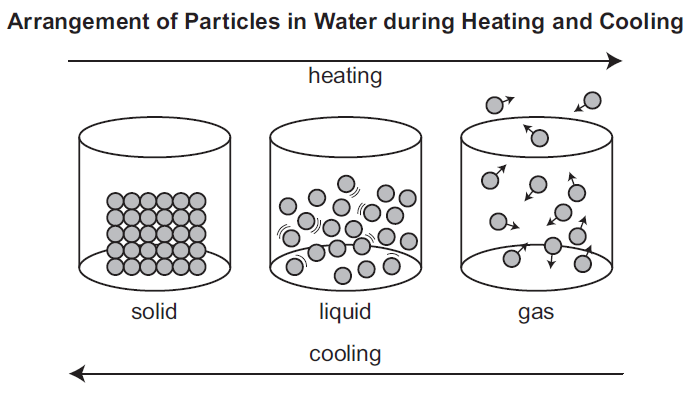
Use evidence to make a claim about how thermal energy affects the water molecules of the pond in winter.
Based on the information in the passage about what happens to the surface of the pond in winter, which explanation best describes why this phenomenon is a physical change?
In winter, many roads are covered in salt to prevent the formation of ice on roadways. The salinity of a pond may increase when runoff from roadways enters the pond. Increases in salinity cause decreases in oxygen in the pond and can prevent ice layers from forming on its surface. Salinity is measured in parts per thousand (ppt).
Which graph best shows the effects of salinity on frog egg hatching rates?