Science 8 - Testlet 015 - Life Science
star
star
star
star
star
Last updated 6 months ago
8 Nsɛmmisa
This question has two parts.
Scientists have proposed two solutions to limit the mosquito fish population.
Solution 1: Use trapping or netting to remove larger mosquito fish. This would target females.
Solution 2: Use genetic engineering to produce mosquito fish with mature males and females that are the same size.
Part A: Which solution would better control the mosquito fish population?
Part B: Explain why people may want to keep some mosquito fish in an ecosystem rather than removing them all.
Mosquito fish, also known as plague minnows, are live-bearers because they are fish that give birth to live young. They are one of the most abundant and widespread freshwater fishes in the world. They are found mainly in warm-water streams in the central portion and southeastern areas of Missouri. The food web shows some interactions of the mosquito fish in its ecosystem.
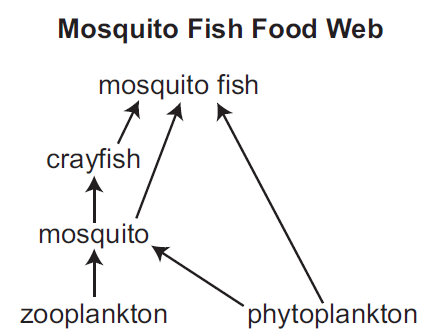
Mosquito fish eat phytoplankton (which make their own food through photosynthesis), crustaceans, such as crayfish, and immature insects, such as mosquito larvae.
Unlike other fish, mosquito fish do not lay eggs; they bear live young. Each female can have three to four broods in her lifetime, and each brood can include 40 to 100 young.
Male and female mosquito fish are a similar size at birth and until they reach maturity. After maturity, female mosquito fish grow at a faster rate than male mosquito fish.
Mosquito fish are often added by humans in streams to control mosquito populations. However, they are an invasive species taking over food sources and impacting ecosystems.
Select the three ways in which successful reproduction through bearing live young benefits the mosquito fish population.
Refer to the Mosquito Fish Food Web.
Complete the statement:
If the mosquito fish population decreases, then the mosquito population will most likely and the zooplankton population will most likely.
Use the Mosquito Fish Food Web to predict how an increase in the crayfish population would most likely affect other populations in the ecosystem.
The mosquito fish population would . The mosquito population would .
Phytoplankton perform photosynthesis in an aquatic ecosystem. The model represents this process.
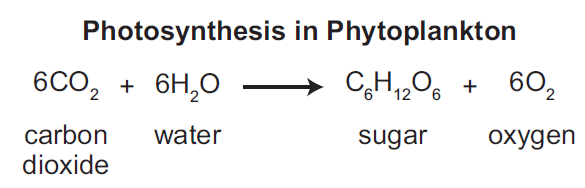
How are carbon (C) atoms used in the process of photosynthesis in phytoplankton?
Write the number of each factor in the chart to identify the biotic and abiotic factors that affect mosquito fish in a pond.
phytoplankton population
carbon dioxide level
water temperature
zooplankton population
Biotic
Abiotic
Which three genetic variations of traits in a population of mosquito fish would most likely increase a mosquito fish’s probability of surviving and reproducing?