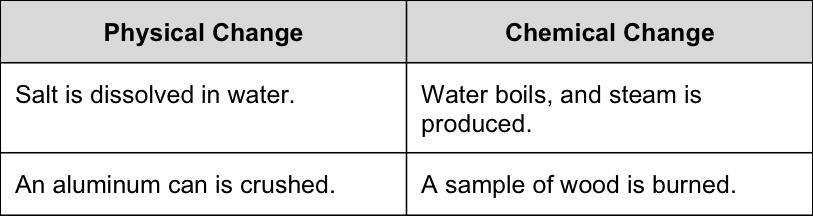
Which of the indicators of change is categorized incorrectly?
Which of the indicators of change is categorized incorrectly?
Sort each property into the correct category. You do not have to drag them, you can just click the property and then click the category.
Viscosity
Tarnish
Conductivity
Boiling Point
Solubility
Corrosive
Temperature
pH Level
Effervesce
PHYSICAL PROPERTIES
CHEMICAL PROPERTIES
You normally use your 5 senses to detect...
Physical changes... (select the one that is true)
Cracking a Glow-stick and making it glow
Mixing cookie dough ingredients
Bread Rising
Hand Warmers
Wood rotting
Using heat to blow glass into a vase
Sugar dissolving in water
Blow Drying your hair
Banana peel turning brown
PHYSICAL CHANGE
CHEMICAL CHANGE
Any characteristic we can observe or measure without changing the chemical composition of the substance
Changes to a substance's appearance/form but not its chemical composition
A characteristic of a substance that can only be seen by changing the chemical composition of a substance
These changes impact a substance's chemical composition, causing a new substance to be created
Which of the following is NOT an example of a physical change?
Which of the following is NOT an example of a chemical change?
One example of physical change is
One example of chemical change is
Every chemical change ...
Which investigation would provide evidence of a chemical change?
Which of the indicators of change is categorized incorrectly?
The reason for Ooblek's strange behavior is
List the names of the 6 experiments in the order in which they were performed.
#1
#2
#3
#4
#5
#6
Identify whether each experiment was an example of a physical or chemical change by dragging it to the correct category.
Make sure each category is in numerical order so your answers are scored correctly.
Experiment # 1
Experiment #2
Experiment #3
Experiment #4
Experiment #5
Experiment #6
Physical Change
Chemical Change
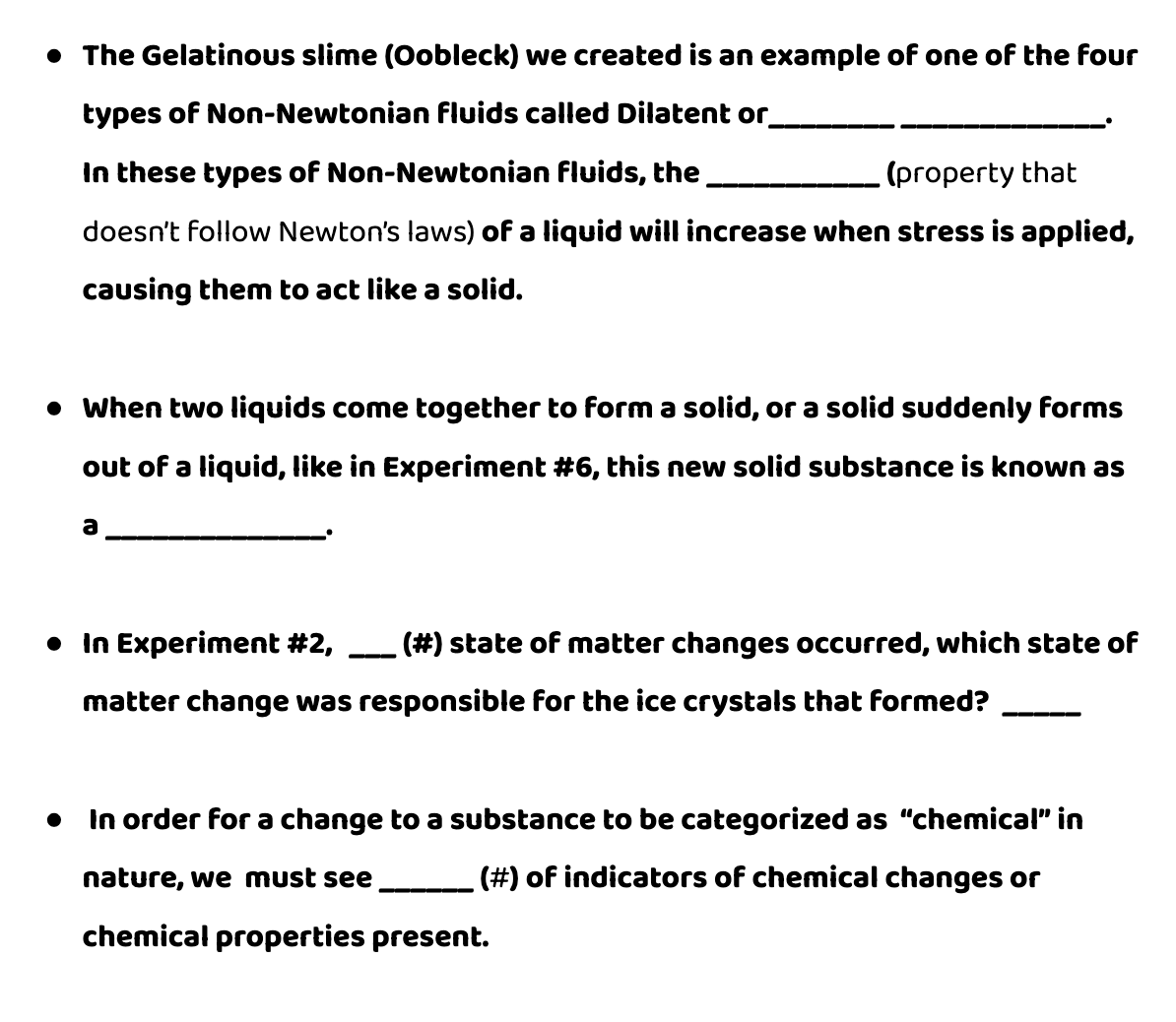
Ooblek is an example of one of the four types of Non-Newtonian fluids called a dilatant or
In these types of non-Newtonian fluids, the
Select both of the experiments that involved the chemical property of pH, whether we used chemicals that helped indicate it or changed the pH level during the experiment.
Select all of the experiments that involved an exothermic reaction taking place.
Select all of the experiments that had an unexpected color change occur.
In Experiment #1, the color changed from
Select all of the experiments that had a state of matter change occur (within the original substance.)
Select all of the experiments that experienced a PHYSICAL change in temperature.
The bubbles that formed in the water during experiment #2 were an example of effervesce
Experiment #5 showed both a new substance and a state of matter change.
Which Physical Change was NOT present in experiment #4?
Select all that apply
Which of the ABCD's of Chemical Change were not present in Experiment #4?
Select all that apply
What was the name of the new substance (the white bio-plastic) created in Experiment #6?
Please only type the one-word answer, do not answer in sentence form.
EXTRA CREDIT: When bubbles form in a liquid, how do we know when it is a chemical change (effervesce) and not just a state of matter change?
Extra points if you can correctly use one of our experiments to support/explain your answer.
EXTRA CREDIT: Rearrange the substances below in order from the least dense (top) to the most dense (bottom) based on their behavior when the dry ice was placed underwater.
Air in the room
Dry Ice Vapors
Water in the bowl.
What do we call a solid that forms from a liquid
In experiment #2, there were
Which state of matter change was responsible for the ice crystals that formed in experiment #2
For a change to a substance to be considered “chemical” in nature, we must see