Distribute to Students
Students will be able to:
Read and understand a pay stub
Compare mandatory and discretionary government spending
Explain the difference between gross and net pay
Analyze the different categories of discretionary government spending
National Standards for Personal Financial Education
Earning Income
6b: Identify which level(s) of government typically receive(s) the tax revenue for income taxes, payroll taxes, property taxes, and sales taxes
6c: Describe the benefits they receive, or may receive in the future, from government-collected tax revenue
7c: Differentiate between gross, net, and taxable income
Distribute to Students
Students will be able to:
Read and understand a pay stub
Compare mandatory and discretionary government spending
Explain the difference between gross and net pay
Analyze the different categories of discretionary government spending
National Standards for Personal Financial Education
Earning Income
6b: Identify which level(s) of government typically receive(s) the tax revenue for income taxes, payroll taxes, property taxes, and sales taxes
6c: Describe the benefits they receive, or may receive in the future, from government-collected tax revenue
7c: Differentiate between gross, net, and taxable income
If you were in charge of how tax dollars are spent, what are some things in your community, state, or nationally that you would choose to pay for? (name at least 5 things)
TEACHER TIP: Some figures in this video are out of date (like the US government’s total revenue and the age at which you can qualify for Medicare). However, the general message of what is withheld from your paycheck, what that money pays for, and what we receive in return is still very relevant.
Some people are surprised when they get their paycheck and the amount of money they receive is lower than they expected. This is often because they don’t know about things like state taxes, federal taxes, and the Federal Insurance Contributions Act (FICA). Watch the video to learn more about the withholdings from your paycheck. Then, answer the questions.
Briefly describe the purpose of taxes.
What, if anything, surprises you about how the federal government spends taxpayer dollars?
If you were in charge of the federal budget, which categories would you prioritize more/less? Why?
What specifically would you spend more on in categories you increased?
What specifically would you cut from the categories you decreased?
The data in this game is from the most recent tax year. Do you think the ranking from highest to lowest changes much between years? Why or why not?
Now that you understand why some money is taken out of your paycheck, let’s dig a little deeper into how that impacts the amount of money that actually ends up in your bank account. Watch this video and follow your teacher's directions to answer the questions either in your student activity packet or within the EdPuzzle itself.
NOTE: EdPuzzle videos shuffle answer choices and do not always match the order provided in the lesson here.
What is the difference between gross pay and net pay?
Net pay is before taxes and deductions are subtracted; Gross pay is your take-home pay
There is no difference between gross pay and net pay
Gross pay is before taxes and deductions are subtracted; Net pay is your take-home pay
Which of the following are two mandatory categories of government spending that are paid for by FICA taxes?
Military and Education
Health and Veterans’ Benefits
Housing and Transportation
Social Security and Medicare
On a pay stub, the amount of money that is left after withholdings is known as…
Gross pay
Net pay
Annual earnings
Wages and tips
Which statement best describes discretionary government spending?
A fixed amount of money spent on the same categories every year
The money used to pay for Social Security and Medicare
A changing amount of money spent on different categories each year
Money that you determine how it is spent by the government when you submit your taxes
Medicare and Social Security are mandatory spending categories funded by which type of taxes that are withheld from your paycheck?
The federal income taxes that are withheld from your paycheck are used to pay for what?
Mandatory spending
Discretionary spending
Unemployment insurance
Medicare and Social Security
All of the following options are benefits we receive as a result of government spending EXCEPT:
What are Pre-Tax Deductions and Contributions?
Contributions taken out of your paycheck AFTER taxes are calculated on your income
Contributions taken out of your paycheck BEFORE taxes are calculated on your income
What are two examples of Employer Contributions?
Health insurance and 401(k)
401(k) and Roth IRA
Federal and state taxes
Traditional and Roth IRA
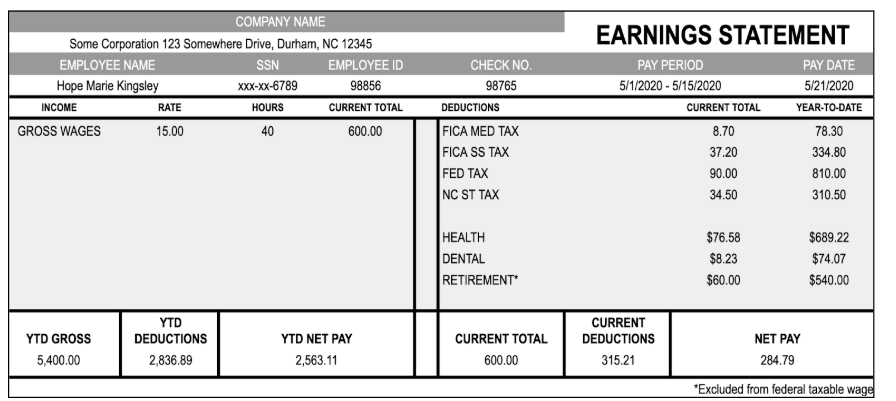
How frequently does Hope receive a paycheck?
Daily
Weekly
Twice Per Month
Monthly
Assuming that Hope receives a paycheck at regular intervals similar to the stub shown, how many pay periods has Hope had year-to-date (YTD)?
2
3
8
9
Which statement below accurately describes Hope’s gross wages?
Gross wages are calculated by multiplying Hope’s hourly rate by the number of hours she worked
Gross wages are Hope’s fixed salary, which she receives for every pay period
Gross wages are calculated by subtracting all of Hope’s deductions from her gross income
Gross wages are how much Hope has earned over the course of the entire year
What was the largest deduction for this pay period?
FICA Medicare Tax
FICA Social Security Tax
Federal Tax
NC State Tax
Look at the lines that say HEALTH, DENTAL, and RETIREMENT. Which statement below is accurate?
Those lines represent taxes that Hope paid to the Federal government
Those lines represent taxes that Hope paid to the state government
Those lines represent benefits that the employer is paying to Hope in addition to her wages
Those lines represent insurance and retirement plans that Hope funds directly from her paycheck
Hope's contribution to her RETIREMENT plan...
is a post-tax contribution on which she pays federal income taxes
is pre-tax and therefore not included in federal income taxes
Is a contribution to her Social Security
is taxed at a rate of 15%
What was the TOTAL amount deducted from Hope's latest paycheck?
$90.00
$284.79
$315.21
$600.00
One of Hope’s coworkers quits, and during the next pay period Hope works 60 hours instead of 40 to help cover the shifts. Which of Hope’s deductions will definitely change as a result?
Her Federal tax
Her health
Her dental
Her retirement
Which of the following statements is TRUE?
Hope has had more deductions this year than take home pay
Hope has had more take home pay this year than deductions
Hope has had equal amounts of take home pay and deductions this year
Hope’s paystub only shows deductions and take home pay for this pay period, not the entire year to date
Hope's employer deposits her paycheck directly into her checking account. How much would her employer have deposited into Hope's checking account on the most recent payday of 5/21/20?
$40.00
$284.79
$315.21
$600.00
What important information is available on a pay stub?