MAP: Grade 6 ELA

Last updated 9 months ago
43 questions

New Responsibility

a story from colonial America

I opened my eyes and blinked a few times. Outside, the sky was still pitch black, and the air in
the room felt chilly. While I normally might want to sleep a few minutes longer, today I felt jittery, so I jumped out of bed. I, Temperance Bishop, had been looking forward to this day since I was a little girl. I hurriedly got dressed and skipped to the barn to complete my chores of gathering the eggs from the chickens and checking the animals in the barn.

As I entered the kitchen with a basket of fresh eggs, Mother greeted me with a smile. “Good
morning, Temperance. Remember what happens today after breakfast?” she asked me.

How could I forget? I had been waiting for this day since I noticed my mother walking down the street carrying a sack filled with pins, needles, and other sewing supplies. Today was the day I would become an official member of the town sewing circle. Members met weekly at Mrs. Johnson’s house and worked together to complete various sewing projects for their homes and community. Mother had made it clear that along with learning new skills and using a spinning wheel, the women used the time to converse with one another about local news.

“Yes, Mother, I know, and I am very excited!” I exclaimed. It was true; I was excited, but I was
also very nervous. I had been sewing since I was old enough to hold a needle and thread, but
being part of the sewing circle would be a whole new level of responsibility. Not only was I
expected to sew, but I also had a vital role in creating admirable projects with other people. Mother and the others would expect me to do my best and uphold the high standards of the group.

I took my seat at the kitchen table and observed my siblings loading their plates with food in
what seemed a blur of movements. Their voices sounded distant. My thoughts were focused on what might happen at my first day with the sewing circle. Today I could make myself and Mother proud, but what if I make a big mistake? My stomach began to ache with my nervousness, but not wanting anyone to realize my doubts, I began to eat. The food seemed tasteless in my dry mouth, and the knot in my stomach steadily grew. I didn’t say anything to anyone. Mother might forbid me from participating if she knew how anxious I was feeling.

After breakfast, I quietly helped clear the dishes from the table and then collected my sewing
materials. Slowly I followed Mother to the door. With each step, I silently told myself that I would be OK, that I knew what I was doing, that I would have fun, and, after all, today I would be treated as a responsible adult.

Although it was only a ten-minute walk to Mrs. Johnson’s house, it felt like an eternity. With each step I lost focus of my positive thoughts as my negative doubts crept back in. What if I don’t understand what the adults are talking about? What if I embarrass Mother and am sent home and told not to return until I’m older? I felt faint and my knees began to buckle. My hands were wet with perspiration.

I was so caught up in my thoughts that I hadn’t realized that I was dragging my feet. Mother
turned back, noticing that I was walking at a snail’s pace behind her. “Temperance, I was nervous my first time going to the sewing circle too,” she said reassuringly as she walked toward me.

“You were?” I asked incredulously.

“Of course I was,” she laughed. “I was so worried that I would make a mistake and embarrass
your grandmother or that I wouldn’t understand the jokes that the adults were telling.”

I couldn’t believe it. My mother had once had the same worries I did, yet she’s a confident and accomplished woman. Everyone in the community respects her. I never imagined her as anything but self-assured. I breathed a sigh of relief and decided to be optimistic about all the aspects of the day that I had been looking forward to. Today, I will contribute to my community. Today, I will show that I am responsible. Today, I will learn something new. Together, Mother and I walked the rest of the way to Mrs. Johnson’s house. I was now ready to begin my journey as the newest member of the sewing circle.
1

Read the paragraph. Circle the underlined word or phrase that best reveals the meaning of the word admirable in the passage.

1

What is the most likely reason the author decided to tell the story from Temperance’s point of view?

1

How does Temperance’s self-doubt affect the development of the plot?

2

Read the sentence from the passage.

My stomach began to ache with my nervousness, but not wanting anyone to realize my doubts, I began to eat.

How does the sentence most contribute to the meaning of the passage? Choose two answers.

2

Read the below quotes from the passage. What can be inferred from the quotes?

Write the letter of one correct inference in the box beside each quote. Only two choices in the Answer Bank will be used.
What can be inferred from the quotes?

Cranes

What are the physical features of cranes?
Cranes are long-necked birds known for their beauty and graceful movements. They can be found on all continents except South America and Antarctica. Most species are gray with patches of white and black. Some species have red or gold on their heads. Because cranes’ necks are so long, their calls are some of the deepest and loudest in the bird world. The deep “whoop” sound made by one North American species earned it the name whooping crane. There are fifteen different species of cranes, which include the notable sarus and sandhill cranes. The sarus crane is the world’s tallest flying bird at almost six feet tall.

What are the migration routes of cranes?
Sandhill cranes are most known for their migration route between Texas and Western Canada. More than half a million of the sandhill cranes stop to rest and refuel in Nebraska for about a month each March. All cranes need a great deal of energy to power their flight. Wetlands, grasslands, and lakeshores provide these large, migrating birds with food sources. Cranes have omnivorous diets. In the wetlands, grasslands, and lakeshore, they find roots, stems, and seeds, as well as fish, insects, snails, small reptiles, and rodents to eat.

What are the threats to cranes?
Although laws in many countries protect cranes, the birds’ survival is at risk because of
environmental threats. Development of land for construction can reduce their habitat. Farmers add to the loss of habitat as well when they drain water from a field in order to use the land to grow crops. The chemicals some farmers use to kill insects on the plants can also harm cranes. More work needs to be done to educate people on how to protect these magnificent birds.

How do scientists do research on cranes?
Studying cranes presents special challenges. Most cranes migrate great distances, need a variety of food, and build their nests in areas that are difficult to find. This means scientists who study cranes must be good detectives just to find the birds. Research scientists have been caught in storms, lived in swamps, and searched mountain lakes from small airplanes while trying to learn about cranes. They sometimes search for years before finally finding a nest or mapping a migration route.

How are people working to protect cranes?
Scientists around the world have begun working together to save the cranes. One crane protection group is the International Crane Foundation. This group, which is based in Wisconsin, started as a crane breeding program to bring back populations of severely threatened species. Now the foundation’s workers travel around the world to work with local conservation groups to help protect crane migration paths. These paths typically cross many countries.

Citizens from across the globe are helping to save and protect cranes as well. In 1995, the Ministry of Natural Resources in Uganda launched a national policy to conserve and manage wetland resources in the country. It serves to protect cranes and other wild animals. Street signs in Uganda remind citizens to protect their national bird, the gray-crowned crane. Villagers there have learned farming methods that avoid draining lakes where cranes nest. They have limited the use of harmful chemicals as well. China has also protected significant crane habitats, including a refuge at Poyong Lake. Because of these efforts, China has more Siberian cranes now than it had 30 years ago. Scientists visit each other’s reserves and share data and ideas for the preservation of cranes. Humans have learned that many countries need to work together to protect the crane.
1

Read the sentence from the passage:
'Cranes have omnivorous diets.'

Which evidence helps the reader understand the meaning of the word 'omnivorous'?

1

Which statement best reveals the author’s purpose in the passage?

2

Read the claims in the table and the evidence from the passage in the Answer Bank. Choose the evidence that best supports each claim.

Write the letter of one piece of evidence in the box beside each claim. Only two choices in the Answer Bank will be used.

1

Circle the sentence in the paragraph that describes the behavior of cranes that makes studying them especially demanding.

2

According to the passage, in what ways are species of cranes distinguished from one another? Choose three answers.

King Midas Has Donkey Ears
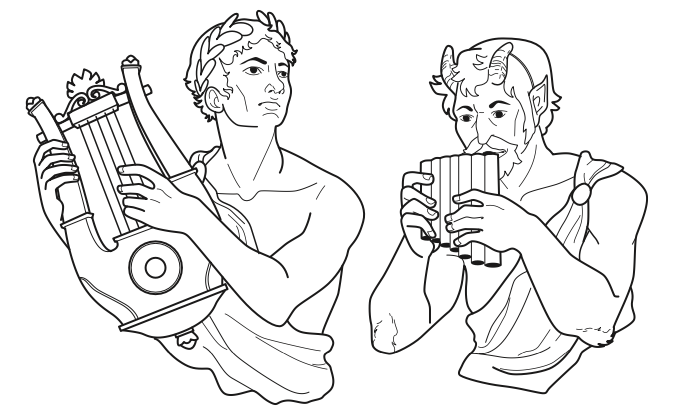

NARRATOR: Apollo and Pan are arguing about who makes better music.

APOLLO: My lyre sings sweeter than silver bells.

PAN: My flute copies the songs of blackbirds.

APOLLO: Let judges decide who is a better musician.

NARRATOR: Three judges, including King Midas, agree to listen. (APOLLO picks up his lyre and
plays. JUDGE ONE nods his head; JUDGE TWO sways from side to side; KING MIDAS yawns.)

PAN: You call that music? (He picks up his flute and plays a lively tune. JUDGE ONE frowns;

JUDGE TWO snorts; KING MIDAS taps his foot enthusiastically.)

NARRATOR: When Pan finishes, the judges huddle to discuss the music.

JUDGE ONE: Apollo’s music is soothing.

JUDGE TWO: I agree that Apollo is the superior musician.

KING MIDAS: I disagree, as I nearly napped while he was playing. Music should be lively, so I vote for Pan.

APOLLO: Two against one, clearly I have won. But Midas, your ears are too small to appreciate what you hear, so I will fix that. (He touches KING MIDAS’s ears.)

NARRATOR: Still arguing, Apollo and Pan exit, while the two judges leave shaking their heads.

KING MIDAS: My ears are tingling, and they feel itchy. (He examines his ears in a mirror.) This is worse than awful; it is horrible, dreadful, and embarrassing. I have the ears of a donkey!
No one must know, so I’ll let my hair grow, and hide these monstrous furry ears under a hat. (He rummages through a box, takes out a hat, and pulls it over his ears.)

NARRATOR: He is able to deceive for a time, but eventually his long hair becomes bothersome, so he summons his barber.

KING MIDAS: Timor!

(TIMOR, the barber, enters.)

KING MIDAS: I need my hair trimmed, but promise you will keep secret whatever you see.

TIMOR: Yes, Your Majesty.

KING MIDAS: Promise?

TIMOR: Yes, Your Majesty, I promise.

NARRATOR: When Timor takes off the king’s hat and combs his hair, he is astonished.

TIMOR: (in a whispery voice) The king has donkey ears. King Midas has donkey ears.

KING MIDAS: I heard that. You just promised to never tell anyone. Now get on with the trimming, but be careful, my ears are sensitive.

NARRATOR: Timor has a difficult time keeping King Midas’s secret, but he had promised.
Meanwhile, King Midas goes about the business of his kingdom, wearing a hat pulled down to conceal his ears.

One day Timor can no longer hold the secret.

TIMOR: If I don’t tell somebody about King Midas’s donkey ears, I’ll explode like a kernel of corn dropped into the fire.

I will go up the mountainside, dig a hole, and whisper the secret into it. That will relieve me of the burden of the king’s secret.

NARRATOR: So that is what Timor does, but the hole he digs reaches into the chamber where
Echo resides, and Echo has the habit of repeating everything she hears.

TIMOR: (on hands and knees beside the hole) The king has donkey ears.

ECHO: The king has donkey ears. King has donkey ears. Donkey ears. Ears, ears, ears.

NARRATOR: Soon the trees pick up the words Echo whispered.

TREES: The king has donkey ears.

NARRATOR: The words are carried on the breeze until they reach the village. Soon everyone
knows King Midas’s secret.

SMALL CHILD: King Midas has donkey ears. No wonder he always wears a hat!

ANOTHER CHILD: How wonderful. No one else has ears like his.

KING MIDAS: Timor!

TIMOR: Yes, Your Majesty.

KING MIDAS: You gave your word you would not disclose my secret, so you are hereby discharged of your duties as royal barber. Instead, you will work in the stables, grooming the horses—and the donkeys.

TIMOR: (hanging his head) Yes, Your Majesty. I have learned that when I promise not to reveal a secret, I must keep my word.

KING MIDAS: I have learned something too. I should not be ashamed of how I look. (He throws his hat away.)
1

Read the lines from the drama.

APOLLO: Two against one, clearly I have won. But Midas, your ears are too small to appreciate what you hear, so I will fix that. (He touches KING MIDAS’s ears.)

NARRATOR: Still arguing, Apollo and Pan exit, while the two judges leave shaking their heads.

How do the lines most contribute to the meaning of the drama?

1

PART A
Which line from the passage best supports a theme of the drama?

1

PART B
Which detail from the drama helps to develop the theme in Part A?

2

How does King Midas’s character in the drama respond as the plot moves toward the resolution?
Complete the chart using the plot events and character responses in the Answer Bank. Write the letter of each answer in the correct box in chronological order.

2

Read the line from the drama.

TIMOR: If I don’t tell somebody about King Midas’s donkey ears, I’ll explode like a kernel of corn dropped into the fire.

How does the author’s use of figurative language in the line contribute to the meaning of the drama? Choose two answers.

Cities, Cities, Cities!

by Marcia Amidon Lusted

Cities have been around for thousands of years. When people first began to grow their own food and raise animals, they began to stay in one place instead of wandering in search of food. They built permanent places to live and settled in villages. Over time, some villages grew into towns, then cities.

But what exactly is a city? A city is an area where a lot of people live close together. Cities have their own governments, as well as systems for sanitation, transportation, and housing. According to some definitions, the population must be at least 10,000 for a place to be called a city. Others say a city must have 30,000 residents to qualify.

But if you think that cities have always had towering skyscrapers and subways running beneath the streets, think again.

No one knows exactly when the first cities grew up. But by about 5,500 years ago there were real cities in ancient Mesopotamia, Egypt, and the Indus valley. These cities often had walls for protection and citadels (large elevated areas inside the city) where special ceremonies were held.

Later, the ancient Romans became expert city-builders. Many of their towns and cities were built according to a grid pattern. There were intersecting roads and carefully designed central areas for public buildings. Sewage systems, water systems, and roads helped these cities run more smoothly. Many modern cities, such as London and Paris, began as Roman cities.

In the United States today, many cities follow a similar grid pattern. In some cases, these cities began as colonies settled by Europeans. The colonists followed a city plan required by the laws of their home countries, such as Spain. Within the grid was a central square or plaza where important business and government buildings were located. In coastal cities, a straight street connected the plaza to the waterside docks.

Back in Europe, between 1600 and 1750, cities were becoming fancier. Kings built new palaces. Public spaces began to include formal parks and gardens. In some cities, streets were arranged like spokes on a wheel, heading out from the center of the city. Monuments, statues, and important buildings were located in the center.

In time, cities began to focus more on business. Instead of handsome gardens or statues, office buildings, factories, and warehouses took the central places of importance. Railroad tracks, and later highways, ran straight through the heart of some cities.

Today’s modern cities are designed around the skyscraper. Skyscrapers contain both offices and apartments. Millions of city dwellers around the world live high above the ground in tall buildings.

What will the cities of tomorrow look like? Taller buildings? New kinds of transportation? We might even see underwater cities or cities high in the sky. Perhaps there will even be cities on the moon.
1

Which sentence from “Cities, Cities, Cities!” best supports the conclusion that ancient Roman cities were created in an organized way?

1

Part A What is one claim that the author makes in “Cities, Cities, Cities!”?

1

Part B Which evidence from the passage best supports the answer to Part A?

1

In “Inventions That Changed City Life,” how does the diagram help the reader better understand the passage?

1

What does the information about elevators in “Inventions That Changed City Life” reveal about the author’s point of view?

1

In “Inventions That Changed City Life,” what does the use of the phrase “a skeleton made of steel” help the reader understand?

1

How do the passages present the topic of cities differently?

1

Which clue can indicate that an online source is not credible?

Source A
Building rooftop gardens is both complicated and expensive. Before the garden can even be planned, an engineer needs to review the building. It is the engineer’s job to make sure the roof is strong enough to support the weight of the garden. Then an architect is hired to design the garden. Only then can construction begin. Rooftop gardens have multiple layers. Each one serves a different purpose, such as irrigating, or watering, the plants and preventing soil runoff.

Source B
Many urban developers are turning to rooftop gardens to make city living more attractive. Cities such as New York rely on multistory apartment buildings to house their dense populations. To attract new buyers, developers are using rooftop gardens to improve the appeal of the buildings. The gardens provide a place to escape from the concrete jungle of the city, even for a short time. They are an area for socialization, encouraging people to connect with their neighbors.

Source C
Many cities are facing increasing problems with air quality. Some cities, like Mexico City, are turning to gardens for help. Rooftop gardens are known for being beautiful, but they are also great at cleaning up the air. The plants use carbon dioxide and produce oxygen in return. They also collect dirt and grime in their leaves as the wind blows it around. Then rain washes all
2

Students are writing a report about the benefits of rooftop gardens. Read the sources the students found for their report.

The students wrote down some claims to use in their report. Read the claims in the table. Complete the table by writing each source name beside the claim it supports.

1

Students are trying to prove the claim that using praise and food for dog training is more effective than punishment. Which research question would help them prove the claim?

Source
While some actors enjoy working in front of a camera, there are some who prefer standing behind a microphone. They are voice actors, and their job includes everything from commercials to cartoons. Voice actors might seem to have it easy, but their job is actually quite difficult. They have to work long hours in the studio, sometimes reading the same few lines over and over again. A lot of voice actors have studios in their homes so that
they can practice or produce demo tapes. Demo tapes have examples of what they can do. They’re used in place of auditions. Many famous actors do voice work. In fact, you can often hear the same voices in video games that are in the shows that inspired them.
1

A student wants to include information from the source in his report about voice actors but does not want to plagiarize the author’s ideas. Read the paragraph from the student’s report.
Circle two sentences in the paragraph that are plagiarized.

2

Students are writing an argumentative essay about stopping production of the penny. They found sources for their essay. Which sources would provide the most relevant information about the topic? Choose two answers.

1

Read the student’s draft paragraph from an informational essay. "Trains just keep getting faster and faster! The steam locomotives of the early 1800s could go about 20 miles per hour. Today, the fastest type of train in the world is a maglev train. These trains regularly carry passengers in several Asian countries. Maglev trains do not have wheels. Instead, they have powerful magnets that let them glide just above the track. Right now, the record for speed is held by the Shanghai Maglev in China. This amazing train can __________." Which option completes the last sentence with the most precise information?

1

A student is writing a report about Pluto. Read her draft:

"Many adults grew up learning that Pluto was the ninth planet from the sun. In 2006, though, astronomers announced that Pluto was no longer considered a planet. The scientists said that to be a planet, an object must meet three conditions. First, it has to be
in orbit around the sun. Second, it must be big and heavy enough to have a round shape. Third, it has to be the biggest object in its own path around the sun. Pluto is round, and it travels around the sun. However, it is not always the largest object in its orbit."

Which sentence would make the best conclusion for the student’s draft?

1

Read a student’s draft essay about Costa Rica.

Costa Rica is a tiny country in Central America. Yet, Costa Rica has more plant and animal species than many other places on Earth. There are more than 800 different types of birds, for example. Some of them do not live anywhere else in the world! __________
The different landscapes explain the country’s many organisms. Costa Rica even has a rare place called a cloud forest. The trees and plants here are covered by cool, misty clouds. Many people visit Costa Rica to hike in the cloud forest.

Which sentence provides the best transition between ideas?

2

Read the paragraph from a student’s draft of a letter to the school principal. Circle the two sentences that should be revised to better match the style of the letter.

1

Read the paragraphs from a student’s draft essay.

Jump-starting a school club or organization takes a lot of effort and collaboration between students and adults. Both students and adults should participate in the planning phases to start the process. There are several procedures to follow, so it’s important to work together. __________

One of the first steps to starting a new club is determining what the purpose of the club will be. From there, a list of signatures is needed from the student body to show that there is sufficient interest. Once the signatures have been obtained, a presentation will need to be made to the administration. If the presentation is approved, you are on to the next step!

Which sentence provides the best transition between the first and second paragraphs?

1

Read the student’s draft paragraph from an informational essay:

__________ Historians examine primary and secondary sources so they can understand the daily life of historical people. Archaeologists search to uncover artifacts from ancient civilizations. Scientists study the artifacts and historians’ notes in order to develop their own theories about historical civilizations. Together, the work of archaeologists, historians,
and scientists has taught us a great deal about the past.

Which sentence best introduces the topic with precise information?

1

Read the draft paragraph from a student’s report about baseball. Circle the sentence that does not support the writer’s purpose in the paragraph.

Listen to the presentation: The Middle School Newspaper - A Worthwhile Effort
1

Which skill discussed by the speaker is developed by students meeting deadlines?

1

According to the presentation, how does a school newspaper contribute to the lives of newspaper readers?

1

According to the presentation, which part of working on a school newspaper widens the number of people with whom students communicate?

1

Which sentence expresses one of the speaker’s main claims in the presentation?

1

According to the speaker, what is the most important quality of a good teacher?

Listen to the presentation: Why Good Teachers Deserve Recognition
1

Part A: Which sentence best states the claim of the presentation?

1

Part B: What evidence from the presentation best supports the answer to part A?

1

What is one way the speaker builds support for the claim of the presentation?

2

According to the speaker, what should be done to recruit the best candidates to become teachers?
*Choose two answers.*