Digital Inquiry - Glacier Erosion
star
star
star
star
star
Last updated 7 months ago
13 questions
TEXT: BREAK IT & MOVE IT
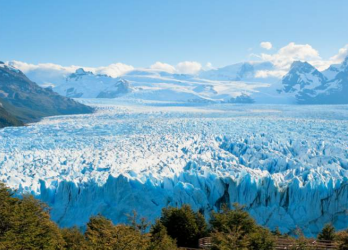
Glaciers could never make the track team. Most of them move too slowly – only 25 centimeters a day. They creep along, changing everything
underneath them. Glaciers melt and refreeze which weakens the structure of the rocks in and under them. Great force from a glacier’s weight presses down on the rocks. Glaciers weather (break down) rocks as they move.
Force from the weight, along with melting and refreezing, moves the ice along. Water that melts from the glacier collects below and also helps the heavy ice to move. It carries and pushes the weathered rocks. The glacier erodes (moves) rocks from their original place. These weathered and eroded rocks can be found hundreds of miles away. This is called deposition (adding sediments to land).
As a glacier weathers and erodes the land in its path, it carves out a specific kind of valley. Because glaciers are wide, their valleys are U-shaped, with steep sides and a round valley floor. Glaciers may not be fast, but they are stronger than the whole weight-lifting team.
1
How fast do most glaciers typically move?
1
What happens when glaciers melt and refreeze?
1
What type of valley shape is created by glaciers?
1
What process describes when glaciers add sediments to land?
1
Which factor helps the heavy ice of a glacier to move?
VIDEO: HOW DO GLACIERS MOVE?
Before we learn how glaciers change Earth’s surface, let’s learn how they move.
Click the link to watch the 7 minute video clip to learn how the Mendenhall Glacier in Juneau, Alaska moves.
1
When a glacier moves, what happens to the rocks it encounters?
1
How does the freeze-thaw cycle affect glacier movement?
1
How long does it take for the new ice in the ice field to make it to the lake in the video.
How Glaciers Carve U-Shaped Valleys
Imagine a massive river of ice slowly moving down a mountain, so heavy and powerful that it can reshape entire landscapes. That's exactly what glaciers do! These incredible ice giants are like nature's sculptors, and one of their most impressive masterpieces is the U-shaped valley.
What is a U-Shaped Valley?
A U-shaped valley looks exactly like its name suggests - it has steep, nearly vertical sides and a flat, wide bottom, just like the letter "U". Unlike V-shaped valleys carved by rivers, which have pointy, sloping sides, glacier valleys are much wider and more dramatically shaped.
How Do Glaciers Create These Valleys?
Glaciers are extremely powerful. As they move slowly down a mountain, they do three important things:
- Scrape the ground: The massive weight of the glacier presses down on rocks and soil.
- Carry rocks: As the glacier moves, it picks up rocks and carries them along.
- Erode the landscape: These rocks act like sandpaper, grinding away at the mountain sides and bottom.
Over hundreds or even thousands of years, the glacier cuts deeper and wider, creating a broad, U-shaped valley. When the glacier eventually melts, it leaves behind this distinctive landscape.
Real-World Examples
You can find U-shaped valleys in many mountainous regions around the world. Some famous examples include:
- Yosemite Valley in California, USA
- Glacier National Park in Montana, USA
- The Norwegian fjords
- Many valleys in the Alps of Switzerland and France
A Slow but Powerful Sculptor
Glaciers might move slowly - sometimes just 25 centimeters per day - but they are incredibly strong. They can reshape entire mountain landscapes, turning rough, jagged terrain into smooth, wide valleys that tell the story of Earth's incredible geological history.
1
What shape do glacier valleys typically resemble?
1
How do glaciers help create these valleys?
1
What makes the rocks in a glacier act like sandpaper?
1
Which of these is a real-world example of a U-shaped valley?
9
Glaciers, massive chunks of ________ that move very slowly, have changed Earth’s surface over time. They change the land through weathering, erosion, and _______________ .
Glaciers break down, or ____________, rocks in sediments as they slowly move. They __________ , or carry, those sediments to a new place.
When glaciers deposit sediments and rocks in a new place, they form moraines. Moraines
are piles of soil and _________ left behind by glaciers.
Glaciers can form _____________ valleys. These valleys are formed due to weathering and erosion. The valleys are _________ and __________________________. The valleys have ________________ .
Glaciers have been changing Earth’s surface for many years, leaving us with interesting
landforms.
Other Answer Choices:
erode
ice
flat along the bottom
wide
deposition
U-shaped
weather
rock
steep sides