A delta is a landform created at the mouth of a river, where the river meets another body of water, such as an ocean, lake, or another river. This process involves the deposition of sediments carried by the river as it slows down upon entering the larger body of water.
The Process of Delta Formation
The primary process contributing to delta formation is deposition. As the river flows, it picks up sediments like sand, silt, and clay. When the river's flow slows down at its mouth, these sediments are deposited, forming a delta. This deposition creates nutrient-rich soil, making deltas fertile and ideal for agriculture.
Types of Sediments and Locations
The sediments typically deposited to form a delta include sand, silt, and clay. Deltas usually form at the mouth of a river, where the river meets a larger body of water.
Famous Deltas
One of the most well-known deltas is the Nile Delta in Egypt. This delta has been crucial for agriculture and civilization for thousands of years.
Influence of Tides and Other Factors
Tides play a significant role in delta formation by helping to deposit sediments. Additionally, factors such as river flow, ocean currents, and tidal patterns can influence the shape of a delta.
Rich Soil in Deltas
The rich soil found in deltas is primarily due to the deposition of nutrient-rich sediments. This makes deltas highly productive for farming and supports diverse ecosystems.
Types of Deltas
There are different types of deltas, including the arcuate delta, bird's foot delta, and cuspate delta. An arcuate delta, like the Nile Delta, is fan-shaped. A bird's foot delta, like the Mississippi Delta, forms when river sediment is deposited faster than it can be removed by tides and waves.
Human Impact on Deltas
Human activities such as damming rivers, deforestation, and urban development can significantly impact delta formation and health. These activities can alter sediment flow and deposition patterns, affecting the delta's ecosystem and stability.
1 point
1
Question 1
1.
What is a delta?
1 point
1
Question 2
2.
Which process primarily contributes to the formation of deltas?
1 point
1
Question 3
3.
What type of sediment is typically deposited to form a delta?
1 point
1
Question 4
4.
Where do deltas usually form?
1 point
1
Question 5
5.
Which of the following is a famous delta?
1 point
1
Question 6
6.
What role do tides play in delta formation?
1 point
1
Question 7
7.
Which of the following factors can influence the shape of a delta?
1 point
1
Question 8
8.
What is the main reason for the rich soil found in deltas?
1 point
1
Question 9
9.
Which type of delta is formed when river sediment is deposited faster than it can be removed by tides and waves?
1 point
1
Question 10
10.
What human activities can impact delta formation?
TEXT: WAVE POWER
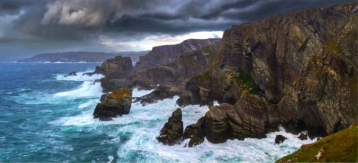
Coastlines, where the water meets land, are constantly changing. Water is the most powerful force of weathering (breaking down) and erosion (moving away) on Earth. As water splashes and flows, it weathers rocks and erodes rock and soil. This leaves behind specific formations on rocky shores.
Tall landforms at the coastline are battered by storms which causes rock to weather and erode, with the heavy pieces deposited (dropped off) at the base. This forms a cliff, a high steep face of rock.
When waves crash especially hard in one place, a cave opening may form. This happens often at sea level, especially where rock is softer in one place.
When a section of land sticks out into the water, the waves can batter from both sides, and instead of a cave, the opening goes clear through and an arch is formed. An arch has some rocky land above an opening.
Sometimes, the top of the archway is so weathered it falls, this leaves a sea stack, a single formation sticking up like a candle in a cake. In these ways, the coastline is constantly being reshaped.
1 point
1
Question 11
11.
What is the most powerful force of weathering and erosion on Earth?
1 point
1
Question 12
12.
What landform is created when tall landforms at the coastline are battered by storms?
1 point
1
Question 13
13.
What happens when waves crash especially hard in one place at sea level?
1 point
1
Question 14
14.
What is formed when a section of land sticks out into the water and waves batter it from both sides?
1 point
1
Question 15
15.
What is left behind when the top of an archway falls due to weathering?
INTERACTIVE: CHATHAM COAST
The link will take you to an interactive slideshow. Click the arrows to view the slides that show how the Chatham coast changed between 1984 and 2016. Be sure to carefully examine Slide 19.
1 point
1
Question 16
16.
What changes do you notice between the image in 1984 and the image in 2016? What contributed to the changes?
8 points
8
Question 17
17.
The shape of the coast changes due to weathering, erosion, and _______________ .
Weathering of rock by waves can form ___________ , high, steep faces of rock.
Waves can also weather rock from both sides to form ___________.
Weathering of caves or arches by waves can form _______________ , single columns of rock near the land.
Deposition, or dropping off sediments at the end of a __________, can form a delta. A delta forms when water in a river _______________. Deltas can change when more _____________ builds up.
While _______________ breaks down rocks along the coast, deposition builds up the land.