TEXT: BREAK IT & MOVE IT
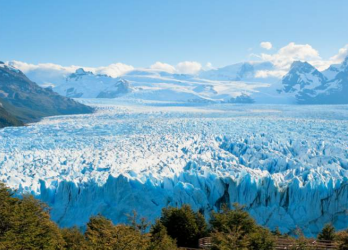
Glaciers could never make the track team. Most of them move too slowly – only 25 centimeters a day. They creep along, changing everything underneath them. Glaciers melt and refreeze which weakens the structure of the rocks in and under them. Great force from a glacier’s weight presses down on the rocks. Glaciers weather (break down) rocks as they move.
Force from the weight, along with melting and refreezing, moves the ice along. Water that melts from the glacier collects below and also helps the heavy ice to move. It carries and pushes the weathered rocks. The glacier erodes (moves) rocks from their original place. These weathered and eroded rocks can be found hundreds of miles away. This is called deposition (adding sediments to land).
As a glacier weathers and erodes the land in its path, it carves out a specific kind of valley. Because glaciers are wide, their valleys are U-shaped, with steep sides and a round valley floor. Glaciers may not be fast, but they are stronger than the whole weight-lifting team.