ILEARN ELA Grade 3

Last updated 11 months ago
21 questions
Treasure in the Field by Marilyn Bolchunos
Once there was a man who lived with his two young sons on a farm in Vietnam. Since the man had to tend the field, the boys took care of the house. That is, they were supposed to take care of the house.

Often the father returned home to find that nothing had been done—he even had to cook dinner.

"What have you been doing all day, Ta?" he would ask his older son.

"Studying, Father, and thinking," Ta would reply.

"And what have you been doing, Hai, my young son?" the father would ask.

"Watching the house for you," Hai would answer.

A neighbor asked the old man, "Are your sons helping you?"

"Oh, they would," the father answered, "but they are young."

Some years later, the neighbor asked, "Aren't your sons helping you in the field?"

"Oh, they would," the father replied again, "but they are still young. I will let them enjoy life now. They will help me later on."

As the years went by, it became clear even to their father that the boys were lazy. Though they sometimes tended the field with him, they always made excuses to go home early.
Finally the father grew too old to work, and he took to his bed. The sons were sad, for they not only depended on their father, but they also loved him.

One day the old man called Ta and Hai to his side and said weakly, "I have a secret to tell you, my sons. Bend close."

Hai and Ta leaned over to hear the secret.

"A while ago," the old man said, "we learned that there is treasure buried in the field. It's still there, but you must dig for it."

The sons' eyes widened.

"Treasure in the field?" Ta said. "Where?" asked Hai. "Dig for it, and you will find it," said their father. "But promise me that you will share it equally."

The sons promised and hurried out to begin. Day after day they dug. Their neighbor was astonished to see how long and hard the young men worked. As for Ta and Hai, they felt stronger and better than ever before.

At last, the entire field had been dug, but no treasure had been found. The brothers moped around with their heads down.

Finally an idea came to Ta. "The land is ready for planting," he said to his brother. "And our rice is almost gone. You take one half of the field, and I'll take the other. We'll tend it just as Father did."

The days passed and the seedlings grew. In due time, the field gave an abundant harvest. There was rice to eat and rice to sell.

When the sons took the rice to the marketplace, it brought a good price.

Excited, Ta and Hai ran back to the house and approached their father's bedside. They dropped coins into the old man's hands.

"Look, Father," said Hai. "We have sold rice and brought you gold!"

"Yes," said Ta. "Just as you said, the treasure was in the field."

The old man smiled. They had learned his secret.

-----
"Treasure in the Field" by Marilyn Bolchunos, from Highlights for Children. Copyright © 2004 by Highlights for Children, Inc.
1

Read the sentences from the passage. Day after day they dug. Their neighbor was astonished to see how long and hard the young men worked.

What does the word astonished most likely mean?

1

PART A
Which statement about the boys is supported by the passage?

1

PART B
Which sentence from the passage best supports your answer in part A?

1

Which detail from the passage best shows that the old man's sons are lazy?

Sap’s Running
by Stephen R. Swinburne

The Coleman brothers—Nelson, Ralph, and Harold—step out their front door in Vermont. They feel the wind. They feel the sun on their faces. “Sap could be running this morning,” says Nelson.

As they pass 75-year-old sugar-maple trees, sap drips from holes in the trees into metal buckets. They know for sure that today will be a good day for sugaring.

Sap from sugar maples looks like water, but tastes sweet. That’s because it has sugar in it. It also contains minerals from the soil. A 50-foot-high sugar maple has nearly two hundred thousand leaves. All these leaves drink in summer sunshine and make sugar. During winter, sugar is stored in the tree. Running sap in the spring contains the sugar that was made in the tree the summer before.

Every spring, the Colemans tap holes into sugar-maple trees, then hang a bucket under each hole to catch the sap. To make syrup, the sap is heated in big open pans so that most of the water will boil away. The Colemans say it takes about thirty-five gallons of sap to make one gallon of maple syrup.

More than a hundred years ago, scientist Charles Darwin wrote that sap flow was a “most mysterious subject.” Since then, many people have studied how sap flows. Much of the research has been done at the University of Vermont, where sap is still being studied.
Nelson Coleman and his brothers have made maple syrup all their lives. It is a family tradition. They don’t worry too much about why the sap is running in their trees this morning. They’re just glad it is.

The Iroquois Legend of Woksis and Maple Syrup
According to legend, an Iroquois chief named Woksis yanked his tomahawk out of a maple tree one spring day. A bowl sat by the trunk of that tree. As the day warmed, sap dripped from the gash into the bowl. When Woksis’s wife saw the sap in the bowl, she thought it was water. She used it to cook their meal. The sap boiled away, leaving maple syrup. When Woksis tasted the sweetened meat, he loved it. So, boiling sap to make maple syrup began.

What Makes Sap Run?
For years, people have thought that sap rises up from the roots of the sugar-maple tree. It doesn’t. “During the time when sap flows from tap holes, the bulk flow of sap is downward,” says Dr. Tim Perkins. He is a scientist at the University of Vermont.

How does sap flow? During cold nights, maple trees freeze solid. That’s when water rises into the trunk and branches. The water forms frost inside tiny hollow spaces within the tree. In the morning, this frost melts and becomes sap, which flows down the tree.

Scientists say that anyone who cuts down a sugar-maple tree in freezing weather can see this is true. When the weather warms up, sap will flow from the cut end of the trunk—not from the stump.

--------------
“Sap’s Running” by Stephen R. Swinburne from Highlights for Children. Copyright © 2004 by Highlights for Children, Inc.
1

What is the most likely reason the author included the legend in the passage? Pick two choices.

1

Part A
Select the sentence that gives the best conclusion about sugar-maple trees.

1

PART B
Select the sentence from the passage that best supports your answer in part A.

1

Which sentence from the passage supports the idea that the Coleman brothers have experience with making maple syrup?

1

The author states that many years ago, sap flow was a "most mysterious subject." How does the author explain that this is no longer true?

What is a Spacewalk?

Any time an astronaut gets out of a vehicle while in space, it is called a spacewalk.
The first person to go on a spacewalk was Alexei Leonov. He was from Russia. The first spacewalk was on March 18, 1965. It was 10 minutes long.

The first American to go on a spacewalk was Ed White. His spacewalk was on June 3, 1965, during the Gemini 4 mission. White's spacewalk lasted 23 minutes.

Today, astronauts go on spacewalks outside the International Space Station. Spacewalks usually last between five and eight hours, depending on the job.

The world record for the most spacewalks is held by Russian astronaut Anatoly Solovyev. He has been on 16 spacewalks and spent more than 82 hours outside in space. That's almost 3 ½ days of walking in space! NASA astronaut Michael Lopez-Alegria holds the U.S. record for the most spacewalks. He has done 10.

Why Do Astronauts Go on Spacewalks?
Astronauts go on spacewalks for many reasons. Spacewalks let astronauts work outside their spacecraft. Astronauts can do science experiments. Experiments can be placed on the outside of a spacecraft. This lets scientists learn how being in space affects different things.
Spacewalks also let astronauts test new equipment. They can repair satellites or spacecraft that are in space. By going on spacewalks, astronauts can fix things instead of bringing them back to Earth to fix.

How Do Astronauts Go on Spacewalks?
When astronauts go on spacewalks, they wear spacesuits. Inside spacesuits, astronauts have the oxygen they need to breathe. They have the water they need to drink.
Astronauts put on their spacesuits several hours before a spacewalk. The suits are pressurized. This means that the suits are filled with oxygen.

Once in their suits, astronauts breathe pure oxygen for a few hours. Breathing only oxygen gets rid of all the nitrogen in an astronaut's body. If they didn't get rid of the nitrogen, the astronauts might get gas bubbles in their body when they walked in space. These gas bubbles can cause astronauts to feel pain in their shoulders, elbows, wrists, and knees.
They leave the spacecraft through a special door called an airlock. The airlock has two doors. When astronauts are inside the spacecraft, the airlock is airtight so no air can get out. When astronauts get ready to go on a spacewalk, they go through the first door and lock it behind them. They can then open the second door without any air getting out of the spacecraft.

How Do Astronauts Stay Safe During Spacewalks?
When on a spacewalk, astronauts use safety tethers to stay close to their spacecraft. Tethers are like ropes. One end is hooked to the spacewalker. The other end is connected to the vehicle. The safety tethers keep astronauts from floating away into space. Astronauts also use tethers to keep tools from floating away. They tether their tools to their spacesuits.
Another way astronauts stay safe during spacewalks is by wearing a special machine on their backs. This machine uses small jet thrusters to let an astronaut move around in space. If an astronaut were to become untethered and float away, the machine would help him or her fly back to the spacecraft. Astronauts control the machine with a small joystick, like on a video game.

How Do Astronauts Train for Spacewalks?
One way astronauts train for spacewalks is by swimming. Floating in space is a lot like floating in water. Astronauts practice spacewalks underwater in a large swimming pool. Astronauts train seven hours in the pool for every one hour they will spend on a spacewalk.
Another way astronauts practice for a spacewalk is by using virtual reality. This is sort of like playing a video game. Astronauts wear a helmet with a video screen inside. They also wear special gloves. A video of what they will see during a spacewalk is shown on the screen inside the helmet. When the astronaut moves, the special gloves allow the movements to be shown with the video. This simulation looks and feels just like a spacewalk.

-----------
"What is a Spacewalk" http://www.nasa.gov/audience/forstudents/k-4/stories/what-is-a-spacewalk-k4.html. In the public domain.
1

What happens when astronauts go on spacewalks?

1

Which sentence from the passage supports the idea that it takes a lot of training to be an astronaut?


Source 1: Smithsonian Sleepovers

by Smithsonian Associates and the Smithsonian Institution

A night of adventure awaits you and your family at a Smithsonian museum.

Imagine rolling out your sleeping bag beneath a 50-foot whale, at the home of the Star-Spangled Banner, or in the shadow of the space shuttle Discovery. That’s exactly what kids and their grown-up companions can do when they attend a Smithsonian Sleepover. The American History Museum, Natural History Museum, or the Air and Space Museum’s Udvar-Hazy Center are all yours during a night of fun that features tours, games, crafts, and more. Which adventure will you choose?


-----------
“Smithsonian Sleepovers” by Smithsonian Associates and the Smithsonian Institution. Copyright © 1995–2018 by Smithsonian Associates and the Smithsonian Institution. Reprinted by permission of Smithsonian Associates and the Smithsonian Institution.
1

Part A
How does the author of Source 1 want the reader to feel about sleeping over at a museum?

1

Part B
How does the author of Source 1 use words and pictures to create this feeling?

1

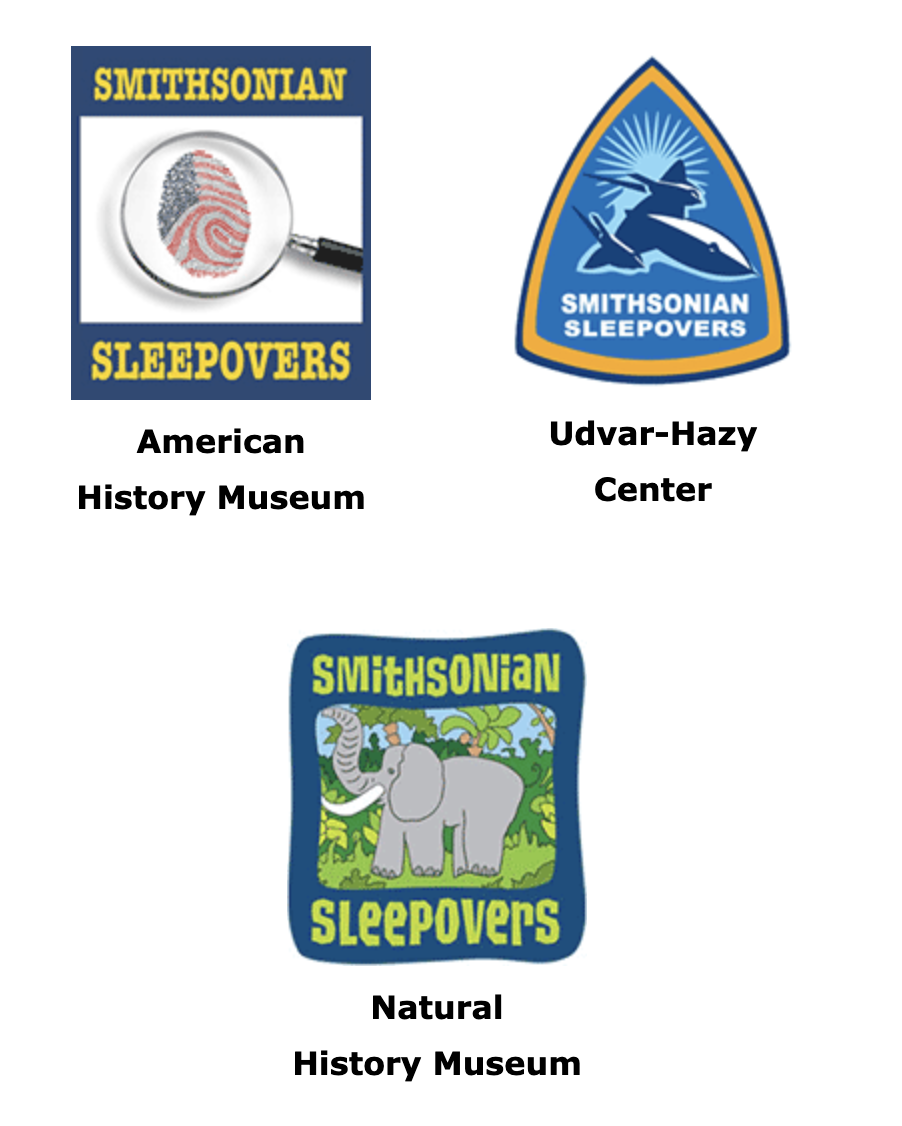
What is the purpose of the three pictures in Source 1? Choose two.
to show where each museum is located

Passage 1: The Case of the Alien Jewel Thief

by Kristin O’Donnell Tubb

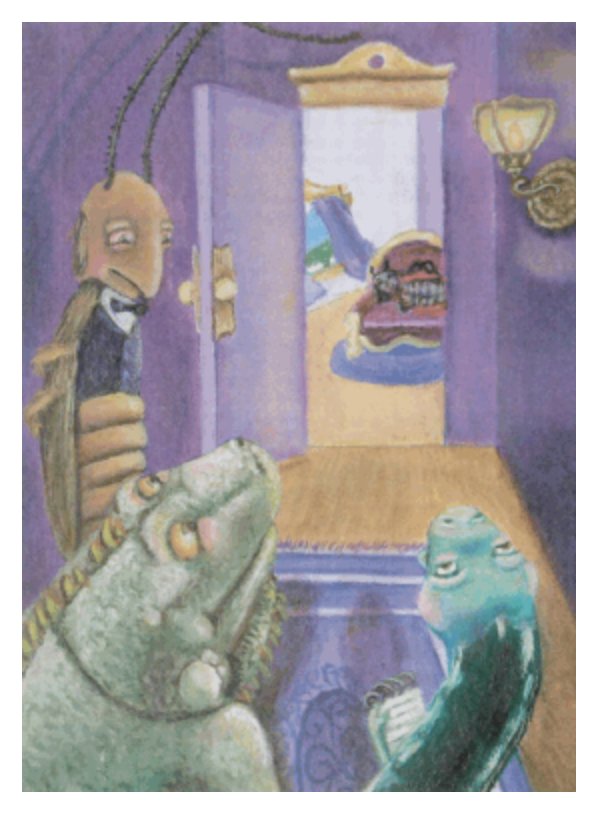
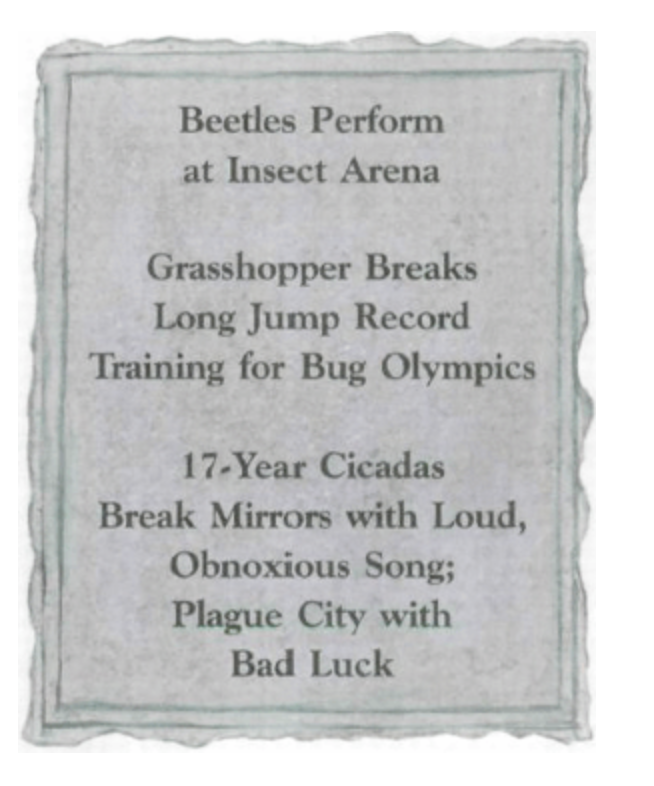
1 I settled into my recliner with The Insect Informer and scanned the headlines:


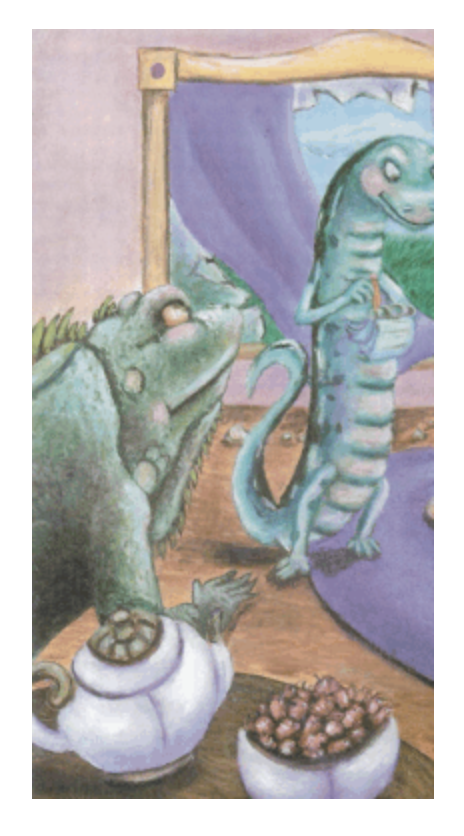
2 Sal bounded into the room. “Get this, Ig. Our new client? Mrs. Langston L. Ladybug III!” Sal beamed. “Her prize jewels were stolen last night. And she says an alien did it!” . . .

3 Sal and I jumped into our car. Two minutes later we screeched to a halt before a castle. . . .

4 A tuxedo-clad cockroach with blood-shot eyes loomed behind me. “I’m Charles, the butler. Come.” . . .

5 We followed him down an ornate hallway. Mrs. Ladybug sprawled on the sofa, holding her wrist to her forehead.


6 "Darlings!" she wailed. "It was frightful!...

7 "Darlings!" she wailed. "It was frightful!...

8 “He crawled right toward me, humming his terrible alien language. And those red eyes—dreadful! Weren’t they, Charles?”

9 “Last night was my night off,” the butler grunted.

10 Sal raised an eyebrow and took more notes. “How did he enter your home?”

11 “Through the window. He smashed it with his horrible alien powers! I’ve never seen anything like it!”


12 I smiled, excited that I was going to crack this case before my big-brained pal Sal. “I beg your pardon, Mrs. Ladybug, but your jewel thief was no alien. He was an insect. Right, Sal?”

13 Sal, not to be upstaged, declared, “Right, Iggy! It was . . . Charles the butler!”

14 All eyes turned toward the cockroach. Mrs. Ladybug gasped. . . .

15 Charles shook his head. “I didn’t do it. My eyes are bloodshot because I was up late practicing the 100-meter dash for the Bug Olympics. I’m a sprinter,” he announced proudly, “not a thief. . . .”

16 I turned toward Mrs. Ladybug. “Your culprit is a cicada, not a cockroach. The horrible sound you heard is his signature song. It’s loud enough to break glass, which is how he entered your house.” . . .

17 “And the reason why you’ve never seen anything like him is because he only comes above ground every seventeen years,” Sal explained. . . .

18 “Well, I wish I hadn’t seen him either!” Mrs. Ladybug declared. “But at least we know where to look, right?” . . .

19 “We’ll do our best, ma’am,” I promised.
1

Which quotation from the first story best shows that Mrs. Ladybug is upset about the crime?

1

In Passage 1, Iggy and Sal are the same in some ways and different in other ways.

Look at the descriptions in the table. Mark the box for each description to show whether it tells about Iggy, Sal, or both Iggy and Sal.

Watching in the Wild

by Charnan Simon

1 Jane Goodall knows how to watch. For more than 40 years, she has watched a group of chimpanzees in Gombe National Park in Africa. What she has seen has changed the way scientists think about animals—and people.

2 Jane was 26 years old when she first went to Gombe. It was 1960, and no one had ever studied chimpanzees in the wild. Jane’s plan was simple. She would travel to Africa and find some chimpanzees. Then she would sit quietly and watch them go about their lives.

3 When she arrived at Gombe, Jane could hear chimpanzees calling to each other across the valleys. She found half-eaten fruits under trees where they had fed. But she didn’t see the chimpanzees themselves. They were shy! Whenever Jane came close, they ran away.

4 Jane was discouraged. But she didn’t give up. If the chimpanzees didn’t want her to come close, she would watch them from a distance. Every day she woke up before dawn. She put on clothes that blended in with the jungle and climbed to the top of a high, rocky ledge. Using binoculars, she sat and looked at chimpanzees—hour after hour after hour.

5 Other people might have been bored. Not Jane! She loved watching the chimpanzees feeding in fig trees and drinking from streams. She saw how they greeted each other with hugs and kisses. She smiled at the baby chimps who perched on their mothers’ backs or sat cradled in their laps.

6 Jane took notes on everything she saw. She wrote about how, at night, each chimp made a cozy nest high in the treetops. Jane watched the chimps bend branches and tuck in smaller twigs. She saw mothers curl up with their babies and then sit back up to make a pillow from a handful of leaves. When the chimps left their nests in the morning, Jane climbed up to try them out for herself!

7 Slowly, the chimpanzees became used to Jane. They let her come closer and closer. Jane began naming the chimps she recognized. David Greybeard had a silvery beard and a calm manner. Old Flo was ugly, with a big nose and raggedy ears—but she was a wonderful mother. Mr. McGregor reminded Jane of the gardener in The Tale of Peter Rabbit.

8 At the time, scientists thought that animals being studied should be given numbers, not names. But Jane didn’t agree. She saw that the chimpanzees had real personalities. It made sense to give them real names. Today, many scientists name the animals they study in the wild.

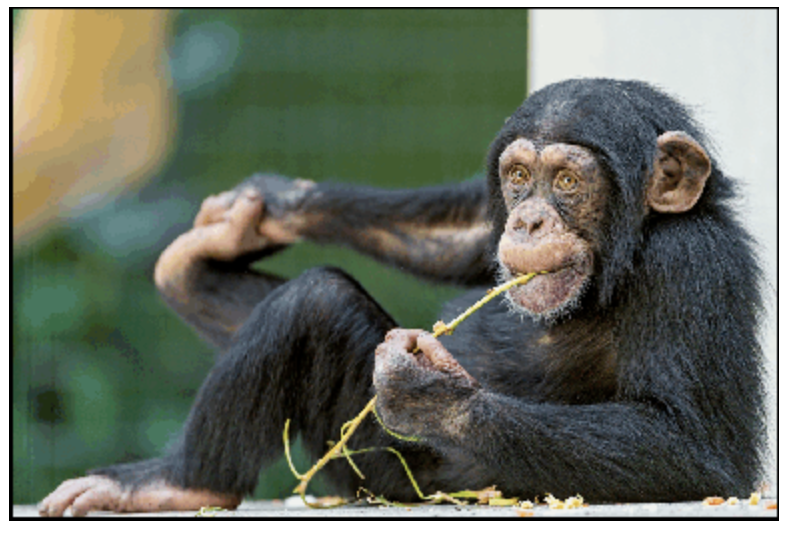
9 One day Jane saw something really exciting. David Greybeard was sitting by a red-earth termite mound. He poked a long grass stem into a hole in the mound. Then he pulled the stem out and ate the crunchy termites that clung to it.


10 Jane was amazed. David Greybeard was using the grass stem as a tool! Until then, scientists thought that only people used tools. Jane saw the chimps using other tools, too. Once, a big brother chimp grabbed a handful of leaves to wipe his little brother’s messy nose. Many times, chimps used crumpled leaves as sponges to soak up water to drink from hollow logs.

11 Over the next 40 years, Jane wrote books about her exciting discoveries. She learned that chimpanzees live in close family groups and make friendships that last a lifetime. They hunt, and they teach their children. They can be happy or sad, angry or afraid. Chimps are more like people than any other living creatures. Studying them has helped scientists understand our own place in nature.

12 And it all started with one woman who knew how to sit quietly—and watch carefully.

Glossary
chimpanzees: a kind of ape

----------
“Watching in the Wild” by Charnan Simon, from Click Magazine. Text copyright © 2003 by Carus Publishing. Reprinted by permission of Carus Publishing via Copyright Clearance Center. Photograph Copyright from Gatag. In the public domain.
1

Which detail from the text shows that Jane Goodall likes chimpanzees?

1

Part A
What is the main idea of the passage?

1

PART B
Click on the detail from the excerpt below that supports your answer in Part A.

1

Select two sentences from the excerpt below that show how Goodall was accepted by the group.

1

Which idea from the passage does the photograph help show?