Desert Landforms
Brought to us by wind and rain.
The desert isn’t just dry, flat sand. Deserts have some of the world’s most unique landforms - arches, pedestals, plains, mesas, buttes, and dunes.
How are Desert Landforms Created?
It takes thousands of years for desert landforms to be formed by three main processes: weathering, erosion, and deposition. Weathering is the wearing away of rock and soil, creating sediments. Erosion is the movement of sediments to another place. Deposition is the dropping of sediment in a new location. Wind and rain cause weathering, erosion, and deposition in deserts. Ice can also contribute to weathering, erosion, and deposition – just not in a desert!
Arches
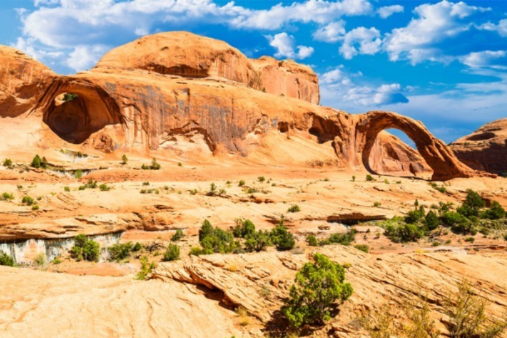
There are four different types of desert arches. Freestanding arches stand alone and have
an easily visible opening. A pothole arch forms on the top of a rock mass. This can join with a cliff wall arch to create a small room-like opening. A natural bridge is an arch that forms over a flowing body of water, like a stream, river, or channel. Weathering by water and wind-blown sand creates arches.
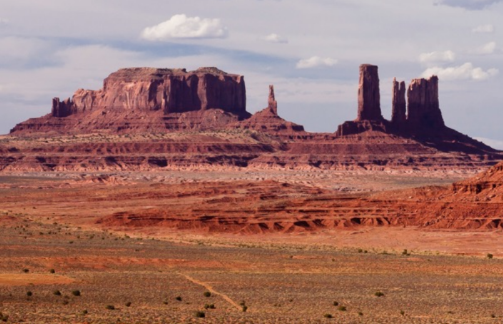
Mesas, Buttes, and Plains Rising out of otherwise flat plains, mesas and buttes are two types of elevated landforms that can be found in deserts.
Mesas are steep-sided and flat- topped hills or mountains. They are sometimes referred to as table hills or mountains. Mesas are more massive than buttes.
Buttes are smaller and steeper versions of mesas, as seen in the comparison picture above. The larger landform on the left is a mesa
and the narrower landforms on the right are buttes. In the foreground, you can see a flat plain. Few plants grow in these dry areas.
Pedestals
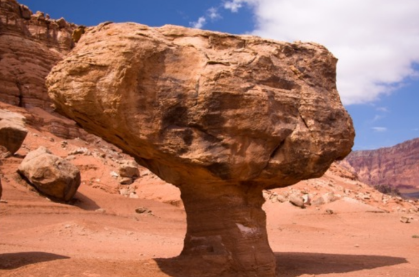
Another elevated landform is known as a pedestal. Pedestals are made by weathering which occurs when wind-blown sediments grind away at formations. Pedestals are cut at the base of the large rock structure and the top is left intact.
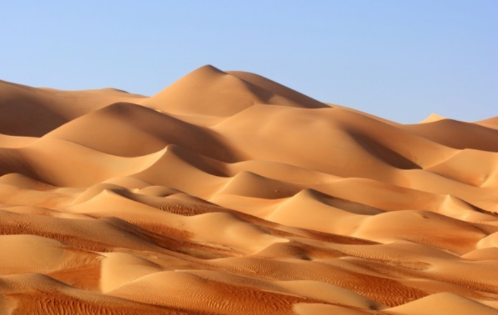
Sand Dunes
A sand dune is a large mound of sand formed by wind deposition of sediments. Much of the rock lost by mesas, arches, and pedestals might end up as a dune. Dunes often shift back and forth, changing in height as the wind blows. They can get quite large. The tallest dune in the world is the Duna Federico Kirbus in Argentina at 9,334 feet or 2,845 meters above sea level!