Ɛhia
1
Ɛhia
1
Ɛhia
1
Ɛhia
1
Ɛhia
3
Be sure to watch the video first. It will help you understand what the article is talking about.
Be sure to watch the video first. It will help you understand what the article is talking about.
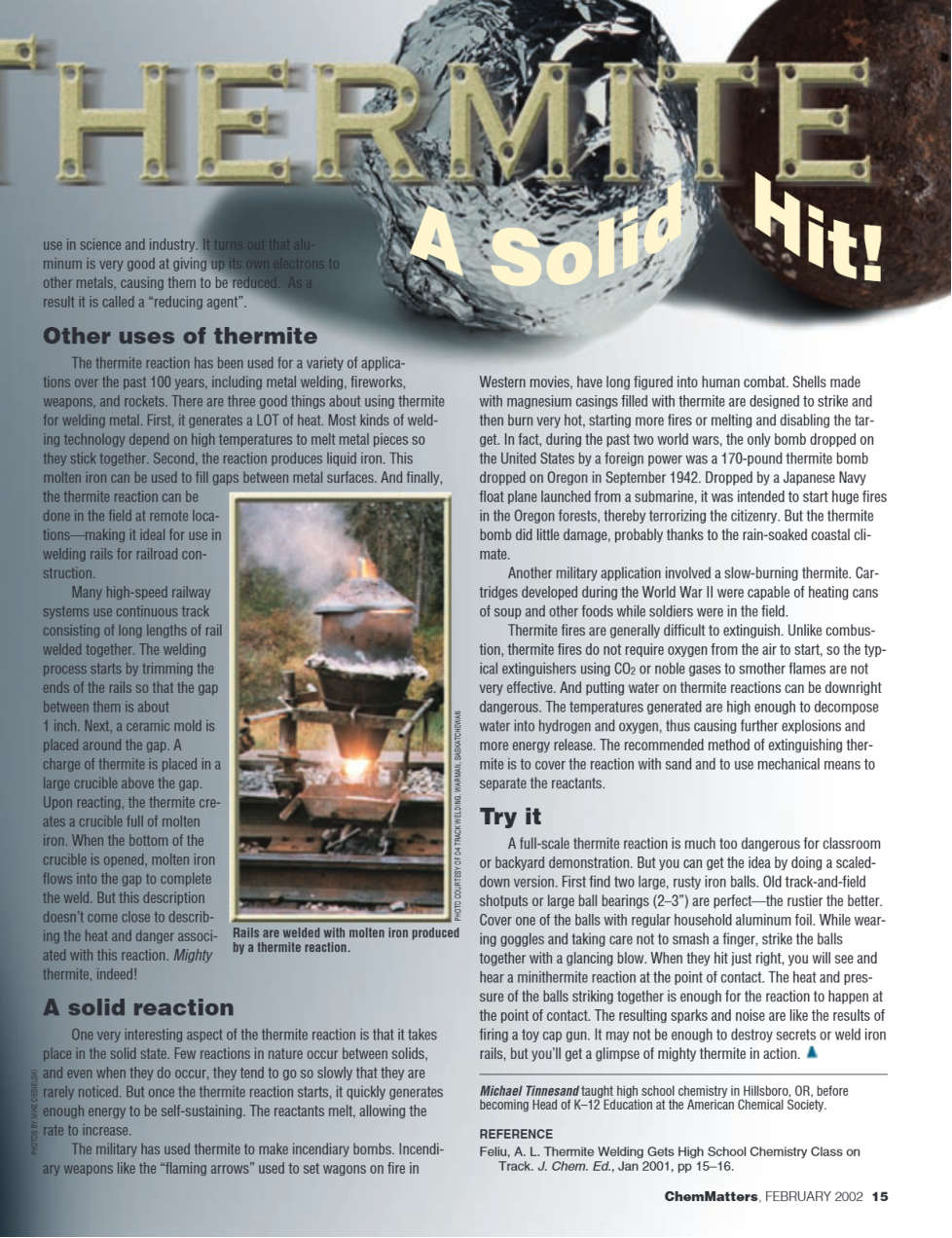
What are some uses of the thermite reaction
How is the thermite reaction different from combustion?
Why shouldn't the thermite reaction be done in the presence of large amounts of water?
The thermite reaction is an example of a single replacement reaction. In a single replacement reaction, there is always a balancing ion in a compound that switches partners. In the thermite reaction, the balancing ion is oxygen. The negative charge of the oxygen atoms balances the positive charge of the iron ions. After, the reaction the negative charge of the oxygen balances the positive charge of the aluminum atoms. In both the reactant and the product, the compound is electrically neutral. In this reaction, the electrons flow from the aluminum to the iron. The negative ion in the reaction could be any element, since it is only required to make the compound electrical neutral.
Single replacement reactions are fairly easy to predict the product, because the elements appear to switch places in the product. In the thermite reaction, the iron and the aluminum switch so that the aluminum is partnered with the oxygen in the product. The same thing can happen with the halogens as you say in the Halogen Pivot Lab. The only difference is that instead of an element and a positive ion switching places, it is an element and a negative ion.
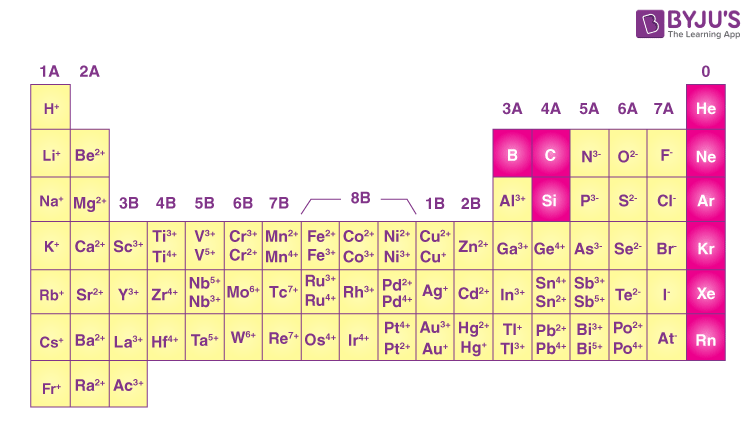
The table below shows the most common ions for the different elements. Use the table below to help you analyze the following reactions
Zinc is mixed with silver chloride. What is true about these two reactants
Zn + 2AgCl
Zinc is mixed with silver chloride. What is true about the reaction?
Zn + 2AgCl
In the halogen lab, dissolved chlorine gas (Cl₂) was mixed with sodium iodide (NaI). Unlike the reaction between the metals, in this reaction reactants are all nonmetals. What is true about these two reactants
What is true about the reaction between chlorine gas and sodium iodide (NaI)
In the reaction between aluminum metal and copper oxide (CuO), a product will be
Because many transition ion metals make multiple positive ions, a roman numeral is used to tell people the charge of the specific ion. Iron(III) is the name of Fe³⁺. What would would be the name of Fe²⁺ ?
What is true about this chemical reaction?
Most transition metals are found as positive ions because our atmosphere is full of oxygen. Elemental oxygen can steal electrons from almost all metals if given enough time. Therefore metallic ores are compounds of ions. Why is it advantageous to use a chemical reaction to convert a metal ore to a pure metal?
When a metal becomes a positive ion, it is said to be
Do a little research. How is aluminum ore converted into aluminum metal?